Skip to content

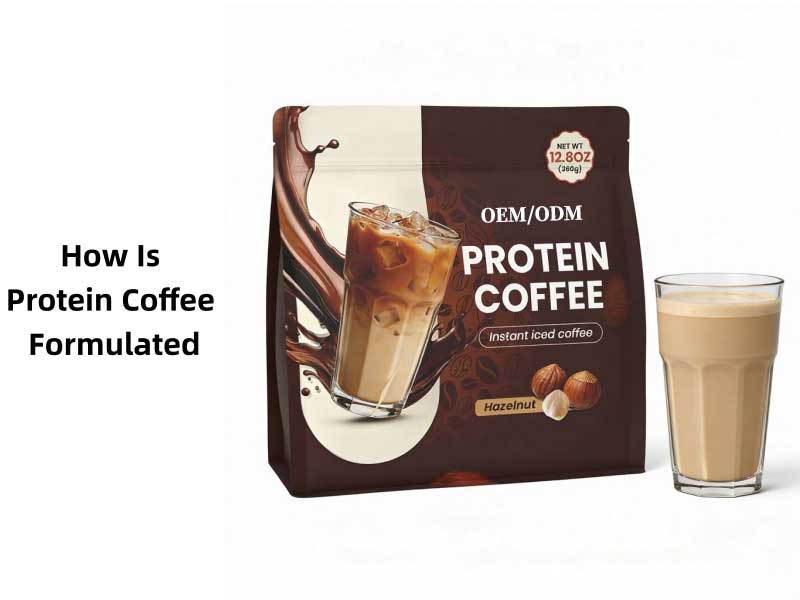
Protein coffee looks simple because the consumer sees only one scoop, one stick pack, or one cup. Behind that convenience, however, several ingredients with very different behaviors have to cooperate. Coffee brings aroma, bitterness, acidity, color, and naturally occurring caffeine. Protein brings nutrition but also changes body, foam, sediment, heat response, and the way flavors are perceived. Sweeteners and flavor systems have to soften harsh edges without turning the drink into a dessert, while the powder still needs to flow through equipment, stay dry in its package, and reproduce the approved sample across commercial batches.
Protein coffee is formulated by selecting a compatible coffee base and protein system, setting the protein and caffeine targets, and balancing sweetness, acidity, flavor, mouthfeel, and serving size. Developers then test hot and cold reconstitution, clumping, sediment, powder flow, moisture sensitivity, and packaging. Before commercial production, the approved formula is translated into controlled weighing, blending, filling, sealing, testing, and batch specifications so each serving performs consistently.
A useful way to think about the category is to imagine two prototypes sitting side by side. Both may claim 20 grams of protein and both may smell like coffee when the sachet is opened. One turns chalky after three minutes, forms small protein particles in hot water, and leaves half the aroma behind the protein taste. The other still drinks like coffee. The nutrition panel may look similar, but the formulation work behind the cup is completely different. That gap between a workable recipe and a repeatable product is where the important decisions begin.
What Is Protein Coffee Made Of?
Protein coffee is usually built from a coffee base, a protein system, sweeteners and flavors, plus supporting ingredients that manage creaminess, dispersion, or stability when needed. The exact composition depends on the intended experience. A light iced coffee, creamy latte, high-protein breakfast drink, and single-serve instant coffee can contain similar ingredient categories but require very different ratios and processing choices.
Coffee Base
For a powdered product, the coffee base has to provide a convincing coffee experience without requiring a separate brewing step. Soluble or instant coffee is therefore common because it can be dry blended, filled into sachets or jars, and reconstituted quickly. The grade selected affects much more than caffeine. Roast intensity, aroma strength, bitterness, acidity, color, and the lingering finish all change the way the finished drink is perceived, especially once a large quantity of protein solids is added to the same cup.
The correct coffee level cannot be chosen in isolation. A protein-heavy formula can suppress perceived coffee aroma and make the drink feel milky even when the coffee dosage looks high on paper. Raising coffee solids can restore roast intensity, but it may also increase bitterness and caffeine. A better development brief defines the desired experience first: a strong roast, mild breakfast coffee, creamy latte, vanilla coffee, or mocha-style drink. That gives the formulator a sensory target that can be tested rather than a vague instruction to make the product taste “more like coffee.”
Preparation liquid also changes the result. A formula that tastes balanced in 250 milliliters of water can become sweeter and heavier in milk, while oat or almond beverages may add their own solids, flavor, and viscosity. If a product is intended for more than one preparation method, those use cases should be included during development. Testing only in ideal laboratory water can hide problems that appear immediately when consumers prepare the product in the way the packaging actually encourages.
Protein and Supporting System
Protein normally represents one of the largest fractions of the dry formula, so it influences serving weight, mouthfeel, flavor, cost, and package size at the same time. A 15-gram protein target using a protein ingredient that is 90% protein theoretically needs about 16.7 grams of that ingredient before coffee, flavors, sweeteners, milk solids, fibers, or other components are added. If the protein ingredient contains 80% protein, the theoretical quantity rises to 18.75 grams. The finished serving can therefore become large very quickly.
Supporting ingredients are used when they solve a clear product problem. Sweeteners can balance roast bitterness and protein aftertaste. Dairy or creamer solids may create a latte-like body. Flavor systems can reinforce coffee aroma that becomes muted by protein. Certain fibers or other permitted solids can influence body, while buffering ingredients may be considered in some formulations when acidity and protein behavior need closer control. The important point is that these ingredients should have a defined function rather than simply making the ingredient list look more sophisticated.
Commercial formulation is easier when the formula is viewed as three layers. The first layer delivers the nutritional target, such as protein and any other intended nutrients. The second creates the sensory experience, including coffee, sweetness, aroma, and creaminess. The third helps the powder survive manufacturing and normal use, including flow, dispersion, moisture protection, and packaging. Once these roles are separated, sample feedback becomes more precise because the team can identify whether a problem belongs to nutrition, taste, or physical performance instead of trying to correct everything with another flavor.
Commercial Formula vs. Home Proffee
Home “proffee” usually means adding a scoop of protein powder or a ready-to-drink protein shake to coffee. That can work well for personal use because the person making the drink can adapt each cup. They can add more milk, use a blender, cool the coffee first, or simply accept some foam and sediment. Commercial protein coffee has a different standard because every sachet or scoop must be designed for thousands of consumers who will not all use the same cup, water temperature, stirring method, or patience.
A packaged product must also remain stable before it reaches the cup. Powder can absorb moisture, compact during transportation, lose aroma, segregate if ingredients have very different particle properties, or become difficult to fill accurately if flow changes. That is why commercial development includes questions that rarely matter in a kitchen: Does the blend remain uniform? Does the powder flow into stick packs consistently? Does the package provide enough moisture protection? Does a hot preparation still look acceptable after ten minutes? Can a production batch reproduce the flavor of the approved sample?
For brands working with an experienced development partner, these practical questions should appear early in the project rather than after the label has already been printed. Protein coffee sits between sports nutrition and functional beverages, so successful development requires knowledge from both areas. The product has to deliver a meaningful nutrition proposition, but it also has to behave like a beverage people actually want to drink every morning.
Which Protein Should Be Used?
There is no single best protein for every protein coffee. Whey isolate can provide high protein density, milk proteins can build a creamier latte profile, collagen can create a lighter drinking experience, and plant proteins can support vegan positioning. The best choice is the protein that meets the nutritional target while remaining compatible with the intended flavor, temperature, serving size, cost, and label strategy.
Whey and Milk Proteins
Whey protein isolate is often considered when a product needs a high protein claim without an excessively large amount of powder. Many commercial isolates are specified around 90% protein or higher on a dry basis, although formulation calculations should always use the actual supplier specification and batch documentation. Whey protein concentrate, including common WPC80 grades, can be more economical but contains a larger proportion of non-protein solids, which may influence flavor, lactose content, mouthfeel, and the quantity required to deliver the same protein claim.
Milk protein concentrates provide another route because they contain casein and whey fractions in proportions closer to milk. They can support a creamy, latte-like profile, but more dairy solids can also make a drink feel heavy if the serving is already large. The choice between whey isolate, whey concentrate, and milk protein should therefore consider more than protein percentage. Allergen positioning, dairy character, total solids, nutritional targets, and the desired texture in 200 to 300 milliliters of liquid matter just as much as the number printed on a raw-material specification.
Hot preparation deserves additional attention. Whey proteins can unfold and interact with one another when exposed to sufficient heat, and the extent of that behavior depends on temperature, exposure time, concentration, pH, and minerals in the surrounding system. This does not mean whey cannot be used in hot coffee. It means that a raw-material data sheet cannot prove how the finished coffee will behave. The complete formula has to be tested at the temperatures consumers are likely to use, especially if the label promises both hot and cold preparation.
| Protein option | Typical commercial protein level* | Useful product fit | Main issue to evaluate |
| Whey protein isolate | ~90% or higher | High-protein dairy coffee | Heat response, dairy notes, foam |
| Whey protein concentrate 80 | ~80% | Value-focused dairy formula | More non-protein solids, lactose, flavor |
| Milk protein concentrate 85 | ~85% | Creamy latte-style product | Higher solids and viscosity |
| Collagen peptides | Often 90%+ | Lighter functional coffee | Amino-acid profile and claim positioning |
| Pea protein isolate | Often 80-85% | Plant-based coffee | Earthy notes, sediment, thickness |
| Soy protein isolate | Often ~90% | High-protein plant formula | Bean-like flavor and allergen considerations |
| Rice protein | Commonly 70-85% | Plant-protein blends | Grittiness and dry mouthfeel |
*Typical ranges vary by supplier and processing method. Finished formulation should use the supplier specification and batch COA rather than a generic percentage.
Plant and Collagen Options

Plant-based protein coffee can be commercially attractive, but it usually requires more sensory work than a simple gram-for-gram replacement of whey. Pea protein can contribute earthy or legume-like notes, rice protein may feel dry or gritty, and soy can have a recognizable bean character. These effects become more noticeable as protein dosage increases because the coffee aroma has to compete with a much larger quantity of protein material. Sweetness and flavor masking can help, but they cannot fully compensate for the wrong protein grade or an unrealistic solids load.
Blending plant proteins can improve the overall nutritional or sensory profile in some products, yet blends also create additional variables. Two proteins can have different particle sizes, water-binding behavior, colors, and settling rates. A blend that looks promising in a shaker may still form sediment in a cup after ten minutes. For this reason, plant formulas benefit from structured comparisons in which protein level and liquid volume remain constant while the protein system changes. That makes it possible to separate the effect of the protein from changes caused by sweetness or coffee strength.
Collagen peptides behave differently from conventional complete proteins and can fit well in coffee products where a lighter drinking texture is preferred. Some grades disperse readily and create less shake-like body than many dairy or plant proteins. However, collagen should not be positioned as nutritionally identical to whey, milk, soy, or other complete protein sources. The brand should decide whether the product is primarily a high-protein coffee, a collagen coffee, or a broader functional coffee before the formula and front-of-pack communication are finalized.
Hot vs. Iced Use
The intended preparation method should influence protein selection from the beginning. A product developed only for iced use avoids some of the heat-related challenges that can appear in hot systems, although it can still suffer from poor wetting, foam, sediment, or excessive thickness. A product marketed for both hot and iced preparation has a narrower formulation window because the same powder must perform acceptably across very different temperatures and often across different liquids as well.
A practical development program may screen the product in cold liquid around 5 to 10 degrees Celsius and hot liquid around 70 to 85 degrees Celsius when those conditions reflect normal use. These are useful development ranges rather than universal specifications. A brand that specifically instructs consumers to use boiling water should test that condition, while a product intended to be mixed into warm brewed coffee may need a lower but still realistic temperature range. The important point is to test the promise made on the package.
Liquid volume should be tested at the same time because concentration changes texture as much as temperature does. A 25-gram serving may taste smooth in 300 milliliters but become heavy in 180 milliliters. Milk can make the drink creamier while increasing total solids, and plant beverages can add their own flavors and stabilizing ingredients. A good formula is therefore not one that works perfectly under one laboratory condition; it is one that remains enjoyable across the reasonable preparation window that real consumers are likely to use.
How Is the Formula Balanced?
Protein coffee is balanced by working backward from the finished serving. Developers define the protein target, coffee intensity, caffeine range, serving weight, liquid volume, sweetness, texture, label position, and cost limits before locking ingredient percentages. Each decision affects the others, so increasing protein, coffee, creaminess, or sweetness can solve one problem while creating another in taste, thickness, packaging, or manufacturing.
Protein and Serving Size
The protein target creates one of the clearest mathematical constraints in formulation. If a finished serving needs 20 grams of protein and the chosen ingredient is 90% protein, roughly 22.2 grams of that ingredient are theoretically required before accounting for protein contributed by other ingredients. If the ingredient is 80% protein, the theoretical requirement becomes 25 grams. Coffee, sweeteners, flavors, minerals, fibers, milk solids, and any additional functional ingredients still have to fit into the same serving after that calculation.
This is why a larger protein number is not automatically a better product. Increasing the protein target can raise raw-material cost, finished serving weight, sachet dimensions, freight weight, viscosity, and the amount of flavor work needed to keep the drink coffee-like. A 15-gram product that consumers enjoy every morning may have stronger repeat-purchase potential than a 25-gram product that feels like a dense shake. The right target should come from the intended consumer occasion and competitive position rather than from chasing the largest possible number on the front of the package.
| Target protein per serving | 80% protein ingredient | 85% protein ingredient | 90% protein ingredient |
| 10 g | 12.5 g | 11.8 g | 11.1 g |
| 15 g | 18.8 g | 17.6 g | 16.7 g |
| 20 g | 25.0 g | 23.5 g | 22.2 g |
| 25 g | 31.3 g | 29.4 g | 27.8 g |
These figures are theoretical formulation calculations, not finished label values. Actual nutrition declarations should be based on the complete recipe, ingredient specifications, applicable calculation methods or testing, and the labeling rules of the target market. The table is most useful as an early feasibility check because it shows how quickly serving size grows when protein purity falls or the target protein claim rises.
Coffee-to-Protein Balance
Coffee and protein compete for sensory attention. Protein increases total solids, changes viscosity, and can soften the perception of aroma, while coffee contributes bitterness, acidity, roast character, and caffeine. When coffee seems weak, simply adding more coffee may strengthen bitterness faster than aroma. When the formula feels too heavy, adding more sweetness may hide some protein notes but can create a lingering finish. These trade-offs are easier to manage when one variable is changed at a time rather than creating a completely different prototype during every sample round.
A useful sampling sequence might keep the protein system constant and compare three coffee levels first. Once the coffee intensity is selected, the development team can compare two or three sweetness levels, then refine flavor and mouthfeel. The liquid volume should remain fixed throughout each comparison because dilution can change the drinking experience more dramatically than a small ingredient adjustment. Structured sampling produces clearer decisions and reduces the common situation in which a brand likes “sample three” but cannot explain which formulation change actually made it better.
The desired coffee style also matters. A mocha formula can tolerate more cocoa, sweetness, and body than a black-coffee-style product. A vanilla latte can use creamy notes as part of the concept, while an Americano-inspired product needs a cleaner finish and less shake-like texture. The ratio is therefore not a single industry number. It is a sensory relationship between coffee strength, protein load, total solids, and the experience the brand is promising.
pH, Cost, and Label Targets
Acidity and minerals can influence protein behavior, particularly in heated systems, but the goal is not to chase a textbook pH number. Coffee is a complex matrix containing acids, minerals, aromatic compounds, and solids, while proteins respond differently depending on their source and concentration. If a hot formula produces particles or unexpected thickening, developers should examine the full system: protein grade, coffee base, mineral load, temperature, water volume, and mixing order. Correcting the real mechanism is more effective than adding stabilizers without diagnosis.
Commercial constraints should be considered at the same time. Premium whey isolate, specialty coffee, natural flavors, branded functional ingredients, rare sweeteners, and individual stick packs can each raise the finished cost. If the target retail price or gross margin is known only after the formula is approved, the team may have to redesign an otherwise successful product. A stronger product brief sets an acceptable manufacturing cost range, target serving size, preferred package, and ingredient priorities before expensive sampling begins.
Label strategy belongs in that same discussion. The target market can affect ingredient permissions, nutrition labeling, caffeine communication, allergen statements, and whether the product is represented as a conventional beverage, food, or dietary supplement. In the United States, for example, the FDA distinguishes conventional foods and dietary supplements partly through product representation and labeling. Brands should confirm classification and claim requirements before printing packaging so formulation, regulatory review, and marketing language develop together rather than becoming separate problems at the end.
How Are Solubility and Texture Controlled?

Solubility and texture are controlled by matching the protein grade, particle characteristics, total solids, liquid volume, temperature, and mixing method. Developers evaluate wetting, clumping, foam, sediment, chalkiness, and viscosity under realistic preparation conditions. A good product should not merely dissolve eventually; it should make an acceptable drink using the spoon, shaker, milk, water, and temperature conditions that ordinary consumers are likely to use.
Clumping and Dispersion
A visible lump does not always mean a protein is chemically insoluble. Dry powders often clump because the outer surface hydrates before water can penetrate the center. A wet shell forms around dry material, creating a soft lump that may survive ordinary stirring. This problem becomes more noticeable as the serving gets larger, because 25 or 30 grams of powder entering a relatively small cup creates a concentrated environment in which particles compete for water at the same time.
Mixing order can therefore matter. Slowly introducing powder into moving liquid may perform differently from dumping an entire sachet onto a still surface. A shaker can break up lumps more effectively than a spoon, but a product positioned as an instant coffee should not depend on unusually aggressive preparation unless the package clearly tells the consumer to shake it. The development target should match the convenience promise. If the product says “stir and drink,” it needs to be judged by stirring rather than by a high-speed blender.
Manufacturing can also influence dispersion. Screening can remove hard agglomerates before blending, while controlled agglomeration or other particle-engineering approaches may improve wetting for suitable materials. Those interventions should follow diagnosis rather than guesswork. If the problem is heat-related protein aggregation, better screening will not solve it. If the problem is poor initial wetting, adding more thickener may make the drink worse. The most useful observation is often what happens during the first 30 seconds after powder touches liquid, because that is when the consumer decides whether the product feels convenient or troublesome.
Heat and Acidity
Heat-related aggregation and poor dry-powder dispersion can look similar in a cup, yet they are different mechanisms. Whey-containing systems deserve careful hot-use testing because heating can change protein structure and promote protein-protein interactions. The degree of change is influenced by temperature, time, protein concentration, pH, and minerals. Coffee adds another layer because its natural acids and dissolved solids create a more complicated environment than the neutral laboratory solutions often used to describe protein behavior.
This is why the question “Can whey be mixed with hot coffee?” is too broad to guide commercial development. A more useful question is whether a specific whey grade, at a specific concentration, in a specific coffee and mineral system, remains acceptable at the temperatures stated in the preparation instructions. A formula can be nutritionally correct and still fail that practical test if it creates fine particles, excessive foam, or a cooked dairy character when consumers prepare it hot.
For a hot-and-cold product, developers can compare several realistic temperatures and record the same observations each time. A screening range such as roughly 70, 80, and 90 degrees Celsius may be useful when those temperatures match likely consumer behavior. The goal is not to prove that the formula is indestructible. It is to identify a reasonable preparation window in which appearance, texture, aroma, and flavor remain acceptable enough that consumers can use the product without learning a special technique.
Sediment and Mouthfeel
A drink can look smooth immediately after mixing and still leave a noticeable layer at the bottom of the cup ten minutes later. That matters because coffee is rarely consumed in one gulp. Sediment evaluation should therefore continue over time. Observations at approximately 5, 15, and 30 minutes can reveal settling, separation, ring formation, foam collapse, or progressive thickening that is not obvious in the first minute after preparation.
Plant proteins often deserve especially close attention because some grades contain particles that create a gritty finish or visible settling. Dairy proteins may show different problems, including foam or heat-related aggregation. The best correction depends on the mechanism. A smaller particle size may improve one formula while increasing water binding in another. A thickener may slow sediment but make the drink feel heavy. Changing the protein grade or lowering total solids can sometimes improve the experience more effectively than adding another functional ingredient.
Mouthfeel should always be judged against the intended coffee style. Consumers may accept noticeable body in a latte, but a coffee positioned as clean, light, or refreshing can become unpleasant if it feels sticky or shake-like. Preparation volume provides a simple but powerful adjustment: the same powder may feel dense at 180 milliliters and balanced at 280 milliliters. The challenge is that more water can weaken coffee aroma and sweetness, so texture, flavor, and dilution need to be evaluated together rather than as separate formulation tasks.
How Are Flavor and Caffeine Optimized?
Flavor and caffeine are optimized together because the coffee base contributes both sensory intensity and naturally occurring caffeine. Developers balance roast character, protein off-notes, sweetness, aroma, and body while calculating the caffeine contribution from coffee and any additional caffeine source. The final target should be consistent enough that the product tastes predictable and its caffeine communication can be supported by specifications, calculations, or appropriate testing.
Coffee Bitterness
Bitterness is part of an authentic coffee profile, but excessive bitterness becomes tiring when it overlaps with protein aftertaste. The problem is not always solved by adding more sweetness. Protein can mute desirable coffee aroma while leaving bitter notes obvious, and a high-intensity sweetener may reduce bitterness at the front of the sip while introducing a lingering sweet aftertaste. A better approach looks at the entire flavor sequence from aroma to finish rather than trying to maximize one flavor dimension.
Coffee grade is one of the first levers. A different instant coffee can change roast intensity and aroma without requiring a large increase in dosage. Roast-style flavors can reinforce the coffee impression, while vanilla, caramel, or cocoa can be used when they fit the concept. Mocha products naturally tolerate more cocoa bitterness and body, whereas a black-coffee-inspired formula needs a cleaner finish. The supporting flavors should make the coffee feel more convincing rather than covering it with a generic sweet profile.
Sensory review becomes more useful when panelists score specific attributes instead of giving only an overall preference. Aroma intensity, first-sip sweetness, roast bitterness, creaminess, protein note, chalkiness, and aftertaste can all be rated separately. A formula may receive a good initial score but leave a strong protein or sweetener note 20 seconds later. That information tells the development team whether to adjust coffee, sweetness, flavor masking, protein selection, or mouthfeel rather than treating “taste” as one vague variable.
Sweetness and Mouthfeel
Sweetener systems need to be evaluated inside the final coffee matrix. Sugar contributes sweetness and solids, while high-intensity sweeteners can deliver sweetness at very low inclusion rates. Stevia, monk fruit, sucralose, and blended systems are common possibilities depending on the market and product positioning, but their sensory curves are different. Some have a slower onset or longer finish, and these characteristics can become more obvious when combined with coffee bitterness and protein notes.
Blending sweeteners can sometimes produce a more rounded profile, but more ingredients do not automatically create a better result. A clean-label target may limit some choices, while a zero-sugar claim may push the team toward higher-intensity systems. The right solution depends on the intended sweetness level, coffee style, consumer expectations, and regulatory status of each ingredient in the target market. Sample feedback should therefore describe whether the product is too sweet at the first sip, too sweet in the finish, or simply not strong enough to balance bitterness.
Mouthfeel should be optimized at the same time because sweetness perception changes with body. A thick latte-style drink can make sweetness feel more concentrated, while a thinner iced coffee may need a different level. Protein, dairy solids, fibers, creamers, and the recommended water volume all influence texture. A formula that tastes balanced in 300 milliliters may feel heavy and overly sweet in 180 milliliters, so the serving instructions are part of the formulation rather than an afterthought added by the packaging team.
Caffeine Target
Caffeine should be treated as a product specification, not assumed from the phrase “coffee powder.” Instant coffee grades can differ in caffeine content, and the contribution from the coffee base needs to be included when a brand sets a per-serving target. If purified caffeine or another caffeine-containing ingredient is added, the total should account for every meaningful source so the finished product can be labeled and positioned consistently.
The desired use occasion should guide the target. A mild breakfast protein coffee, a stronger office-energy product, and a pre-workout coffee may all need different caffeine strategies even if their protein claims are similar. For consumer context, the U.S. FDA has stated that about 400 milligrams of caffeine per day is an amount not generally associated with negative effects for most healthy adults, while also emphasizing that individual sensitivity varies. That figure is a daily reference point, not a recommended caffeine level for one protein-coffee serving.
Brands should also consider who may use the product and how caffeine is communicated. Pregnancy, certain medical conditions, medications, age, and sensitivity can change how much caffeine a person should consume, so product communication needs appropriate warnings and local regulatory review. From a formulation perspective, the simplest system is often the easiest to control: define the target, use documented coffee and caffeine inputs, avoid unnecessary overlap with multiple stimulant sources, and confirm the finished specification before artwork and large-scale production are locked.
How Is Protein Coffee Made at Scale?

Commercial protein coffee is made through controlled raw-material verification, screening where needed, weighing, blending, in-process checks, filling, sealing, coding, and finished-batch evaluation. Scale-up succeeds when the approved sample can be reproduced across thousands of servings while maintaining protein and caffeine targets, flavor, blend uniformity, powder flow, hot and cold reconstitution, fill weight, moisture protection, and documented batch traceability for commercial release.
Weighing and Blending
A bench sample may contain only a few hundred grams, while commercial production can involve tens or hundreds of kilograms. That change in scale makes particle properties much more important. Protein may represent most of the formula by weight, while a high-intensity sweetener, mineral, or flavor component may be present at less than one percent. If ingredients with very different inclusion rates, particle sizes, and bulk densities are added without a controlled sequence, a blend can look uniform in the mixer yet produce inconsistent servings later.
Small-dose ingredients may therefore be pre-blended with a larger portion of another ingredient before entering the main batch. Raw materials can be screened where appropriate to remove hard lumps, and the main blend needs enough mixing to achieve uniformity without unnecessary handling that encourages segregation. Transfer from the mixer to the filling line also matters because vibration and repeated movement can cause powders with different densities to separate. The manufacturing process has to control the complete path, not just the few minutes the ingredients spend inside the blender.
For a brand evaluating a manufacturing partner, practical process questions are more useful than general claims about advanced equipment. How are small-dose ingredients introduced? How is blend uniformity checked? Which packaging lines are used for stick packs, pouches, or jars? How is fill weight monitored? Zoxizo’s documented powder workflow includes screening, accurate weighing, powder blending, stick-pack and pouch packaging, jar filling, weight checks, sealing, and batch coding, with particular attention to blend uniformity, moisture control, flavor consistency, and powder flow during scale-up.
Moisture and Packaging
Moisture is one of the quietest risks in a protein-coffee project. Protein powders, coffee powders, flavors, sweeteners, and other solids can absorb moisture to different degrees. As moisture enters the product, a free-flowing blend may begin to form soft agglomerates and eventually hard caking. The same change can affect filling accuracy, aroma, and reconstitution. A powder that looks excellent when it leaves the mixer can therefore perform poorly months later if the package does not provide appropriate protection for the formula and distribution conditions.
Single-serve stick packs are attractive because they provide a defined serving and limit repeated exposure after opening. Sachets offer similar convenience in a different shape. Pouches and jars suit multi-serving products but are opened repeatedly, so the powder experiences more contact with ambient air during consumer use. Packaging selection should therefore consider moisture barrier, seal quality, serving size, headspace, storage environment, shipping route, and how long a consumer is likely to keep the package open after first use.
Accelerated stability screening can help expose weaknesses sooner, and conditions such as 40 degrees Celsius and 75% relative humidity are commonly encountered in stability programs for various regulated and food-related products. Those conditions should not be used as a universal shelf-life formula, however. Shelf life depends on the actual product, package, test protocol, acceptance criteria, and target market. The useful principle is simpler: stability should be evaluated in the package that will actually be sold, because a formulation and its package form one protection system during storage and transport.
Scale-Up and Quality Checks
Before bulk production, the preferred sample needs to become a written specification rather than a memory of what the team liked during tasting. The specification can define serving weight, appearance, coffee aroma, sweetness, preparation volume, protein target, caffeine target, package type, and the quality tests agreed for the project. Once those items are locked, production has an objective reference for deciding whether a bulk batch remains close enough to the approved development version.
| Checkpoint | Example condition or specification | What it helps verify |
| Hot reconstitution | Product-specific test, often within 70-85 C | Lumps, aggregation, aroma, viscosity |
| Cold reconstitution | About 5-10 C when iced use is intended | Dispersion, foam, sediment |
| Sediment observation | Approximately 5, 15, and 30 minutes | Settling, separation, texture change |
| Serving dilution | Defined volumes such as 200, 250, and 300 mL | Taste and mouthfeel tolerance |
| Blend uniformity | Multiple samples from the completed blend | Serving-to-serving consistency |
| Fill control | Routine line weight checks | Net-weight consistency |
| Package seal | Finished-pack inspection | Moisture and leakage protection |
| Sensory comparison | Bulk batch against approved sample | Coffee, sweetness, aroma, aftertaste |
| Stability program | Product- and package-specific protocol | Caking, aroma, color, reconstitution over time |
Not every protein coffee needs exactly the same testing plan. A simple dairy coffee with a short ingredient list may have different risks from a plant-based product containing multiple functional ingredients. What matters is that the control plan reflects the actual formula, packaging, preparation instructions, and claims. Quality checks are most valuable when acceptance criteria are agreed before production, because a test result is difficult to interpret if the team has never defined what “acceptable” means.
At Zoxizo, functional drink and protein-powder development can include sample work around flavor, solubility, powderiness, hot and cold preparation, moisture pickup, caking, aroma, and early stability observation before scale-up. For brands bringing a benchmark product, concept, or target nutrition panel, that approach makes the development conversation more practical: the team can compare measurable sample variables, lock the best version, and then carry the same critical attributes into packaging and bulk-production controls rather than treating formulation and manufacturing as separate stages.
Conclusion
Protein coffee is not difficult because coffee and protein cannot coexist; it is difficult because the finished product has to satisfy several expectations at the same time. It should deliver a credible protein amount without becoming excessively thick, taste recognizably like coffee without relying on extreme sweetness, provide a controlled caffeine experience, mix with reasonable effort, remain acceptable in the intended hot or cold preparation, and survive manufacturing, packaging, storage, and distribution without losing the properties approved during sampling.
For brands developing a commercial product, the most productive starting brief is therefore specific. Define the target protein per serving, approximate caffeine range, preferred coffee style, preparation liquid and temperature, serving volume, sweetness direction, target market, package format, and cost range before requesting the first sample. A development partner can then turn those requirements into variables that can actually be compared. When formulation, sensory testing, production feasibility, packaging, and quality control are considered together, protein coffee becomes much easier to scale into a product consumers can prepare consistently and brands can reorder with confidence.
Frequently Asked Questions
Can You Put Protein Powder in Hot Coffee?
Yes, many protein powders can be used in hot coffee, but the result depends on the protein type, concentration, coffee composition, and temperature. Whey proteins can change structure and aggregate when exposed to sufficient heat, especially in concentrated or acidic systems. Commercial products intended for hot use should therefore be tested at realistic preparation temperatures. Better results may also come from controlled mixing order, appropriate dilution, and selecting a protein grade that performs well in the final coffee matrix.
What Is the Best Protein for Protein Coffee?
There is no universal best protein. Whey isolate is useful when high protein density and a familiar dairy profile are priorities, while milk protein can suit creamier latte-style products. Collagen peptides may create a lighter drinking texture, and pea, soy, rice, or blended plant proteins can support plant-based positioning. The best choice is the one that meets the nutrition target while delivering acceptable flavor, texture, sediment control, hot or cold performance, cost, and regulatory positioning for the intended market.
Why Does Protein Powder Clump in Coffee?
Protein powder can clump because the outside of a dry particle hydrates faster than water reaches the center, creating a wet shell around dry material. High powder concentration, rapid addition, poor agitation, and particle characteristics can make this worse. In hot coffee, some protein systems may also form aggregates because heat, acidity, minerals, and protein concentration influence molecular interactions. Commercial formulation should distinguish simple wetting problems from heat-related instability because the two problems require different solutions.
How Much Protein Should Protein Coffee Contain?
The right amount depends on the product position and serving experience rather than one industry-wide number. A higher claim requires more protein material, which increases serving weight and can make the beverage thicker or harder to flavor. For example, 20 grams of protein theoretically requires about 22.2 grams of a 90% protein ingredient or 25 grams of an 80% ingredient before other components are added. Brands should balance the desired claim against taste, serving size, package format, cost, and repeat-use convenience.
Does Protein Coffee Contain Caffeine?
Most protein coffee containing real coffee will contain caffeine naturally, but the amount can vary substantially with the coffee ingredient and dosage. Some formulas may also contain added caffeine, which means the total must include every meaningful source. Brands should set a per-serving target and work from supplier specifications or appropriate finished-product testing. Caffeine communication should also consider local labeling requirements and the intended use occasion, because a mild breakfast coffee and an energy-positioned coffee may require very different product specifications.
Can Protein Coffee Be Made With Plant Protein?
Yes, protein coffee can be formulated with pea, soy, rice, or blended plant proteins, but replacing dairy protein gram for gram rarely produces the same drink. Plant proteins may introduce earthy, bean-like, dry, or gritty notes and can show more visible sediment depending on the grade. Successful plant-based development usually requires testing protein source, particle characteristics, sweetness, flavor masking, serving dilution, and sediment over time. The goal is to make the plant protein work with the coffee rather than simply hiding it.