Skip to content

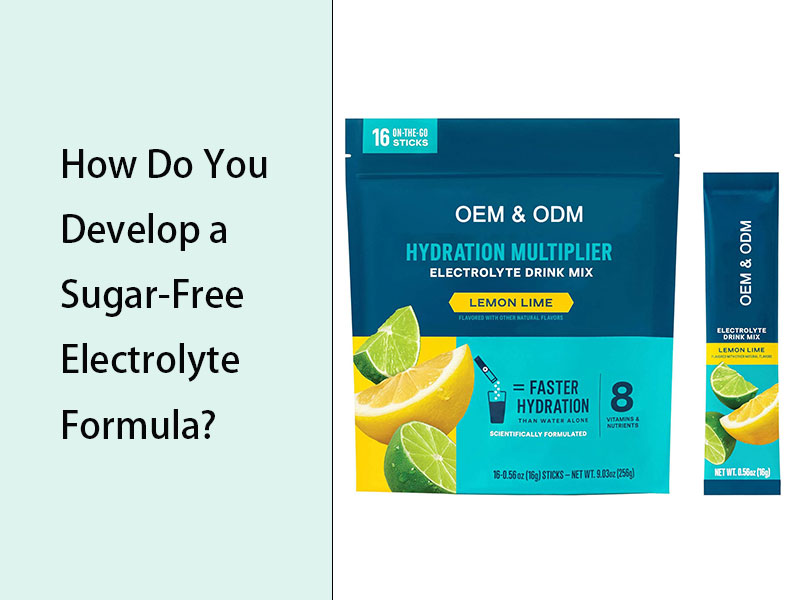
A sugar-free electrolyte formula looks simple on a finished label, yet the development work behind it is rarely simple. Removing sugar changes more than sweetness. Sodium becomes easier to taste, potassium bitterness becomes more obvious, some magnesium sources can affect mouthfeel or dissolution, and a high mineral load can quickly consume the space available in a compact stick pack. The product also has to make sense at a real drinking volume, survive storage, run through production equipment, and support the claims printed on the finished package.
To develop a sugar-free electrolyte formula, first define the hydration use case and target water volume, then establish elemental sodium, potassium, magnesium, and optional calcium targets. Choose mineral forms for taste, solubility, elemental yield, and cost; build the sweetener-acid-flavor system around that mineral base; and validate serving weight, powder stability, mixing performance, labeling, batch specifications, and packaging before commercial scale-up.
The most useful way to think about the project is as a connected system rather than a recipe. A formula can look excellent in a spreadsheet and still fail because it tastes too salty at 400 mL, leaves sediment after five minutes, cakes inside the jar, or requires more powder than the planned sachet can hold. Experienced product teams discover those trade-offs early. The interesting part begins when the first technically correct prototype reaches a glass of cold water and someone has to decide whether consumers will actually want a second sip.
What Makes an Electrolyte Formula Sugar-Free?
A sugar-free electrolyte product must satisfy both formulation and labeling requirements. Removing sucrose is not enough by itself. The finished serving, all sugar-contributing ingredients, sweetener system, calorie position, intended market, and front-panel wording should be reviewed together. In the United States, a “sugar free” claim generally requires less than 0.5 g of sugars per reference amount and labeled serving, subject to additional FDA conditions.
Sugar-Free Claims
The first practical distinction is between a formula that contains no intentionally added table sugar and a finished product that can legally use a sugar-related claim. Those are not automatically the same thing. Flavor systems, fruit-derived components, carriers, and other minor ingredients can contribute sugars even when sucrose is absent from the main formula. For a U.S.-market product, the finished serving therefore has to be evaluated against the conditions in 21 CFR 101.60(c), rather than relying on the wording of the ingredient brief alone.
The wording also matters. “Sugar Free,” “No Added Sugar,” and “Unsweetened” communicate different things and should not be treated as interchangeable packaging copy. A brand may want a zero-sugar product because it fits a low-carbohydrate positioning, because consumers dislike conventional sports-drink sweetness, or because the product is intended for repeated daily use. Those commercial goals can all be valid, but the formulation team should know which one is actually driving the project before the sweetener system and label artwork are finalized.
International projects need another layer of discipline. A claim developed for the United States should not simply be transferred to the European Union, United Kingdom, Canada, Australia, or the Middle East without checking the local definition and presentation rules. The same formula may be acceptable across several markets while the front-panel wording changes. Resolving that point before packaging approval is much cheaper than discovering it after thousands of printed cartons or sachets have already been produced.
Hydration Purpose
Sugar is not necessary in every consumer electrolyte powder, but eliminating sugar changes the type of product being developed. One common mistake is to compare a lifestyle electrolyte supplement directly with oral rehydration salts used in clinical care. The World Health Organization’s reduced-osmolarity oral rehydration solution contains 75 mmol/L sodium and 75 mmol/L glucose, with a total osmolarity of 245 mOsm/L. Glucose is deliberately part of that therapeutic system, so a sugar-free lifestyle product should not be presented as simply “ORS without sugar.”
For a commercial hydration powder, the more useful question is what drinking occasion the product is meant to serve. Daily hydration, prolonged exercise, hot-weather work, travel, fasting, low-carbohydrate lifestyles, gym use, and outdoor sports can all justify different mineral profiles. The intended use affects not only sodium, but also flavor strength, serving frequency, water volume, pack size, and the level of saltiness consumers are likely to accept. Formulation becomes much more coherent once the consumption context is defined first.
This positioning decision also protects the product from unnecessary complexity. If the goal is a light daily drink mixed into a 500 mL bottle, adding every possible mineral may create more disadvantages than benefits. If the goal is a higher-sodium sports product, stronger mineral character may be acceptable, but the flavor system must be built for it. In both cases, the best formula is not the one with the longest Supplement Facts panel; it is the one whose ingredient load matches the promise and the expected consumer experience.
Product Positioning
A clear product brief should define at least six variables before detailed formulation begins: target consumer, use occasion, expected drinking frequency, target water volume, core nutrition claim, and packaging format. Those decisions narrow the available formulation space quickly. A single-serve stick for office or travel use may need a lighter and cleaner profile than a product aimed at endurance training, while a jar designed for repeated home use can tolerate a larger serving weight than an ultra-compact sachet.
The brief should also identify what the product is not trying to be. That point often saves more time than adding another ingredient. A brand developing an everyday hydration mix does not need to copy the sodium level of every high-sweat sports formula. A fitness-focused product does not need six minerals if three well-chosen electrolytes create a stronger taste, cost, and performance balance. A premium positioning does not require expensive mineral forms unless they support a meaningful nutritional, sensory, or branding advantage.
When the positioning is clear, every later decision becomes easier to defend. Mineral levels can be evaluated against the intended use, sweetness can be judged at the real water volume, serving weight can be checked against the package, and optional ingredients can be accepted or rejected based on whether they strengthen the final product. This is also the point where a development partner can add real value: not by supplying a generic electrolyte blend, but by translating a commercial concept into a formula that can actually be sampled, tested, packaged, and scaled.
Which Electrolytes and Mineral Forms Should You Use?

Most sugar-free electrolyte formulas begin with sodium, potassium, and magnesium, while chloride and sometimes calcium help complete the profile. The more technical decision is the source of each mineral. Sodium chloride, sodium citrate, potassium chloride, potassium citrate, and different magnesium salts deliver different elemental percentages and behave differently in taste, acidity, solubility, serving weight, powder flow, and cost.
Core Electrolytes
Sodium is usually the first mineral to settle because it can shape the entire sensory direction of the drink. A relatively small change in sodium can be immediately noticeable in cold water, especially when sugar is absent. Potassium often supports a broader electrolyte profile, but some potassium sources become bitter or mineral-like as the dose rises. Magnesium is attractive because consumers recognize it, yet it often takes more formulation work to achieve a meaningful elemental amount without making the serving too large or the drink too difficult to flavor.
Chloride commonly enters the product through sodium chloride or potassium chloride rather than as a separate design decision, but it still needs to be calculated in the finished composition. Calcium can be useful in a multi-mineral concept, although it should be added for a clear reason rather than simply to increase the electrolyte count on the front panel. Certain calcium materials add considerable raw-material weight, and some combinations can affect clarity or sediment, so the product benefit should justify the additional formulation burden.
A practical development sequence is to establish the sodium target first, then decide how much potassium and magnesium fit the intended use and sensory profile. After that, chloride, calcium, phosphorus, and trace minerals can be evaluated one by one. This sequence prevents a common development problem in which the team chooses an impressive list of nutrients first and only later discovers that the combined mineral salts require too much powder, taste too aggressive, or cannot be accommodated in the planned single-serve package.
Mineral Forms
Two materials can supply the same named mineral and still behave very differently in the finished drink. Sodium chloride is efficient and familiar, but it contributes obvious saltiness as the amount rises. Sodium citrate provides sodium with a different taste profile and buffering effect, and formulators sometimes use one source or a blend of both. Potassium chloride delivers potassium efficiently, but bitterness can become limiting, while potassium citrate may integrate differently with citrus or fruit-acid systems.
Magnesium requires even more care because the phrase “magnesium citrate” or “magnesium glycinate” does not by itself tell the formulator how much elemental magnesium the supplied material will deliver. Commercial ingredients can differ by chemical form, hydration state, assay, carrier, particle size, and supplier specification. The theoretical calculation is useful for planning, but the actual manufacturing formula should be based on the supplier specification and current COA rather than on a generic internet percentage.
| Mineral Source | Approx. Theoretical Elemental Content* | Practical Strength | Key Formulation Check |
| Sodium chloride | 39.3% sodium | Efficient sodium delivery | Saltiness at higher dose |
| Trisodium citrate dihydrate | 23.4% sodium | Sodium plus citrate/buffering | Higher raw-material weight per mg sodium |
| Potassium chloride | 52.4% potassium | Efficient potassium delivery | Bitter or mineral finish |
| Tripotassium citrate monohydrate | 36.2% potassium | Useful in citrate systems | Higher powder weight than KCl |
| Magnesium citrate | Varies by exact material | Common in powder formulas | Assay, taste, solubility |
| Magnesium malate or glycinate | Varies by specification | Alternative positioning options | Elemental yield, cost, sensory behavior |
*Theoretical values apply only to the stated chemical form. Commercial calculations should use the supplier specification, assay, hydration state, and COA for the actual raw material.
The table makes one point especially clear: the label target and the manufacturing weight are not the same number. Delivering 400 mg of elemental sodium does not mean adding 400 mg of sodium chloride. The compound contains sodium plus its counter-ion, so the physical ingredient weight is substantially higher. Once potassium, magnesium, acids, flavors, sweetener, and optional functional ingredients are included, the finished serving can grow quickly even when the Supplement Facts panel looks compact.
Elemental Mineral Math
Elemental calculations should be maintained separately from the batch formula. Sodium chloride provides an easy example. Sodium accounts for about 39.3% of pure sodium chloride by molecular weight, so 1,000 mg of sodium chloride supplies roughly 393 mg of elemental sodium before any assay adjustment. Potassium chloride is about 52.4% potassium by molecular weight, meaning 500 mg of potassium chloride supplies approximately 262 mg of elemental potassium under theoretical conditions.
In real production, the calculation should begin with the target elemental amount and work backward through the actual ingredient specification. If a raw material is standardized at a particular assay, that value belongs in the formula calculation. The development sheet should show both the desired elemental mineral per serving and the grams of compound needed to achieve it. Keeping those two columns separate makes formula review much easier and reduces the risk of a label value being confused with a raw-material addition weight.
This math also exposes packaging constraints before they become expensive. A product may be marketed around 1,000 mg of sodium, but the physical salt required to deliver that number can consume several grams of a small sachet once other minerals are added. If the commercial brief calls for a 4 g stick, the team must determine whether the mineral system, flavor system, and processing aids can realistically fit. It is better to discover that on the development spreadsheet than during the first filling trial.
How Do You Set Electrolyte Levels and Serving Size?
Electrolyte levels should be built around intended use, consumer expectations, water volume, sensory tolerance, ingredient chemistry, and applicable labeling rules rather than a universal sodium-to-potassium-to-magnesium ratio. Successful products already occupy very different positions within the category. The goal is to choose a mineral load that makes sense for the product and then confirm that the serving weight and dilution instructions can support it.
Sodium by Use Case
Current commercial products demonstrate how wide the category can be. LMNT publishes 1,000 mg sodium, 200 mg potassium, and 60 mg magnesium per serving. Ultima Replenisher lists 55 mg sodium, 250 mg potassium, 100 mg magnesium, and 47 mg calcium per serving in its current daily electrolyte formulas. Both are marketed as sugar-free electrolyte products, yet the sodium difference is more than eighteen-fold, which shows why there is no single commercial ratio that every formula should copy.
| Published Product Example | Sodium | Potassium | Magnesium | Calcium | Total Sugars |
| LMNT | 1,000 mg | 200 mg | 60 mg | – | 0 g |
| Ultima Replenisher | 55 mg | 250 mg | 100 mg | 47 mg | 0 g |
These published values are market examples, not universal formulation recommendations. The difference reflects distinct product strategies, not a simple “high dose versus low dose” quality judgment. One formula may be designed around sodium-forward replacement, while another may emphasize a broader daily mineral blend. A useful competitive review therefore looks at the label together with intended consumer, serving directions, flavor style, package format, and brand positioning instead of averaging several competitors into one arbitrary target.
The sodium target also has to respect consumer context. A product designed for endurance athletes, heavy sweaters, outdoor workers, or prolonged heat exposure may have a different rationale from a general lifestyle drink. At the same time, no fixed amount is appropriate for every person. Health conditions, medications, dietary sodium intake, kidney function, and individual needs vary, so marketing copy should avoid implying that one serving profile is universally optimal. Product development can define a target audience without turning that audience definition into medical advice.
Potassium and Magnesium
Potassium and magnesium should earn their place through the total product design rather than through label aesthetics. Higher potassium can make the formula look more substantial, but the selected source may add bitterness before the target is reached. Magnesium creates similar tension because a meaningful elemental amount can require a relatively large amount of raw material, depending on the source. The result can be a larger serving, a more mineral finish, greater formulation cost, or a drink that needs stronger flavor and acid to remain pleasant.
A practical review asks four questions for each mineral: What elemental amount supports the positioning? How much physical raw material is required? What does that material do to taste and dissolution? What does it add to cost per serving? If an ingredient performs poorly on three of those four measures, it deserves another look even if the consumer recognizes the nutrient name. This is where experienced formulation teams often simplify a concept rather than adding more ingredients.
Competitor labels can help define the market, but they should not become recipes. A finished Supplement Facts panel does not reveal the development constraints behind it. The manufacturer may have selected a particular salt because of taste, supply, cost, packaging, or production behavior. A mineral number that looks strategically attractive may be difficult to reproduce in a different water volume or flavor system. Benchmarking is most useful when it helps a brand decide where it wants to sit in the category, not when it replaces product development.
Serving Size and Dilution
Serving weight and dilution should be part of the first formulation brief because they directly control what is physically possible. Suppose a project targets a 4.0 g stick pack. If the mineral salts already occupy 2.8 g, only 1.2 g remains for acids, flavor, sweetener, color, anti-caking support, and any additional functional ingredients. If taste trials later require another 700 mg of flavor-acid system, the team must increase the stick weight, reduce the mineral load, or redesign the ingredient system.
Water volume changes sensory perception just as dramatically. One serving in 350 mL can taste much saltier and sharper than the same serving in 600 mL. That is why a useful sample specification should define the testing condition, such as one serving in 500 mL of cold water, shaken for ten seconds, then evaluated at thirty seconds, two minutes, and five minutes. Those checkpoints are not regulatory requirements; they are practical ways to make development results repeatable across the R&D, quality, and commercial teams.
Serving size also affects packaging economics and consumer convenience. A 3.5 g stick, 5 g stick, and 8 g stick require different film dimensions, carton counts, shipping weights, and filling settings. Larger servings give formulators more room to solve taste problems, but they can increase packaging material and freight cost. Smaller servings look convenient, but they force harder choices about mineral load and flavor space. The right serving size is therefore the point where nutrition, sensory quality, machinery, packaging, and cost agree with one another.
Which Sweeteners and Flavors Work Without Sugar?
Sugar-free electrolyte flavor development works best when sweetener, acid, aroma, mineral character, and dilution are designed as one sensory system. Stevia and monk fruit can provide sweetness at low inclusion levels, but they do not reproduce all the flavor-rounding and mouthfeel functions of sugar. A successful formula therefore manages saltiness, bitterness, acidity, aroma, and lingering aftertaste together rather than simply increasing sweetness.
Sweetener Architecture
Stevia is widely used in sugar-free electrolyte powders because a small amount can create substantial sweetness without adding several grams to the serving. Monk fruit can support a different label story and sensory profile, while blended high-intensity sweetener systems can sometimes create a smoother sweetness curve than using one sweetener aggressively. The correct choice depends on the mineral load, flavor family, target market, and the type of finish the brand wants consumers to experience.
The same sweetener level does not behave the same way in every mineral base. Increasing sodium can make a previously balanced flavor seem thin, while potassium chloride may introduce bitterness that requires a different sweetness-acid relationship. Certain magnesium systems can add dryness or mineral character that becomes more obvious after swallowing. That is why sweetener selection should happen after the basic mineral architecture is understood, rather than being treated as a universal dosage that can be copied from one flavor to another.
Controlled comparisons make this stage more efficient. A useful trial can keep minerals, flavor, acid, and water volume constant while testing a baseline sweetener level plus one sample around ten percent higher and another around ten percent lower. The team then evaluates not only sweetness intensity, but also salt masking, bitterness, aftertaste, and desire for another sip. The sweetest sample often loses because high-intensity sweetness can linger after the fruit aroma has disappeared, making the drink feel less clean than the lower-sweetness version.
Acid and Flavor
Citric acid is common because it produces familiar brightness and pairs naturally with lemon, lime, orange, berry, and many tropical profiles. Malic acid gives a different kind of tartness, often with a longer finish that can work well with apple, watermelon, berry, and candy-like fruit flavors. Some formulas use a combination because the acid system changes not only sourness, but also how mineral saltiness and sweetness are perceived from the first sip through the finish.
Too little acid can leave the drink flat, salty, or dull, while too much acid can make the formula harsh enough that consumers describe it as chemical even when the ingredient list is straightforward. The right balance depends on dilution. A system that tastes bright and refreshing at 600 mL may be unpleasantly sharp at 350 mL. Development samples should therefore be tasted exactly as the consumer will prepare them, and flavor approval should include at least one full serving rather than only a small sensory cup.
Flavor family also matters. Citrus profiles are common in electrolytes because acidity and slight mineral character can feel natural together. Watermelon can tolerate some saltiness in sports-oriented positioning, while strong berry or tropical flavors can carry a heavier mineral base than delicate peach or floral profiles. The best flavor is not simply the one a brand manager likes most; it is the one that remains recognizable, balanced, and pleasant after the complete mineral system has been added at the intended concentration.
Aftertaste Control
Aftertaste is one of the most useful indicators of whether a sugar-free electrolyte prototype is truly finished. The first sip can be attractive because the aroma and acid arrive quickly, but five to thirty seconds later the formulation may reveal stevia linger, potassium bitterness, metallic mineral character, dryness, or a salty coating on the tongue. Consumers experience that finish repeatedly through an entire bottle, so a prototype that is acceptable in one sip can still be tiring after 500 mL.
A practical sensory scorecard can record aroma before drinking, first-sip sweetness, acidity, salt impact, bitterness at five seconds, sweetener linger at fifteen seconds, mineral dryness, and overall willingness to take another sip. The last measure is especially valuable because it translates technical observations into a consumer behavior question. A drink does not need to taste like soda, but it should make the next sip feel easy rather than forcing the user to finish the bottle out of obligation.
When aftertaste is poor, simply adding more flavor is often the wrong correction. Potassium bitterness may respond better to a different salt or lower potassium level. Saltiness may improve through sodium-source blending, a different water volume, or a flavor family that naturally tolerates salinity. Stevia linger can sometimes improve by lowering sweetness and increasing aroma rather than increasing sweetener. Good iteration changes one or two variables at a time so the team can see which adjustment actually improved the drink instead of losing the cause-and-effect relationship among ingredients.
How Do You Control Solubility and Powder Stability?

A commercially workable electrolyte powder should disperse predictably, flow consistently during filling, resist excessive moisture pickup, maintain acceptable flavor and appearance, and remain compatible with its package through the intended shelf life. Mineral form, particle size, hygroscopic ingredients, humidity exposure, blending sequence, flavor carriers, and packaging barrier performance all influence those outcomes. Stability work therefore starts during formulation rather than after the first production run.
Dissolution and Sediment
The word “soluble” can create false confidence because chemical solubility under ideal laboratory conditions is not the same thing as consumer-friendly mixing. A mineral may dissolve after prolonged stirring in warm water while leaving visible particles when a consumer empties a sachet into a cold bottle and shakes it for ten seconds. Development testing should copy the actual preparation instructions as closely as possible, including water temperature, dilution volume, mixing method, and the time at which appearance is assessed.
A simple internal test can record the drink at ten seconds, thirty seconds, two minutes, and five minutes after mixing. The team should note whether powder remains on the surface, particles settle to the bottom, foam persists, haze develops, or the appearance changes over time. These checkpoints are not universal industry standards; they are practical tools for building a repeatable specification. The same approach can be used across different mineral forms so that a formulation decision is based on observable behavior rather than on supplier descriptions alone.
Not every cloudy electrolyte drink is defective. Natural flavor systems, colors, and certain mineral combinations can create acceptable haze. The important question is whether the appearance is expected, repeatable, and consistent with the product concept. When sediment is excessive, the development team should identify the ingredient responsible before changing everything else. The cause may be a poorly soluble source, excessive concentration, particle-size mismatch, pH interaction, or an ingredient that simply does not belong at the proposed level in that format.
Moisture and Caking
Electrolyte powders are often sensitive to atmospheric moisture because mineral salts, organic acids, flavors, and other ingredients can be hygroscopic. A blend may look excellent immediately after production and still develop lumps after repeated humidity exposure. That means caking should be considered during ingredient selection, processing, and packaging design rather than treated as a cosmetic problem to be solved only with an anti-caking agent.
Important variables include incoming raw-material moisture, manufacturing-room humidity, time exposed during transfer and filling, packaging barrier properties, seal integrity, and consumer-use pattern. A jar is opened repeatedly, allowing humid air to enter the headspace, while each stick pack stays sealed until use. Stick packs can therefore reduce repeated consumer exposure, but they still need suitable barrier film and strong seals. A poor film structure can undermine an otherwise well-designed formula just as easily as a weak ingredient choice.
A practical stability review should ask more than whether the powder “caked” or “did not cake.” It should record how flow changed, whether lumps break easily, whether the product can still be scooped or filled, whether color or flavor shifts occur, and whether the mixed drink performs the same after storage. Depending on the formula and market, moisture, water activity, accelerated storage, and real-time stability work may be appropriate. The exact protocol should match the product rather than being copied mechanically from a different powder category.
Blend and Packaging
Blend uniformity becomes more challenging when ingredients are present at very different inclusion levels. A mineral may account for kilograms in a production batch while a high-intensity sweetener or color is present at a tiny fraction of that amount. Differences in particle size and density can encourage segregation during blending, discharge, transport, or filling. A controlled process may therefore use premixing for low-dose materials, a defined ingredient addition sequence, appropriate blender loading, validated blend time, and in-process checks before packaging begins.
Filling accuracy matters because serving-level variation can translate into nutrient variation when minerals make up a large proportion of the powder. If the target serving is 4.0 g, the actual tolerance should be established around the validated filling process and the product specification rather than copied from an unrelated product. The manufacturer needs to know how the equipment behaves with that exact powder because flowability, bulk density, and static can change after seemingly small formula adjustments.
Packaging format should be selected together with the formula. Stick packs are convenient for travel and single-use dosing, jars can reduce packaging cost per serving, and pouches can provide a useful middle ground. High-barrier materials may be worth the additional cost for moisture-sensitive blends. For brands developing a new electrolyte line, it is often more efficient to confirm formula, serving weight, and package format before artwork is finalized, because changing the gram weight late in development can affect sachet dimensions, carton count, claims, shipping cost, and retail presentation at the same time.
How Do You Validate the Formula for Commercial Production?
A sugar-free electrolyte formula is ready for commercial scale-up only when the approved mineral targets, raw-material specifications, flavor profile, dilution instructions, powder behavior, serving weight, package, label, and testing plan all describe the same product. Validation should progress from controlled prototypes to documented specifications and manufacturing trials so that problems are found before large quantities of finished units have already been filled and packed.
Sample Protocol
The first prototype should be treated as a measurement tool rather than as a sales sample. It should answer specific questions: Is the sodium level appropriate for the positioning? Does the potassium source create bitterness? Does the magnesium target fit inside the serving weight? Is sweetness balanced at the stated dilution? Does sediment appear after several minutes? When the team records those answers, the next sample can solve a defined problem instead of simply being “version two.”
Controlled iteration is much faster than changing many ingredients at once. One round can hold the mineral system constant while comparing three sweetness levels. The next can fix sweetness and compare acid ratios. Another can compare two flavors or mineral sources. This V1-V2-V3 approach creates a clear reason for each revision and allows commercial, R&D, and quality teams to discuss the same evidence. It also makes it easier to manage cost because the team can see which sensory improvement came from which ingredient change.
The approved sample should eventually become a physical and documentary reference for bulk production. Its formula version, flavor code, serving weight, dilution volume, color, appearance, and key sensory attributes should be recorded. A phrase such as “make it taste like the last sample” is not a specification. Once a product moves from a few hundred grams to a production batch, small ambiguities can become expensive, especially if different teams are relying on different versions of the formula or packaging brief.
Specifications and QC

Commercial validation converts the approved concept into measurable requirements. The master formula should identify the exact raw-material grade and specification used for every ingredient. Elemental mineral calculations should reconcile with the finished label. The flavor and sweetener codes should match the approved sample. Serving weight and package dimensions should match the validated filling process. Quality testing should then be selected according to the formula, declared nutrients, target market, process risks, customer requirements, and any third-party testing commitments.
| Development Stage | What Should Be Defined | Practical Checkpoint |
| Bench formula | Mineral forms and elemental targets | Recalculate each declared mineral from actual raw-material assay |
| Mixing test | Water volume and consumer preparation | Observe at 10 sec, 30 sec, 2 min, and 5 min |
| Sensory approval | Sweetness, acidity, saltiness, bitterness | Compare controlled variants at identical dilution |
| Packaging trial | Target fill weight and format | Confirm machine performance and repeatability |
| Stability program | Appearance, flavor, caking, moisture | Define protocol before final shelf-life position |
| Finished QC | Relevant nutrient, microbial, and contaminant specifications | Test against approved product and market requirements |
| Batch release | Formula, package, label, and documents | Release against one controlled finished-product specification |
The exact analytical plan will vary. Depending on the formula and market, finished-product work may include relevant nutrient or active verification, microbiological testing, heavy metals or other contaminant specifications, and additional customer-requested or market-specific testing. A COA should report the tests actually performed for the agreed specification; it should not be treated as a document that automatically proves every possible product claim. Likewise, third-party testing should be scoped early because it can affect budget and lead time.
For brands working with a manufacturing partner, traceability matters as much as the first passing test. Raw-material lot records, batch documentation, retained samples, packaging records, and finished-product results create the evidence needed to investigate a future complaint or batch difference. A good quality system therefore connects incoming materials, production, testing, and release rather than treating the finished COA as the only quality record that matters.
Label and Claim Review
Label review should happen before custom packaging is printed. In the United States, “sugar free” is a regulated nutrient-content claim, and FDA guidance points back to the conditions in 21 CFR 101.60(c). The finished formula, serving size, ingredients, and related calorie statements therefore have to be consistent with the claim. The same discipline should be applied to “No Added Sugar,” “Unsweetened,” electrolyte claims, flavor descriptions, and any other front-panel language that could be interpreted differently from the actual composition.
Hydration language also deserves care. A lifestyle electrolyte supplement can be positioned around hydration support or electrolyte replenishment when the formula and applicable regulatory review support that wording, but it should not casually borrow the identity of therapeutic oral rehydration products. WHO’s reduced-osmolarity ORS contains 75 mmol/L sodium and 75 mmol/L glucose and is designed for a clinical purpose. A sugar-free consumer electrolyte powder is a different product class, even when some of the mineral names overlap.
The ingredient statement, Supplement Facts or Nutrition Facts panel, suggested use, warnings, net contents, lot information, and package claims should all be checked against the same approved formula version. Late formula changes can force label changes, and late label changes can waste printed packaging. For export projects, market-specific review should be planned before bulk production because local rules can affect ingredient acceptability, nutrient declarations, warning language, and the exact claims a brand can use.
Scale-Up
Scale-up is where a formula that worked in a small laboratory blend proves whether it is also a manufacturing formula. Fine particles may distribute differently in a large blender, hygroscopic ingredients may pick up moisture during longer handling, flavors can behave differently after extended blending, and a powder that poured easily from a bench container may bridge or feed inconsistently in a stick-pack machine. A scale-up trial should therefore confirm ingredient sequence, premix requirements, blend time, powder flow, fill accuracy, seal quality, and sensory equivalence to the approved sample.
The first production batch should be mixed and tasted under the same dilution conditions used during development. If the finished drink becomes noticeably saltier, weaker in aroma, darker in color, slower to dissolve, or more prone to sediment, the difference should be investigated rather than dismissed as normal variation. The comparison is especially useful when natural flavors or mineral raw materials change lots, because those materials can vary within supplier specifications while still affecting the finished sensory experience.
For brands that need outside support, Zoxizo can help connect concept definition, custom formula development, sample iteration, taste and solubility review, packaging decisions, quality documentation, and commercial manufacturing instead of treating those activities as isolated handoffs. The practical advantage is continuity: the same approved serving target, sensory profile, formula version, and package specification can follow the project from early R&D through bulk production, which reduces the number of opportunities for the commercial concept to drift before launch.
Conclusion
Developing a sugar-free electrolyte formula is ultimately an exercise in disciplined trade-offs. More sodium can strengthen a sports positioning while making flavor harder. More magnesium can improve label appeal while increasing powder weight. A smaller stick pack improves portability while reducing space for flavor and acids. A clean sweetener system can support positioning while exposing mineral bitterness more clearly. The strongest product is not the one that maximizes every number; it is the one where mineral targets, water volume, taste, serving size, stability, packaging, quality specifications, and claims remain aligned from the first prototype through repeat production. When that alignment is built early, the formula becomes easier to manufacture, easier to explain, and much more likely to deliver a consistent experience after launch.
Frequently Asked Questions
What electrolytes should be included in a sugar-free electrolyte powder?
Most commercial formulas start with sodium, potassium, and magnesium, while chloride usually comes through sodium chloride or potassium chloride and calcium may be added when it supports the positioning. There is no requirement that every electrolyte product contain the same number of minerals. The better approach is to define the use case, elemental targets, serving size, taste expectations, and package format first, then choose only the minerals that can be delivered meaningfully without making the powder too large, bitter, salty, unstable, or expensive.
How much sodium should an electrolyte formula contain?
There is no single sodium amount that fits every consumer electrolyte product. Current commercial examples range from very low-sodium daily formulas to products providing around 1,000 mg sodium per serving, reflecting very different audiences and positioning. The appropriate target should consider expected sweat loss, use occasion, dietary context, serving frequency, water volume, taste tolerance, and local labeling requirements. Brands should avoid treating a competitor’s sodium number as a universal benchmark or implying that one fixed amount is appropriate for every individual.
Can an electrolyte formula work without glucose or sugar?
Yes, many consumer electrolyte powders are formulated without sugar and use high-intensity sweeteners or an unsweetened flavor system instead. However, a sugar-free lifestyle electrolyte should not be confused with therapeutic oral rehydration solution, where glucose has a deliberate physiological role in the WHO-recommended formulation. The commercial development question is therefore not whether every hydration product needs glucose, but whether the intended use, mineral profile, sensory system, label claims, and consumer expectations are coherent without it.
Which sweetener is best for a sugar-free electrolyte powder?
There is no universally best sweetener because the mineral base changes how sweetness is perceived. Stevia is common because it works at low inclusion levels, monk fruit can support a different label and flavor strategy, and blended systems may create a smoother sweetness curve. The best choice should be determined through tasting at the intended dilution. A sweetener that performs well in a light daily formula may create lingering sweetness or fail to mask bitterness in a higher-sodium or higher-potassium system.
Why does electrolyte powder sometimes clump in the package?
Clumping is often related to moisture pickup. Mineral salts, acids, flavors, and other powder ingredients may be hygroscopic, especially when exposed to warm or humid air during processing, storage, or repeated jar opening. The solution can involve raw-material selection, humidity control, powder handling, suitable anti-caking support, stronger moisture-barrier packaging, and better seal performance. A formula should be tested as a complete system because adding an anti-caking ingredient cannot fully compensate for a highly moisture-sensitive blend placed in unsuitable packaging.
How should a sugar-free electrolyte formula be tested before bulk production?
A useful validation program should confirm elemental mineral calculations, flavor and aftertaste, dissolution at the intended water volume, sediment, serving weight, powder flow, packaging compatibility, moisture behavior, label accuracy, and an appropriate finished-product testing specification. Samples should be evaluated under realistic consumer conditions rather than only in ideal laboratory mixing. The approved formula version should then be linked to raw-material specifications, packaging records, batch documentation, and quality-control requirements before the first commercial production run is released.
Can a manufacturer customize an existing electrolyte formula instead of developing one from zero?
Yes. Many projects can begin with a proven base formula and adjust mineral levels, sweetness, flavor, serving size, supporting ingredients, or packaging, while others require a fully custom formulation because the desired positioning is materially different. The right path depends on how much differentiation the brand needs, the launch schedule, regulatory requirements, ingredient availability, budget, and the amount of sample iteration required. Starting from an existing base can shorten development, but it should still be validated against the new product’s own taste, claims, package, and target market.