Skip to content

Gut-health products often look simple from the front of the bottle. One says “prebiotic,” another says “50 billion CFU probiotic,” and a third promises the convenience of a “synbiotic” formula. The temptation is to treat those words as a ranking system, with synbiotic automatically sitting at the top because it appears to combine the other two. In practice, the categories describe different approaches, and none of them is automatically the best choice. The important questions are what the product contains, how the ingredients are expected to work, whether the strain or substrate has relevant evidence, whether the serving is practical, and whether the finished product can maintain its intended quality through shelf life.
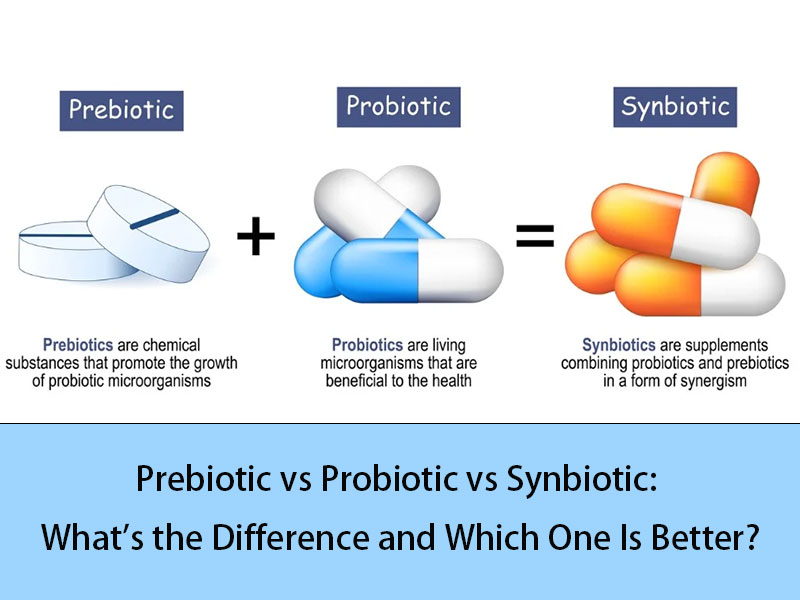
Prebiotics are substrates selectively used by host microorganisms, probiotics are live microorganisms that confer a health benefit when administered in adequate amounts, and synbiotics combine live microorganisms with selectively utilized substrates in a mixture that confers a health benefit. None is universally better. The better choice depends on the intended gut-health goal, ingredient or strain evidence, serving amount, tolerability, dosage form, stability, packaging, and the quality that remains when the consumer actually uses the product.
That distinction becomes more important once you move beyond the headline. A formula with an eye-catching CFU number can still be poorly matched to its intended use, while a lower-count product with well-characterized strains and an appropriate shelf-life specification may be much more thoughtfully designed. The same is true for prebiotics: a small token amount of fiber on a label does not tell the same story as a formula built around a meaningful substrate strategy. Understanding those differences makes it easier to compare products, interpret labels, and develop supplements that have a clear reason to exist.
What Is the Difference Between Prebiotics, Probiotics, and Synbiotics?
Prebiotics provide substrates that selected microorganisms can use, probiotics provide live microorganisms with demonstrated benefits, and synbiotics intentionally combine live microorganisms with selectively utilized substrates. The categories overlap in gut-health applications, but they are not interchangeable. Each should be evaluated according to the identity of its ingredients, the amount delivered, the supporting evidence, the finished-product format, and the quality that can be maintained during storage.
What Is a Prebiotic?
A prebiotic is often described as “food for good bacteria,” which is a useful starting point but not the complete scientific picture. The widely used scientific definition focuses on a substrate that is selectively utilized by host microorganisms and confers a health benefit. That means a carbohydrate does not become a prebiotic simply because it is fermentable, and dietary fiber as a whole should not be treated as a synonym for prebiotic. The ingredient needs evidence that connects its selective microbial utilization with a relevant health benefit.
Common commercial examples include inulin, fructooligosaccharides, usually abbreviated FOS, and galactooligosaccharides, or GOS. These ingredients appear frequently in powders, capsules, gummies, and combined gut-health formulas, but they are not identical in formulation behavior. Their physical properties can influence sweetness, viscosity, powder flow, dispersibility, serving size, and gastrointestinal tolerance. This is one reason experienced developers look at the substrate as both a microbiome ingredient and a physical component of the finished product.
Serving size is particularly important. Many prebiotic strategies require gram-level inclusion, whereas vitamins, minerals, and botanical extracts may often be used in much smaller quantities. In the United States, the Daily Value for total dietary fiber is 28 grams on a 2,000-calorie reference diet. That figure is not a recommended dose for prebiotics, but it provides useful scale: a tiny capsule may not be a realistic format for a concept that depends on several grams of substrate per serving. A powder, stick pack, or drink mix may offer more flexibility when the ingredient load is substantial.
What Is a Probiotic?
A probiotic is not simply any “friendly bacteria.” Scientifically, probiotics are live microorganisms that confer a health benefit when administered in adequate amounts. That definition immediately creates several quality questions: which microorganism is being used, how precisely is it identified, what evidence supports its intended use, what viable count is appropriate, and will enough of the microorganism remain alive throughout the product’s intended shelf life? Those questions are more informative than the size of the number printed on the front panel.
Strain identity matters because different strains within the same species can have different documented characteristics. Evidence generated for one strain should not automatically be transferred to another strain just because the species name looks similar. A technically strong product therefore benefits from clear organism identification and documentation that connects the strain, amount, and intended positioning. A vague “probiotic blend” may be easy to market, but it gives a technical reviewer far less information than a formula whose organisms are properly specified.
CFU, or colony-forming units, is the familiar measure used to communicate the quantity of viable microorganisms. According to the U.S. National Institutes of Health Office of Dietary Supplements, many probiotic supplements contain about 1 to 10 billion CFU per dose, while some provide 50 billion CFU or more. Higher numbers are not automatically more effective. The useful question is whether the selected strain or strain combination is delivered at a suitable level and whether that level remains appropriate when the consumer takes the product, not merely when the ingredients are first blended.
What Is a Synbiotic?
A synbiotic combines live microorganisms and substrates, but the modern scientific definition is more demanding than “a probiotic plus a prebiotic in the same bottle.” A synbiotic is a mixture comprising live microorganisms and substrates selectively utilized by host microorganisms that confers a health benefit. This framing puts the finished mixture, its biological rationale, and the evidence supporting its intended benefit at the center of the discussion rather than treating combination itself as proof of superiority.
Current scientific terminology distinguishes complementary and synergistic synbiotics. In a complementary approach, probiotic and prebiotic components can each contribute through their established roles. In a synergistic approach, the substrate is selected so that it is selectively utilized by the co-administered microorganism or microorganisms, making the interaction between components a central part of the formulation concept. That distinction is important for brands because it separates simple ingredient stacking from a more deliberate product-development strategy.
A synbiotic therefore raises additional development questions. The team needs to consider whether the selected microorganisms and substrate make sense together, whether both can be delivered at practical amounts, whether the substrate changes taste or texture, whether the microbial component can survive the finished-product environment, and whether the product can be manufactured and stored without undermining its intended specification. The term “synbiotic” can be useful and meaningful, but it earns its value through formulation logic rather than the number of categories listed on the front label.
| Category | Core Component | Typical Quantity Language | Main Quality Question |
| Prebiotic | Selectively utilized substrate | Often gram-level, ingredient dependent | Is the substrate supported at the intended use level and practical in the serving? |
| Probiotic | Live microorganism(s) | CFU per serving; many products use 1-10 billion CFU, some 50 billion+ | Are the right organisms viable at an appropriate level through shelf life? |
| Synbiotic | Live microorganism(s) + substrate(s) | CFU plus substrate amount | Is the combination coherent, supported, stable, and practical? |
| General dietary fiber | Fiber ingredient | U.S. Daily Value: 28 g/day for total dietary fiber | Does the ingredient actually meet the scientific criteria for a prebiotic? |
Is a Synbiotic Just a Probiotic Plus a Prebiotic?
For casual conversation, “probiotic plus prebiotic” is a convenient shortcut. For serious product comparison and formulation work, it is too broad. A capsule containing a well-characterized probiotic blend and a token amount of generic fiber may look similar on the front label to a product in which the strain, substrate, serving level, stability profile, and intended benefit were designed together. The ingredient categories may match, but the depth of the formulation does not.
This distinction matters because the synbiotic concept has evolved as microbiome science has become more precise. Product developers now have to think about the relationship between components rather than assuming that any two “biotic” ingredients automatically create a stronger formula. If a prebiotic is added simply to create another front-panel claim, the finished product may gain complexity without gaining meaningful differentiation. The same can happen when multiple strains are included mainly to inflate a count or make the label look more comprehensive.
A durable synbiotic strategy should be explainable in plain language. Which microorganisms are present? Which substrate is used? What amounts are delivered? How does the selected format protect the live component? What does the consumer need to do to use the product correctly? What evidence supports the intended positioning? When a formulation team can answer those questions clearly, the term “synbiotic” becomes more than a marketing label; it becomes a concise description of how the product was designed.
How Do Prebiotics, Probiotics, and Synbiotics Work?
Prebiotics mainly influence the microbial environment by supplying substrates that selected microorganisms can use. Probiotics introduce specific live microorganisms with documented functions. Synbiotics combine those two approaches in one formulation. Their effects are not uniform across an entire category: outcomes can vary with the exact substrate, strain, dose, product matrix, diet, baseline microbiota, storage conditions, and characteristics of the person using the product.
How Do Prebiotics Feed the Microbiome?
The phrase “feeding the microbiome” can sound as if prebiotics simply provide calories to every microbe in the digestive tract, but selectivity is one of the core ideas. A prebiotic substrate reaches microorganisms capable of utilizing it, and the resulting fermentation can influence microbial activity and the metabolites produced in the gut environment. Different substrates have different structures, and those structural differences help explain why they should not all be treated as functionally identical.
The same ingredient also has to work outside the body before it can do anything inside the body. A prebiotic used at several grams per serving may change the viscosity, sweetness, powder density, dispersibility, or mouthfeel of a drink mix. Some fiber-rich powders thicken quickly, some are prone to clumping in humid conditions, and others may create a texture that consumers notice immediately. These are not minor manufacturing details; they can determine whether people enjoy the product enough to take it regularly.
Tolerance is another part of the equation. Fermentable substrates can produce gastrointestinal effects that vary between people and with serving amount. More substrate does not automatically mean a better consumer experience. This is especially relevant when a brand tries to create a “high potency” prebiotic powder by pushing the inclusion level upward without enough attention to real-world use. A well-designed product balances the scientific rationale with an amount that fits the dosage form, flavor system, expected tolerance, and routine of the intended consumer.
How Do Probiotic Strains Work?
Probiotics do not share one universal mechanism. Depending on the organism, strain, and context, documented effects may involve interactions with resident microbes, production of microbial metabolites, competition in the intestinal environment, interactions with barrier-related processes, or signaling connected with immune function. The most practical lesson is that probiotic effects can be strain- and dose-specific, which is one reason results from one product should not be casually generalized to every product containing a similar species name.
The surrounding product matrix also matters. A freeze-dried microorganism in a low-moisture capsule faces a different environment from the same organism incorporated into a gummy, a powder with hygroscopic ingredients, or a ready-to-drink system. Manufacturing temperature, moisture exposure, oxygen exposure, blending stress, storage time, packaging barrier, and shipping conditions can influence viable count. A product can therefore start with a sensible strain selection and still become technically weak if the formulation and packaging do not protect it.
This is also why the “number of strains” is a poor shortcut for quality. Ten strains chosen because they make the label look impressive may create a more complicated stability and documentation problem than two strains selected with a clear purpose. A strong formulation should be able to explain the role of each organism, the target viable count, and the conditions required to protect it. That approach is less dramatic than simply printing a large number on the front label, but it is far more useful when the product needs to perform consistently from the first lot to the last month of shelf life.
How Do Synbiotic Ingredients Work Together?
A well-designed synbiotic has two moving parts: a live microorganism component and a substrate component. In a complementary formulation, each component can contribute through its own established function. In a synergistic formulation, the relationship is more deliberate because the substrate is selected so that it can be utilized by the co-administered microorganism or microorganisms. In both cases, the point is not simply to combine categories; it is to create a product in which the ingredients, amounts, and intended benefit form a coherent whole.
This changes the order of product development. Instead of starting with a competitor’s label and asking how many strains and fibers can be copied into a similar formula, a stronger process starts with the intended consumer and use case. The team can then identify suitable microorganisms, decide what substrate strategy fits the concept, establish practical serving amounts, and test whether the combination behaves well in the chosen format. Only after those questions are answered does it make sense to finalize the front-panel story.
Complexity can also work against a synbiotic. Adding three fibers, ten strains, enzymes, botanicals, minerals, and flavor components can make a Supplement Facts panel look premium, but every additional ingredient can affect cost, serving size, compatibility, stability, sensory quality, and documentation. A focused product with a clear biological and commercial rationale may be easier to explain, easier to manufacture, and easier for consumers to use consistently than an “everything for gut health” formula that tries to solve too many problems at once.
Do Different Strains and Fibers Work Differently?
Yes. This is one of the most important principles in the category because consumers often search for “the best probiotic” or “the best prebiotic” as though each term referred to a single ingredient. In reality, different probiotic strains can have different documented characteristics, and different prebiotic substrates can differ in fermentation profile, physical behavior, tolerability, and feasible serving amount. The category name tells you what kind of approach you are looking at, not the complete performance profile of the ingredient.
For practical product comparison, it helps to move one level deeper. Instead of asking only whether a product “has probiotics,” look for the actual organisms and the viable count. Instead of asking only whether a formula “has prebiotics,” check which substrate is present and how much is delivered. Instead of assuming a synbiotic is automatically better, ask what the combination is designed to do and whether the serving is large enough to support that purpose without making the product inconvenient or difficult to tolerate.
This principle also protects against overinterpreting research. A study involving one strain, one population, one dose, and one duration does not prove that every product using the same species will produce the same outcome. The same caution applies to prebiotic research. That may sound less exciting than a broad headline, but it is exactly the kind of distinction that improves product decisions for consumers, formulators, retailers, and brands.
Which Is Better for Different Gut Health Goals?
No single category is best for every gut-health goal. A prebiotic may fit when the concept centers on substrate or fiber intake, a probiotic when a specific live strain is central to the evidence, and a synbiotic when combining microorganisms and substrates serves a clear purpose. The intended outcome should guide the formulation rather than the popularity of the category name or a larger number on a competing label.
Which Is Better for Daily Microbiome Support?
For general daily microbiome support, all three categories can fit, but they create different product experiences. A prebiotic-led formula may appeal to people who want a food- or fiber-oriented routine and can work especially well in powders where gram-level inclusion is easier. A probiotic-led product is a better fit when the concept centers on selected live microorganisms and the brand wants the product story to focus on strain identity, viable count, and supporting evidence.
A synbiotic can make sense when the product is designed to combine both approaches, but the extra complexity needs to earn its place. More ingredients mean more sourcing decisions, more questions about compatibility, greater serving-size pressure, potentially more stability work, and often higher cost. If the combined formula forces the consumer to swallow many capsules or prepare an unpleasantly thick drink, the theoretical advantage may be offset by poor adherence in everyday life.
Daily use makes routine especially important. A technically sophisticated formula has limited value if consumers do not take it consistently. The “better” option is therefore often the one that balances evidence, appropriate dose, tolerability, convenience, taste, package format, and price well enough to support regular use. That may be a simple prebiotic powder, a focused probiotic capsule, or a carefully designed synbiotic, depending on the target audience and the product’s reason for being.
Which Is Better for Digestive Regularity?

When digestive regularity is the central goal, fiber and selected prebiotic strategies can provide a more intuitive starting point than simply adding a high-CFU probiotic. The U.S. Food and Drug Administration gives “fiber maintains bowel regularity” as an example of structure/function language, and the U.S. Daily Value for total dietary fiber is 28 grams. That number is a total dietary-fiber reference, not a universal prebiotic dose, but it illustrates the scale of fiber intake compared with many capsule-based supplement ingredients.
Probiotics can also be relevant to digestive-health formulations, but the evidence needs to be interpreted at the strain and dose level. It is not scientifically sound to assume that every Lactobacillus or Bifidobacterium strain will produce the same effect. For a brand, this is an important product-development distinction: a targeted probiotic formula should be built from the evidence available for the selected strains rather than from the popularity of the species name.
Synbiotics may be useful when a combined microorganism-and-substrate strategy is central to the product, but tolerance still matters. Some consumers are more sensitive to fermentable carbohydrates, so an aggressive substrate dose can make a formula harder to use even when the ingredient is scientifically interesting. Persistent constipation, diarrhea, pain, bleeding, unexplained weight loss, or other continuing gastrointestinal symptoms should also be medically evaluated rather than managed only by switching between supplement categories.
Which Is Better When Fiber Intake Is Low?
If low dietary-fiber intake is the main gap, a fiber- or prebiotic-forward product can be the more direct option because a probiotic itself does not provide meaningful dietary fiber. This distinction is easy to miss when a capsule is marketed as “synbiotic.” The product may contain billions of live microorganisms but only a small amount of added substrate, which means the word “synbiotic” does not tell you how much fiber the serving actually contributes.
Dosage form becomes practical very quickly. A small capsule has limited physical capacity, and the exact amount it can hold depends heavily on capsule size and powder density. Gram-level prebiotic strategies may therefore require several capsules per serving, whereas a scoop or stick pack can accommodate more material with less inconvenience. This is one reason powder formats remain common in fiber-focused gut-health products even when capsules may look simpler from a packaging perspective.
Consumers can compare products by reading the actual serving size and ingredient quantity rather than relying on phrases such as “with prebiotics.” Brands can use the same logic during development. If the product concept requires several grams of substrate, the required inclusion level should be decided before the dosage form is locked. Choosing a small capsule first and trying to force a gram-level concept into it later usually leads to unnecessary compromises.
| Product Goal | Logical Starting Point | Useful Measurement | Main Limitation to Check |
| Add meaningful fiber to a daily routine | Fiber/prebiotic powder | Grams per serving | Taste, viscosity, tolerance, serving size |
| Deliver selected live organisms | Probiotic | CFU per serving through shelf life | Strain evidence and viability |
| Combine microbes and substrates | Synbiotic | CFU + substrate amount | Compatibility, evidence, total serving |
| Keep the serving compact | Probiotic or concentrated combination | Capsule count and fill weight | Limited room for gram-level substrates |
| Build a drink-mix gut-health product | Prebiotic or synbiotic powder | Grams per stick or scoop | Moisture, dispersion, flavor, stability |
Is a Synbiotic Always Better?
No. A synbiotic is not automatically a premium or more effective version of a probiotic. The assumption usually comes from simple arithmetic: if a probiotic is useful and a prebiotic is useful, putting both together must be better. Biology and product engineering are rarely that simple. Each additional component introduces new variables involving serving size, physical compatibility, taste, moisture behavior, packaging, stability, cost, and consumer tolerance.
The same caution applies to CFU. Many retail probiotic supplements contain roughly 1 to 10 billion CFU per dose, while some contain 50 billion CFU or more, but a higher count is not automatically associated with greater benefit. The same principle should be applied to strain count and ingredient count. A twelve-strain synbiotic with several fibers is not automatically more sophisticated than a focused product with one or two well-characterized strains and a clear substrate strategy.
A more useful decision sequence is to identify the consumer, define the intended normal health function, select ingredients with relevant evidence, establish a practical serving, choose a format that can protect the formula, evaluate tolerance and sensory quality, confirm the labeling approach, and test whether the product can meet its specification throughout shelf life. A simple probiotic that does those things well can be a stronger product than a crowded synbiotic that treats complexity as the main selling point.
Can You Take Prebiotics and Probiotics Together?
Yes. Prebiotics and probiotics can be consumed together through food, separate supplements, or a combined formula. They do not need each other in order to qualify individually, however. When they are intentionally combined in one product, the term “synbiotic” should be used with an understanding of the scientific definition rather than assuming that every probiotic-plus-fiber mixture has the same evidence, biological relationship, dosage logic, or finished-product quality.
Do Prebiotics and Probiotics Need Each Other?
No. A prebiotic can work through microorganisms already present in the host, while a probiotic can be administered without an added prebiotic substrate. This matters because consumers are sometimes told that a probiotic without a separate prebiotic is somehow incomplete. That claim is too broad. If a specific probiotic strain has evidence at an appropriate dose in a particular formulation, an extra substrate is not automatically required for it to qualify or function as intended.
The reverse is also true. The digestive tract already contains a large microbial community, so a prebiotic does not need a supplemental probiotic beside it in order to be utilized by resident microorganisms. This gives product developers several legitimate routes. A prebiotic powder can remain deliberately substrate-focused, a probiotic capsule can prioritize strain identity and stability, and a synbiotic can combine both when there is a clear formulation reason to do so.
This distinction can improve cost and product clarity. Every ingredient takes up space, adds sourcing work, requires documentation, affects cost, and may change the physical behavior of the formula. Removing ingredients that do not materially strengthen the product can be just as valuable as adding new ones. A focused product is often easier to explain and easier for consumers to use than a formula that has been expanded mainly because the market currently rewards long ingredient lists.
Is Every Combination a Synbiotic?
Not every random combination of bacteria and fiber should be treated as equivalent to a scientifically supported synbiotic. The current scientific definition requires a mixture containing live microorganisms and substrates selectively utilized by host microorganisms that confers a health benefit. That wording was designed to move the category beyond the older shortcut of simply calling any probiotic-plus-prebiotic combination a synbiotic.
Imagine two products. Formula A contains clearly identified microorganisms, an appropriate substrate, a sensible serving size, a defined viable-count target, and a packaging plan designed around stability. Formula B contains an unspecified microbial blend and a very small amount of generic fiber added mainly so that “synbiotic” can appear on the front panel. Both products may use the same category word, but their formulation quality and evidence base can be very different.
The label should therefore trigger deeper questions rather than end the comparison. What live microorganisms are present? What substrate is present? How much of each is delivered? Does the formula maintain the intended viable count through shelf life? Does the combination have a clear reason to exist? Is the product positioned around a normal health function that the available evidence can reasonably support? These questions are especially important for brands building products that need to withstand retailer, distributor, platform, and consumer scrutiny over several years rather than a single product launch.
What Are Complementary and Synergistic Synbiotics?

Complementary and synergistic synbiotics describe two different ways to design the microorganism-substrate relationship. A complementary synbiotic combines probiotic and prebiotic components that can contribute through their respective established functions. A synergistic synbiotic is built so that the substrate is selected for utilization by the relevant co-administered microorganism or microorganisms, making the interaction between the components central to the concept and the evidence used to support the finished formulation.
The distinction changes how an R&D team approaches development. In a complementary project, the team may start with an established probiotic and an established prebiotic and then evaluate whether they can be combined successfully in the chosen dosage form. In a synergistic project, the development process begins more directly with the relationship: which microorganism is being targeted, which substrate is expected to support it, what inclusion levels are required, and what evidence is needed for the resulting mixture?
Synergistic development can create genuine differentiation, but it is not a shortcut to a premium claim. A formulation still has to be manufacturable, stable, acceptable to consumers, and supported by evidence. A complicated biological concept that cannot survive routine storage or fit into a practical serving is not a strong commercial product. The most useful synbiotic strategies are those that connect the scientific concept with a format and manufacturing plan that remain realistic at commercial scale.
Do They Need to Be Taken at the Same Time?
There is no universal requirement that every prebiotic and probiotic must be consumed at exactly the same time. Timing recommendations should be based on the specific strain, formulation, product directions, intended use, and supporting data. Broad statements such as “all probiotics must be taken on an empty stomach” or “prebiotics must be taken thirty minutes before probiotics” oversimplify a category that includes many different organisms, matrices, coatings, delivery formats, and stability characteristics.
When both components are formulated into one synbiotic capsule, powder, stick pack, or gummy, they naturally arrive in the same serving. When a person gets prebiotic substrates from food and takes a probiotic separately, exact synchronization is not automatically necessary. Product directions should therefore avoid creating complicated routines unless the formulation or supporting evidence provides a genuine reason for them.
Consistency often matters more in real life. Consumers are more likely to follow a simple daily routine than a schedule involving multiple supplements at narrow time windows. For developers, the practical goal is to design instructions that match the formulation and can be followed consistently. That is a better foundation for product experience than borrowing a timing rule from a different probiotic strain or product and presenting it as though it applies to the entire category.
What Should You Look for in These Supplements?
Look beyond the biggest CFU number and the longest ingredient list. A useful probiotic label identifies relevant microorganisms and provides meaningful potency information; a prebiotic product should identify the substrate and amount; and a synbiotic should make both components clear. Shelf-life viability, storage directions, serving size, formulation evidence, packaging, manufacturing quality, and appropriate claims often reveal more about the product than a large headline number on the front panel.
Which Probiotic Strain Details Matter?
Probiotic evaluation starts with identity. A technically informative product provides more than a generic phrase such as “probiotic complex.” Organisms should be characterized and documented to an appropriate taxonomic level, including strain designation where relevant. That level of detail helps connect the organism in the commercial product with the organism used in supporting research and reduces the risk of assuming that every strain within the same species is functionally interchangeable.
Taxonomy can also change over time. The historically broad Lactobacillus genus, for example, was substantially reorganized in 2020, which is why modern technical documents may use newer genus names while consumers and older publications still use familiar historical terminology. The key is consistency. Raw-material specifications, certificates of analysis, formulation records, product documentation, and label copy should all refer to the organism in a way that can be traced accurately.
For brands evaluating a formulation or supplier, identity should lead naturally to documentation questions. Is the strain designation clear? Is the raw material supplied with suitable quality documentation? Does the finished formula use the same identity language as the evidence being cited? Is the viable count connected to the actual product rather than only to the raw-material input? These questions make a strain list much more meaningful and also help reduce errors when a product is scaled, reformulated, or prepared for additional markets.
How Much Does CFU Matter?
CFU matters because it measures viable microorganisms, but the number should not be treated as a universal performance ranking. Many probiotic supplements on the market provide around 1 to 10 billion CFU per dose, while some contain 50 billion CFU or more. That range is useful for understanding the marketplace, but it is not a rule saying that every probiotic should sit inside those numbers or that the highest number is best.
The stronger question is what viable count the consumer receives through the product’s intended shelf life. A hypothetical Product A might advertise 50 billion CFU but provide limited information about strain identity or whether that count is guaranteed only at manufacture. Product B might provide 10 billion CFU from clearly identified strains with a shelf-life specification designed around the amount that remains viable at expiration. The front-panel number alone cannot establish which product is better designed.
For manufacturers, this means CFU has to be managed as a stability specification rather than just a marketing number. The formulation may require an appropriate overage to account for expected decline, but there is no universal overage percentage that can be responsibly applied to every strain and dosage form. The correct approach depends on strain characteristics, raw-material potency, process exposure, packaging, storage condition, shelf-life target, and stability data. A defensible specification is product-specific.
Which Prebiotic Ingredients Are Common?
Inulin, FOS, and GOS are among the most recognizable prebiotic ingredients used in supplements. Inulin is widely used in powders and fiber-oriented products and can influence body, mouthfeel, sweetness, and viscosity depending on its source and grade. FOS is common in prebiotic and synbiotic formulas and can be suitable for powders, capsules, and combination products. GOS is another established prebiotic category frequently associated with digestive-health applications and microbiome-focused formulations.
The field is broader than those three ingredients, however, and the scientific concept should not be reduced to a short list of popular names. Other substrates, including certain resistant starches and additional oligosaccharides, can fit the prebiotic framework when they meet the relevant criteria. The practical point is that a product should not call every type of fiber “prebiotic” simply because that word is attractive on a label.
Commercial development adds another layer. The formulation team needs to examine serving amount, bulk density, taste, viscosity, sweetness, hygroscopicity, powder flow, compatibility with flavors and sweeteners, and consumer tolerance. An ingredient can have an excellent scientific story and still be a poor fit for a specific format. A ready-to-mix stick pack, for example, needs the substrate to disperse reasonably well and remain acceptable after mixing, while a capsule formulation is constrained by physical fill volume. Ingredient selection therefore has to connect science with real product behavior.
How Do Storage and Shelf Life Affect Quality?
Storage is particularly important for probiotics because the product concept depends on live microorganisms. Viable counts can decline during storage, so the number present when the raw material is received or when the product is first manufactured is not the only meaningful figure. The important specification is the count the product is designed to maintain under its intended storage conditions through the labeled shelf life.
Temperature is part of that discussion, but “all probiotics need refrigeration” is not a universal rule. Some strains and finished-product systems are designed for ambient storage, while others require tighter control. Moisture, oxygen exposure, water activity, product matrix, processing conditions, packaging barrier, and distribution environment can all influence stability. For a powder, a high-barrier sachet may be appropriate; for a bottle, closure system and desiccant strategy may become more important. The correct solution is product-specific.
Claims and labels also form part of quality. In the United States, dietary supplement structure/function claims must be truthful and not misleading, and disease-treatment claims create a very different regulatory issue. Language such as “supports digestive health” or “supports normal digestive function” is conceptually different from saying that a product treats IBS, cures constipation, or heals a disease condition. A good product-development process therefore reviews the formula, evidence, label, and marketing language together rather than treating compliance as a final proofreading step.
How Are Prebiotic, Probiotic, and Synbiotic Supplements Developed?
Commercial development starts with the intended consumer, health positioning, target market, sales channel, and dosage form. The team then selects strains and substrates, sets realistic serving amounts, develops prototypes, evaluates taste and processing behavior, plans stability and packaging, defines quality specifications, reviews labeling, and scales the formula into production. For probiotic and synbiotic products, viable-count management through shelf life adds an important layer to ordinary supplement development.
How Are Probiotic Strains Selected?
Strain selection should begin with the product brief rather than the highest CFU number available from a raw-material supplier. The team first needs to know who will use the product, where it will be sold, what normal health function it is intended to support, what dosage form is preferred, what retail position the brand is targeting, and how long the product is expected to remain in distribution. Those answers narrow the field before formulation work becomes expensive.
The next layer is technical. The strain should be appropriately identified, suitable for the intended application, supported by relevant evidence, and available with documentation that can be used consistently across raw-material review, formulation records, quality control, and labeling. The proposed inclusion level also needs to fit the chosen format. A strain that looks attractive in a paper may still be impractical if the cost, supply continuity, required viable count, processing tolerance, or storage profile does not fit the commercial product.
Multi-strain formulas need the same discipline. Adding more organisms can broaden a label story, but it also increases sourcing, documentation, stability, and compatibility work. Every strain should have a reason to be present. A development team that can explain the purpose of each organism, the target viable count, the expected shelf-life behavior, and the relationship between strains is usually building a more defensible product than one that simply assembles the largest possible blend.
How Are Prebiotic Substrates Selected?
Prebiotic selection combines microbiome science with formulation engineering. The first question is whether the proposed substrate has appropriate evidence for the intended positioning. The second is quantitative: how much needs to fit into one serving? That question often determines dosage form earlier than brands expect. A formula that requires several grams of substrate may naturally point toward a powder or stick pack rather than a compact one-capsule serving.
The third consideration is sensory performance. In a drink powder, developers may need to test sweetness, thickness, aftertaste, dispersibility, powderiness, and flavor interaction. The fourth is tolerance because a fermentable substrate can feel very different at low and high intake levels. The fifth is process behavior, including hygroscopicity, caking tendency, powder flow, water binding, and packaging requirements. These factors affect whether the product can move from a promising bench sample into consistent commercial production.
Ingredient cost also needs to be understood in context. A cheaper substrate that forces an oversized serving, creates poor mouthfeel, or requires more expensive packaging can become a false economy. Likewise, a premium ingredient can make sense only if its technical and commercial value is clear enough to justify the cost. Product development works best when ingredient selection, serving size, format, consumer experience, and target margin are reviewed together rather than sequentially.
Which Dosage Form Works Best?

There is no single best dosage form for gut-health products. Capsules are familiar, portable, and useful for concentrated probiotic formulas, but they have limited room for gram-level substrates. Powders provide far more space for prebiotics and synbiotic combinations and work well in jars or single-serve stick packs, although flavor, dispersibility, moisture control, and serving convenience become important. Gummies can improve consumer appeal but introduce a more challenging environment involving heat, water activity, acidity, texture, and live-microorganism stability.
The correct sequence is formula first and format second. Choosing a gummy because it looks attractive on social media, or choosing a capsule because competing products use capsules, can create expensive compromises later if the desired ingredient load does not fit. A more efficient process establishes the intended strain count, substrate amount, serving weight, stability requirements, and consumer routine before the packaging format is locked.
Zoxizo’s current gut-health development scope includes probiotic capsules, probiotic powders, children’s probiotic powders, gut-health gummies, synbiotic supplements, fiber-plus-probiotic powders, and broader digestive-health formulas. The wider manufacturing platform supports multiple dosage forms, including powders, capsules, tablets, gummies, drops, softgels, functional drink powders, energy gels, and tea-based products. For brands comparing formats, that breadth is most useful when it allows the formula to dictate the dosage form rather than forcing every concept into the same production line.
How Are CFU and Stability Controlled?
CFU control starts before the finished product reaches the packaging line. The development team establishes a target viable count based on the selected strain, evidence, product positioning, and shelf-life goal. Manufacturing then has to account for the fact that viable microorganisms can be affected by processing and storage. The amount added at blending is therefore not necessarily the same as the amount expected to remain after months in a bottle, sachet, or blister pack.
A commercial control plan can include incoming strain identity and potency, formula calculations, justified overage where appropriate, blend uniformity, unit-weight control, finished-product viable count, microbiological quality, packaging integrity, stability checkpoints, and clearly defined storage conditions. No universal moisture percentage, water-activity limit, overage percentage, or storage temperature can responsibly be applied to every probiotic product. Those specifications have to be established around the actual strain, matrix, dosage form, packaging, distribution conditions, and available data.
For projects developed with Zoxizo, probiotic-specific controls can be discussed alongside strain naming, CFU addition, expected production loss, shelf-life viable count, moisture, temperature, package sealing, transportation, and label representation. The company’s quality framework also includes more than 30 testing and quality personnel who support raw-material review, in-process checks, finished-product inspection, and batch documentation. The value of those controls is not the number alone; it is the ability to turn a formulation target into a repeatable production specification.
| Development Stage | Practical Measurement or Specification | Key Question |
| Raw-material intake | Identity, incoming potency, COA | Is the correct strain or substrate supplied at the expected specification? |
| Formula calculation | Target CFU, substrate amount, serving weight | Can the intended dose fit the chosen format? |
| Blending and processing | Uniformity, process exposure, unit weight | Can the formula be made consistently without unnecessary stress? |
| Finished product | Viable count, microbiological quality, relevant physical tests | Does the lot meet the agreed release specification? |
| Packaging | Seal integrity, moisture/oxygen barrier as needed | Does the package protect the formula during storage and distribution? |
| Stability | Scheduled potency and physical-quality checks | Does the product remain within specification through the intended shelf life? |
| Release documentation | Batch COA and applicable quality records | Can the finished lot be traced and supported with appropriate documentation? |
A strong gut-health product is therefore not created by choosing the most fashionable category. It is created by connecting the consumer need with an evidence-based ingredient strategy, a realistic serving, a dosage form that can carry and protect the formula, a stability plan that reflects the actual product, and labeling that communicates the intended function without overpromising. The same discipline applies whether the final product is a simple prebiotic powder, a focused probiotic capsule, or a more complex synbiotic system.
For consumers, the simplest takeaway is that prebiotics, probiotics, and synbiotics answer different questions. For brands, the larger lesson is that the category name should come after the product logic. If you start by defining who the product is for, what it should realistically support, what evidence should sit behind the ingredients, and what the manufacturing process can maintain through shelf life, the choice between prebiotic, probiotic, and synbiotic becomes much clearer. That approach also creates products that are easier to explain, easier to evaluate, and more likely to remain credible as the microbiome market becomes more sophisticated.
Frequently Asked Questions
Is It Better to Take a Prebiotic or a Probiotic?
Neither is universally better. A prebiotic provides a substrate that selected microorganisms can use, while a probiotic provides live microorganisms with an intended health benefit. The more suitable option depends on the goal, diet, existing fiber intake, strain evidence, serving format, and tolerance. Someone mainly trying to increase a fiber-oriented microbiome strategy may look first at prebiotics, while someone seeking a specific strain-based product may focus on probiotics. Persistent digestive symptoms should be discussed with an appropriate healthcare professional.
Can I Take Prebiotics and Probiotics Together?
Yes, prebiotics and probiotics can be consumed together, either through food and supplements separately or in a combined product. They do not have to be taken at exactly the same time to qualify or function as their respective categories. If they are combined into one supplement and positioned as a synbiotic, the useful questions are which microorganisms and substrates are present, what amounts are delivered, whether the combination has a clear rationale, and whether the finished formula remains stable through shelf life.
Are Synbiotics Better Than Probiotics?
Not automatically. A synbiotic combines live microorganisms and selectively utilized substrates, which can create a broader formulation strategy, but more components do not guarantee a better outcome. A focused probiotic with clearly identified strains, appropriate CFU, suitable evidence, and good shelf-life stability can be more defensible than a crowded synbiotic assembled mainly for a longer ingredient list. The better product is the one whose ingredients, amounts, format, evidence, tolerability, and stability fit the intended use.
What Is the Difference Between a Prebiotic and a Synbiotic?
A prebiotic is a substrate selectively utilized by host microorganisms that confers a health benefit, while a synbiotic combines live microorganisms with one or more selectively utilized substrates in a mixture that confers a health benefit. The practical difference is that a prebiotic product does not need to contain added live microorganisms. A synbiotic does. Because the synbiotic contains both components, developers also have to manage viable count, compatibility, serving size, packaging, storage, and the rationale for combining the ingredients.
How Many CFU Should a Probiotic Have?
There is no universal CFU number that is best for every probiotic. Many retail supplements provide around 1 to 10 billion CFU per dose, while some contain 50 billion or more, but higher numbers are not automatically more effective. The appropriate level depends on the strain, intended use, supporting evidence, formulation, and shelf-life target. Consumers should look beyond the front-panel number, and brands should establish a product-specific viable-count specification rather than copying a competitor’s CFU headline.
Do Synbiotic Supplements Need Refrigeration?
Some do and some do not. Refrigeration requirements depend on the microorganisms, raw-material technology, finished-product matrix, moisture and oxygen sensitivity, packaging, stability data, and the storage conditions used to support the labeled shelf life. Many modern probiotic and synbiotic products are designed for ambient storage, while others need tighter temperature control. The correct instruction is the one established for the actual formulation, so consumers should follow the product label and brands should define storage requirements from stability data rather than category-wide assumptions.
What Should a Brand Check Before Developing a Synbiotic Supplement?
A brand should clarify the target consumer, market, intended normal health function, strain identity, substrate choice, CFU target, substrate amount, serving size, dosage form, stability plan, packaging barrier, testing requirements, label language, target cost, and production scale. These decisions are connected. A large substrate dose can change the dosage form, a moisture-sensitive strain can change the packaging, and an ambitious CFU claim can change overage and stability requirements. Reviewing the full system early reduces reformulation and helps create a product that can scale consistently.