Skip to content
Launching one dietary supplement is largely a product-development exercise. Launching five, eight, or twelve related supplements is a portfolio and supply-chain exercise. The difference becomes clear long before production starts. A formula change can affect ingredient purchasing, serving size, testing, artwork, and packaging. A gummy can require a very different development path from a capsule. A custom stick pack can be delayed by printed film even when the powder is already approved. Once several SKUs move at the same time, decisions that looked independent begin to affect one another.
A strong multi-SKU dietary supplement line starts with a defined portfolio structure and then aligns formulas, dosage forms, ingredients, packaging, testing, production, documentation, and replenishment around that structure. Each SKU should have a clear role, but the whole range should share enough logic to remain manageable as order volume and product count increase.
The most expensive problems often begin before anyone books production. A team may approve six attractive concepts, only to discover later that three formulas overlap, two rely on long-lead ingredients, one has packaging minimums far above the expected launch quantity, and the planned bestseller is the hardest product to manufacture. The more useful question is therefore not, “How many supplements can we launch?” It is, “Which products should exist together, and can they be developed and supplied as one coherent system?”
What Should a Multi-SKU Supplement Line Include?
A multi-SKU supplement line should contain products with clearly different roles inside one coherent portfolio. Core products define the range, while complementary, premium, format-specific, or channel-specific products should be added only when they serve a distinct consumer need or commercial purpose. Every additional SKU should justify its development work, inventory, packaging, testing, and long-term supply requirements.
Before discussing ingredients, flavors, or bottle designs, define what each product is expected to do for the portfolio. One product may be responsible for customer acquisition. Another may drive repeat purchasing. A third may work naturally in a bundle. Another may help the brand enter a pharmacy, gym, wholesale, or subscription channel. This approach is more useful than starting with a list of popular categories and assuming that variety alone creates a strong product line.
A broad catalogue can look impressive while quietly increasing operational risk. Five SKUs mean at least five finished-product specifications, five artwork files, five batch-release decisions, and five inventory positions. If those products use several dosage forms, unique raw materials, different bottles, custom cartons, or separate testing requirements, the complexity increases quickly. A product line therefore becomes stronger when each SKU earns its place instead of merely filling space in a catalogue.
For example, a sports-nutrition range may include hydration, creatine, pre-workout, protein, and recovery products because those products fit recognizable stages of the same routine. A healthy-aging portfolio might instead combine daily micronutrients, omega-based products, antioxidant formulas, joint support, and beauty-from-within products. The relationship between products should be clear enough that the consumer understands how they fit together without needing a long explanation.
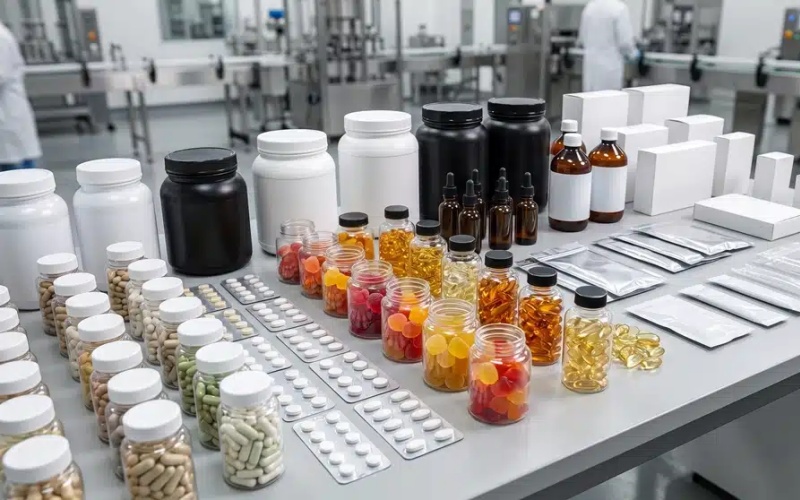
Zoxizo’s documented manufacturing scope includes powders, capsules, tablets, gummies, liquid drops, softgels, instant drink powders, energy gels, and related formats. This makes it possible to plan a portfolio around the most suitable dosage form for each formula rather than forcing every product into the same format.
| Portfolio Role | Typical Purpose | Example | Main Question Before Development |
| Hero SKU | Drives recognition and acquisition | Electrolyte powder | Is it differentiated enough to anchor the line? |
| Core SKU | Supports repeat purchasing | Creatine powder | Can it be replenished reliably? |
| Complementary SKU | Expands the routine | Magnesium capsules | Does it add a distinct use occasion? |
| Premium SKU | Supports a higher price tier | Advanced gummy | Does added complexity create real value? |
| Channel SKU | Fits a specific retail model | 30-serving capsule bottle | Is the format suitable for that channel? |
| Future Extension | Expands the portfolio later | Functional drink powder | Can existing systems be reused? |
Which SKUs Belong in the Core Portfolio?
Core SKUs should sit at the intersection of commercial relevance, repeat-purchase potential, brand positioning, and manufacturing feasibility. A product may be fashionable or widely discussed without deserving a permanent place in the portfolio. The more useful approach is to evaluate whether the SKU serves a defined audience, fits the intended price and margin structure, has a recognizable use occasion, and can be produced and replenished consistently.
A practical screening method is to score each candidate against strategic importance, expected demand, differentiation, technical difficulty, and inventory risk. A product does not need to perform equally well on every dimension. A high-value hero product may justify more development work. A supporting product may be less differentiated but commercially useful because it increases basket size or completes a routine.
Mature portfolios are usually more disciplined than they first appear. They are willing to remove products that overlap, sell too slowly, create excessive packaging complexity, or tie up too much working capital. Before approving a SKU, the team should be able to explain in one sentence who it is for, when it is used, what makes it different from the closest product in the range, and why carrying its inventory makes commercial sense.
How Do Hero and Supporting SKUs Work Together?
A hero SKU gives the portfolio a clear center. It may be the most differentiated formula, the strongest customer-acquisition product, the highest-volume item, or the product most closely associated with the brand’s positioning. Supporting products should strengthen that role by expanding the consumer routine rather than competing with the hero product for the same purchase.
A hydration-led line offers a simple example. An electrolyte powder may lead acquisition, creatine can fit performance routines, magnesium can occupy an evening recovery occasion, and an amino-acid or protein product may expand the sports-nutrition stack. The products do not need identical ingredients or formats, but their relationship should be obvious enough that the range feels intentional.
Supporting products also do not need the same formulation complexity as the hero SKU. A flagship formula may deserve several development rounds, distinctive ingredients, sensory work, and more customized packaging. A supporting capsule may create more value through straightforward positioning, stable sourcing, and reliable replenishment. Applying equal complexity to every product can consume R&D and purchasing resources without improving the final range.
A simple commercial test helps: can the products be bundled naturally, can one product introduce another, and would a consumer understand when to use each one? When the answers are clear, the range is usually structurally stronger.
How Many SKUs Should You Launch First?
There is no universal ideal number because SKU count alone does not measure difficulty. Four products that span gummies, powders, softgels, and liquid drops can be more complex than eight capsule products using familiar raw materials and a shared packaging family. The number of unique development systems is often a better planning metric than the number of product names.
Count the unique dosage forms, flavors, new ingredients, custom packaging components, certifications, and analytical programs involved. Each additional system creates another dependency. A first launch containing three dosage forms, four custom containers, and multiple specialty ingredients may need more project management than a much larger line built around a simpler architecture.
Capital exposure also grows with variety. Every SKU may require ingredients, printing, packaging, laboratory work, setup charges, finished inventory, and safety stock. Slow-selling products can leave unused labels, bottles, cartons, or specialized ingredients long after the first production run.
For established brands with stable forecasts and committed distribution, a broader first wave can be reasonable. For a new category, phased launches often provide better data. The full architecture can still be planned in advance so that later products fit the original system instead of forcing a redesign every few months.
Do the SKUs Serve the Same Consumer?
Products do not need to serve exactly the same person, but they should belong to a believable consumer ecosystem. Product lines can segment by health goal, age, activity level, lifestyle, use occasion, dosage-form preference, price tier, or sales channel. The problem begins when those segments become so disconnected that the portfolio feels like several unrelated businesses combined under one label.
Consumer routines are often more useful than broad demographic labels. The same person may prefer a morning drink powder, a simple capsule during the day, and an evening relaxation product. Those products can belong together even if their formulations and formats are very different.
Channel also influences the structure. Pharmacy, wholesale, Amazon, specialist retail, gym distribution, and subscription e-commerce can create different expectations around serving count, bottle size, label hierarchy, shelf presentation, and replenishment. A product designed for one channel may not automatically be efficient in another.
Before formulation starts, write down who each SKU is for, when it is used, what job it performs, and how it differs from the closest product in the portfolio. When several descriptions sound interchangeable, the line is probably overbuilt.
How Do You Build a Shared Product Architecture?
A shared product architecture connects ingredients, dosage forms, serving logic, packaging, specifications, naming, and production planning across the portfolio. The objective is not to make every product identical. It is to create enough common structure that sourcing, manufacturing, quality control, artwork management, and future expansion remain manageable as the line grows.
The simplest way to expose the architecture is to build a product matrix before deep formulation begins. List every planned SKU down one side and place target consumer, functional goal, dosage form, key ingredients, serving size, flavor, packaging, target cost, testing needs, target market, and launch wave across the top. Patterns and conflicts tend to become visible very quickly.
The team may discover that several products can use the same bottle family, three formulas depend on the same mineral, or two powders could share a pouch size and scoop. It may also reveal one product with a completely unique supply chain, an expensive patented ingredient, or a packaging system that no other SKU uses. These differences are not necessarily problems, but they should be intentional.
Shared ingredients can reduce supplier complexity and sometimes improve procurement efficiency, but they should never be included merely because they are convenient to purchase. Every ingredient still needs to suit the dosage form, serving size, sensory profile, product concept, cost target, and target market. Zoxizo’s documented ingredient-development framework considers target-market suitability, dosage reasonableness, taste and stability effects, inventory status, sourcing, testing, cost, and compliant label presentation before finalizing ingredient decisions.
Dosage-form architecture deserves the same attention. Powders can support larger serving weights. Capsules can make certain ingredients easier to consume without flavor masking. Gummies can improve the sensory experience while introducing active-loading, moisture, texture, and stability challenges. Drops can support concentrated liquid servings, while softgels often fit oil-based ingredients. A coherent product line may use several forms, but each format should solve a real product problem.
| Architecture Area | Can Often Be Shared | Requires SKU-Specific Review |
| Ingredients | Common vitamins, minerals, excipients | Dose, form, interactions, stability |
| Bottles | Bottle families and closures | Fill volume, protection, serving count |
| Labels | Layout and visual hierarchy | Facts panel, warnings, directions |
| Cartons | Brand structure | Product data and pack count |
| Testing | Common QC framework | Formula-specific analytical scope |
| Suppliers | Approved supplier network | Ingredient specifications |
| Records | Shared document-control system | Formula and process details |
Which Ingredients Can Be Shared Across SKUs?
Shared ingredients make sense when they work scientifically, commercially, and operationally. A mineral, botanical, amino acid, flavor component, or excipient may appear in several products, but it does not automatically belong at the same level or in the same form.
A useful portfolio tool is an ingredient map. List every active ingredient across every SKU, then flag high-cost materials, patented ingredients, allergens, specialty botanicals, long-lead ingredients, and raw materials that require additional documentation or testing. The map reveals where purchasing efficiency exists and where concentration risk is developing.
If five SKUs depend on one specialty material, consolidated purchasing may be attractive, but one supply interruption can affect a large portion of the portfolio. Mature planning therefore considers supplier alternatives, specification consistency, safety stock, and procurement timing for critical shared ingredients.
Technical behavior can also change by dosage form. An ingredient that works well inside a capsule may create bitterness, color changes, sediment, or texture problems in a gummy or flavored powder. The goal is therefore not to maximize ingredient reuse. It is to reuse ingredients when doing so improves the system without weakening the finished product.
How Do You Avoid Formula Overlap?
Formula overlap becomes expensive when two products have different labels but solve nearly the same problem with similar ingredients, consumers, and use occasions. Marketing teams then have to create artificial distinctions, inventory is divided across products that compete with one another, and customers may struggle to decide which formula they actually need.
An overlap matrix can help. Compare each SKU by primary benefit, secondary benefits, core actives, target user, dosage form, serving occasion, and price tier. When two products overlap across most of those dimensions, determine whether the difference is meaningful enough to justify separate inventory and development.
Some overlap can be intentional. A capsule and powder may serve different format preferences. A premium product may occupy the same functional territory as an entry-level formula while using different ingredients or positioning. Day and night products can also share certain ingredients while serving different moments.
Combined use deserves additional attention. When several products are intended to be used together, repeated nutrients and actives should be reviewed across the stack. A coherent portfolio should make combination easier to understand rather than forcing consumers to solve a complicated dosage puzzle.
Which Dosage Form Fits Each SKU?
Dosage form should follow the formula and the intended consumer experience rather than fashion alone. Powders can handle gram-level servings and often work well for hydration, creatine, collagen, greens, protein, and functional drink concepts. Capsules can avoid taste issues when the total ingredient load fits a reasonable capsule count. Tablets can suit certain vitamin and mineral systems when compression and disintegration are technically appropriate.
Gummies look simple to consumers but can be technically demanding. Active loading, acid balance, sugar system, texture, moisture, heat exposure, flavor, and stability can all affect feasibility. Zoxizo’s internal project guidance notes that custom gummy programs can require higher minimum quantities than standard capsule or some powder projects because of molding, texture adjustment, active loading, setup, packaging, and stability requirements.
Softgels are commonly considered for oil-based and fat-soluble ingredients, while drops can work for concentrated liquid servings. No format is automatically superior. The useful questions are whether the formula fits the format, remains stable, can be consumed comfortably, and can be manufactured repeatedly at the planned commercial scale and cost.
How Should Packaging Stay Consistent?

Packaging consistency should make the product line immediately recognizable without forcing every formula into the same physical container. Typography, color hierarchy, information placement, closure family, naming conventions, and carton structure can be standardized while package dimensions and formats vary according to product requirements.
For example, three capsule SKUs may use the same bottle family and label dimensions. A powder may use a larger jar or pouch but follow the same graphic architecture. A stick-pack product may use sachets inside a carton while preserving the same front-panel information hierarchy.
Every unique bottle, lid, scoop, label, sachet film, carton, seal, or insert creates another purchasing and inventory item. Standardizing unnecessary variation can reduce procurement and warehouse complexity. However, over-standardization can also lead to oversized containers, poor filling efficiency, wasted freight volume, or inadequate product protection.
Packaging should therefore be reviewed together with serving count, product density, moisture sensitivity, filling method, merchandising, shipping, and consumer use. A package that looks elegant in a digital render but creates problems in production or transport is not truly optimized.
Which Development Model Fits Each SKU?
Not every product in a multi-SKU line needs the same development path. Full custom formulation is appropriate when differentiation is strategically important, while mature formulas with targeted modifications can be more efficient for supporting products. Development resources should be concentrated where they create meaningful commercial value rather than distributed equally across every SKU.
As a portfolio grows, this choice becomes increasingly important. Ten SKUs entering deep custom development simultaneously can create much more R&D, sourcing, sampling, testing, packaging, and approval work than expected. The project may spend weeks perfecting products whose commercial roles do not justify the same level of complexity as the hero SKU.
A practical portfolio can combine three development routes. Full custom formulation suits flagship, premium, or proprietary concepts. A mature formula with selected modifications can fit core products that need some differentiation without a complete restart. More standardized products can work for supporting categories where the commercial value comes mainly from branding, merchandising, channel access, or bundle positioning.
Zoxizo’s documented development scope covers both mature-formula customization and from-zero development. Existing formulas can be adjusted for taste, sweetness, color, selected ingredients, serving size, labels, and packaging, while fully customized products can be developed around target market, consumer group, dosage form, ingredient strategy, cost, flavor, packaging, and compliance. The company materials also record 25+ R&D personnel and a 20,000+ formula library.
The correct development route depends on the strategic importance of the SKU. A formula expected to define the brand for years may justify deeper work. A supporting product whose main purpose is basket expansion may create more value through availability and consistency than novelty.
Do All SKUs Need Custom Formulas?
No. Full custom formulation is valuable when it solves a specific problem or creates a real competitive difference that cannot be achieved through a mature formula platform. That difference may come from ingredient choice, active levels, serving structure, branded materials, flavor, dosage form, or a tightly defined consumer need.
Customization also creates downstream responsibilities. A new ingredient may require sourcing, new supplier documents, added testing, or longer lead times. A unique flavor system may need multiple sampling rounds. Specialty actives can affect cost, availability, and production scale. A formula that looks impressive during concept development but cannot be manufactured repeatedly is not a successful formula.
Supporting products often benefit from a more restrained approach. A straightforward magnesium capsule may create more value through consistent quality and clear positioning than through unnecessary complexity added merely to make the label look more distinctive.
The most useful question for each product is simple: what specific commercial advantage is being purchased with additional development complexity? When the answer is clear, deep customization can be justified. When the answer is vague, a simpler development path deserves serious consideration.
When Is a Mature Formula More Efficient?
A mature formula can be an efficient starting point when the underlying category is well understood and the brand does not need extensive novelty in every component. It provides a known technical foundation while still allowing selected adjustments to flavor, sweetness, color, serving size, ingredients, packaging, and branding.
This approach can be particularly useful for supporting products. A portfolio may invest heavily in a differentiated hydration powder while starting from an established technical base for a daily vitamin or mineral product. That keeps development resources focused where they influence the brand most.
A mature formula should not be treated as universally suitable. Target-market requirements, ingredient availability, allergens, serving levels, label content, cost, and packaging still need product-specific review. Meaningful changes can also affect stability or manufacturing behavior.
Zoxizo’s own development guidance emphasizes confirming formula feasibility, ingredient availability, packaging minimums, testing requirements, market claims, and shipping conditions before sampling or bulk production. The value of a mature formula therefore lies in providing a stronger starting point, not in removing the need for technical review.
How Do You Prioritize Formula Investment?
Formula investment should follow commercial importance rather than internal enthusiasm. Teams naturally become interested in unusual ingredients or technically complex ideas, but technical novelty is not always the same as business value. A product with modest formulation complexity but strong repeat purchase may deserve more attention than a technically fascinating SKU with uncertain demand.
A useful prioritization method is to score each SKU from one to five for expected revenue contribution, differentiation, repeat-purchase potential, strategic importance, and technical difficulty. The purpose is not to produce a perfect financial model. It is to make the trade-offs visible before the R&D budget is committed.
Development work can also create value beyond one product. A successful flavor system may be reused across future powders. A qualified raw-material supplier may support several formulations. A packaging format that performs well may become standard across a capsule range.
This is where portfolio thinking becomes more efficient than product-by-product development. The team stops asking only what a single formulation costs and begins considering whether the work creates reusable knowledge, sourcing leverage, or manufacturing capability for future SKUs.
How Do MOQ and Cost Change by SKU?
MOQ varies because manufacturing projects are structurally different. Dosage form, raw-material purchasing, production setup, packaging, printing, testing, certifications, and customization depth can all change the commercial minimum. One generic MOQ for every product is rarely realistic.
A custom gummy can require more setup than a familiar capsule. Custom stick-pack film can have its own printing minimum. A high-cost patented ingredient may require a purchasing commitment that becomes the real quantity constraint. Softgels, specialty pouches, custom molds, and certain certification projects can add another layer of requirements.
For a multi-SKU portfolio, it is useful to separate manufacturing MOQ, ingredient-purchasing MOQ, and packaging MOQ. The three numbers may be different. Packaging can become the hidden restriction even when a formula is technically producible in a smaller batch.
Zoxizo’s internal guidance specifically cautions against presenting one universal MOQ and notes that special packaging, higher-value ingredients, more complex dosage forms, and certification requirements can increase minimum quantities.
Cost analysis should also include testing, packaging setup, freight, warehousing, and unused component exposure. A low unit price achieved by buying far more inventory than the market can absorb may increase total project risk instead of reducing it.
How Do You Coordinate Multi-SKU Development?
Multi-SKU development should be managed as one connected program rather than several unrelated product projects. Formula development, ingredient sourcing, sampling, packaging, labels, testing, production, and logistics all contain dependencies, so the project schedule should show which activities can run in parallel and which decisions must be completed before the next stage begins.
A dependency map is one of the simplest ways to improve control. Preliminary packaging choices can often be explored while formulas are being developed, but final artwork should not be printed while serving information is still changing. Ingredient sourcing discussions can start early, but production should wait until the correct formula and approved sample are clearly defined.
The documented Zoxizo workflow follows a structured sequence covering requirement analysis, target market, product direction, formula development or matching, ingredient and cost assessment, dosage-form confirmation, flavor and packaging decisions, sampling, revisions, pricing, artwork, bulk manufacturing, in-process QC, finished-product testing, documentation, shipment preparation, logistics, and reorder support.
For larger portfolios, classifying products by technical complexity makes scheduling easier. A familiar capsule may be low complexity. A flavored powder using new ingredients may be medium complexity. A high-active gummy with custom packaging may be high complexity. Starting the difficult products earlier gives simpler products time to catch up and reduces the risk that one technically challenging SKU determines the launch date for the entire range.
A useful project tracker can include:
- Formula version
- Ingredient status
- Dosage form
- Sample status
- Sensory approval
- Packaging specification
- Artwork status
- Testing scope
- Label approval
- Production readiness
- Batch status
- Quality release
- Shipping status
How Should Sampling Be Sequenced?
Sampling should be prioritized according to technical uncertainty rather than product numbering. Products containing unfamiliar ingredients, high active levels, challenging flavors, new delivery formats, or narrow cost targets should normally enter development first because they are more likely to require additional rounds of adjustment.
A complex gummy may need more texture work than a capsule. A flavored greens powder may need several sensory revisions. A liquid formula may introduce solubility, sediment, or flavor challenges. These products should enter the sampling schedule early enough that their extra work does not compress the final launch timeline.
Sampling can also generate knowledge for other products. A flavor direction approved for one powder can influence another. A bottle size that works particularly well may become the standard for several capsule SKUs. A label review may expose information requirements that affect the entire range.
The source documentation notes that sample timing depends on formula complexity, raw-material availability, dosage form, and customization level. It also states that feedback can be used to adjust taste, texture, color, solubility, packaging, and cost before the approved sample becomes the reference for bulk production.
What Should Be Locked Before Production?
A production-ready product needs more than an approved taste. The formula version, ingredient specifications, dosage form, serving size, flavor or sensory target, packaging components, artwork, label information, testing scope, coding requirements, and approved sample reference should be controlled before bulk manufacturing starts.
Version confusion becomes increasingly dangerous as SKU count grows. One department may approve a new formula while purchasing works from an earlier specification. Packaging artwork may still show an old serving size. Production may receive instructions based on a file that was already replaced.
Each SKU should therefore have an approval record with a version number, date, and clearly identified final files. Depending on the project, packaging details may include bottle size, closure, seal, desiccant, scoop, label dimensions, carton, sachet film, pouch material, case configuration, and coding requirements.
This discipline is not bureaucracy for its own sake. It protects speed. Clear approvals reduce the number of interruptions during production and make repeat orders easier because the team can identify exactly which version should be reproduced months later.
How Do Packaging Decisions Affect Timing?
Packaging often becomes the true critical path even after formula development is complete. Stock bottles and pressure-sensitive labels usually have different preparation requirements from custom pouches, specialty cartons, printed sachet film, molded components, or unusual closures.
Every custom packaging item can involve artwork approval, print setup, color matching, production, transport to the filling location, and incoming inspection. If several SKUs use completely different packaging systems, those dependencies multiply and can become harder to coordinate than formulation itself.
Formula changes can also affect packaging. A serving-size revision may change Supplement Facts, directions, net contents, or bottle capacity. A late ingredient change can require artwork revisions. Ordering printed materials too early can leave the brand with obsolete cartons, labels, or film.
Zoxizo’s internal project guidance identifies raw-material availability, custom printing, special packaging processes, label revisions, sample changes, testing, certification, and production schedules as factors that can extend overall lead time. Packaging should therefore be treated as an early project decision rather than the decorative step at the end.
How Do You Build a Multi-SKU Timeline?
Start with the intended commercial launch and work backward through freight, quality release, finished-product testing, manufacturing, packaging arrival, material preparation, sample approval, and formulation. Then identify the longest dependency for each SKU instead of assigning the same lead time to every product.
One capsule may be driven mainly by ingredient sourcing. A gummy may depend on formulation iterations. A custom stick-pack product may be controlled by printed film. A project with additional certifications or specialized testing may have its own documentation timeline.
Portfolio gates can help maintain control. Useful gates include concept approval, formula approval, sample approval, artwork approval, production readiness, quality release, and shipment readiness. Individual SKUs can progress at different speeds while the team reviews overall readiness at those milestones.
The source material states that sample timing varies with raw-material availability and customization complexity, while bulk production timing should be confirmed after sample, label, packaging, and other commercial requirements are settled. It also notes that forecasts allow repeat-order planning and material preparation to be handled more efficiently.
A realistic schedule should contain contingency. A plan with no room for revisions may look efficient on paper but becomes fragile as soon as one ingredient, package, test, or sample takes longer than expected.
How Are Quality and Compliance Controlled Across SKUs?

Quality and compliance should operate through a common control framework while preserving SKU-specific specifications. Each product needs its own raw-material requirements, production controls, finished-product checks, label information, batch documentation, and traceability. As the number of SKUs increases, document and version control become just as important as laboratory testing.
Different dosage forms and ingredients create different quality priorities. A probiotic formula may require attention to viable count and storage conditions. Botanicals can introduce identity and contaminant considerations. Powders may require blend, sensory, or dissolution checks depending on the product. Gummies bring texture, moisture, and stability questions. Oil-based formulas have different oxidation and packaging considerations from dry capsules.
The company’s documented quality framework includes raw-material review, active-ingredient confirmation, production-process control, finished-product testing, batch documentation, and after-sales traceability. It also describes production-line QC checks including pre-production trials and post-production sampling.
Testing should be selected according to the product rather than copied from another SKU. Possible analytical areas may include active content, microbiology, heavy metals, pesticide residues, allergens, CFU, purity, residual solvents, stability, and other market-specific items where relevant. Some work may require third-party laboratories, additional cost, or extra time.
Compliance also changes by destination. Ingredient declarations, Supplement Facts, warnings, suggested use, claims, responsible-party information, language, and importer requirements can vary. A visual packaging template may be shared across the range, but the regulatory information still needs to be reviewed product by product.
| Control Level | Typical Focus | Value Across Multiple SKUs |
| Raw Materials | Identity, specifications, documents | Reduces material variability |
| Pre-Production | Formula version and setup | Prevents wrong-version production |
| In-Process | Filling, weight, mixing, appearance | Detects deviation early |
| Finished Product | Specification and relevant testing | Supports batch release |
| Packaging | Components, artwork, coding | Reduces mix-up risk |
| Batch Records | Lot data, production records, QC | Supports traceability |
| Retained Samples | Reference from released lots | Helps investigate feedback |
What Testing Does Each SKU Need?
Testing should start with the product’s risk profile rather than a universal checklist. Formula composition, dosage form, active ingredients, target market, claims, shelf-life expectations, and commercial requirements should determine what needs to be evaluated.
A probiotic product may emphasize viable count. A botanical formulation can require more raw-material identity information. A mineral formula may require a different analytical focus from a gummy. Powders can create questions around blending, sensory performance, or dissolution depending on the concept.
Testing also occurs at several stages. Some controls belong with supplier qualification and incoming materials. Others take place during production. Finished-product release may require a separate analytical scope. Third-party testing can be appropriate when independent evidence is required, but it should be planned before launch dates are fixed because certain tests add cost and time.
The more useful question is not simply whether a manufacturer “tests products.” Procurement and product teams should understand what is tested, at which stage, against what specification, who performs the work, and what documents are available for the resulting batch.
How Are Batch Records and Traceability Managed?
Traceability connects every finished lot to the materials, formula version, packaging, production process, and release decision used to manufacture it. In a multi-SKU system, this matters because ingredients, packaging components, and manufacturing resources may be shared across many products.
Every production lot should have a clear batch identity. Depending on the product and system, records can connect raw-material lots, production details, process checks, packaging materials, test results, deviations, and release status. Retained samples can provide another reference if quality feedback appears later.
Traceability also supports consistency in repeat orders. A second or third production run should be linked to the approved specification from earlier batches, while any intentional change is documented rather than silently introduced.
Zoxizo’s company documentation states that support can include COA, MSDS/SDS, raw-material documents, finished-product batch files, testing-related documents, and export materials according to product and project requirements. A strong system should make it possible to investigate a batch without first having to reconstruct the formula or packaging history from old messages.
Do Different Markets Need Different Labels?
Yes. A formula can remain identical while its commercial label changes because countries and sales channels may have different requirements for language, ingredient naming, warnings, mandatory statements, nutrition or supplement panels, responsible-party information, and claims.
The safest approach is to identify target markets before large quantities of printed packaging are ordered. A brand planning sales in several regions may need separate labels, over-labels, cartons, or packaging variants. Even when the formula is identical, these packaging versions effectively create additional SKUs that need artwork and inventory control.
Claims deserve particular care. Supplement language should avoid disease-treatment claims, guaranteed results, and unsupported clinical statements unless the relevant market framework and substantiation clearly permit them. Zoxizo’s internal content rules specifically avoid cure, treat, prevent-disease, guaranteed-effect, and unsupported clinical language.
For U.S.-style projects, dietary supplement labels should not be described as “FDA approved.” The company documentation instead refers to support for Supplement Facts, ingredients, suggested use, warnings, lot information, expiration details, and related product documents, with final compliance reviewed according to the target market and sales channel.
How Do You Keep SKUs Consistent Over Time?
Consistency begins with an approved master specification. Formula, raw materials, sensory expectations, dosage form, packaging, artwork, coding, and testing requirements should all have controlled references so that later production runs are based on the intended product rather than remembered instructions.
Change control is equally important. Suppliers change, packaging components are discontinued, raw materials become temporarily unavailable, and regulations evolve. A new ingredient source, capsule shell, flavor system, or bottle should be assessed for possible effects on product performance, label content, testing, cost, and consumer experience.
Forecasting also supports consistency. Emergency purchasing creates more pressure to make substitutions. When brands provide realistic forecasts, purchasing and manufacturing teams have more time to secure the intended materials and schedule repeat production.
Consistency does not mean that a product can never change. It means that changes are deliberate, reviewed, approved, and traceable. A commercially successful supplement should still be recognizable in its fifth or tenth production run. Repeatability is one of the clearest differences between a good development sample and a good manufacturing system.
How Do You Scale and Replenish a Multi-SKU Line?

Scaling a multi-SKU line means keeping products available and consistent while each SKU develops its own sales pattern. Replenishment should therefore use sales velocity, inventory cover, ingredient lead times, packaging status, testing requirements, and production schedules at SKU level rather than applying one fixed reorder rule to the entire portfolio.
The first production run rarely predicts the long-term sales mix accurately. The expected hero product may perform moderately while a supporting product becomes the bestseller. Wholesale may favor a different pack count from e-commerce. Promotions can change demand quickly, and some categories naturally show stronger seasonality than others.
Inventory planning should move from launch assumptions to actual consumption data as soon as useful sales history becomes available. Track finished inventory, average weekly sales, committed wholesale orders, planned promotions, incoming stock, open purchase orders, material status, and estimated production timing.
The reorder point should reflect the longest important dependency. A product with eight weeks of finished inventory may still require action if a critical raw material has a long procurement cycle. Another SKU with five weeks of stock may be less urgent if its ingredients and packaging are already available.
Shared materials can simplify planning. Several capsule SKUs using the same bottle family can make packaging forecasting easier. Several formulas sharing one ingredient can create purchasing efficiency. The same overlap can also create concentration risk when one delayed material affects several products.
Manufacturing capability becomes increasingly important as the range expands. Zoxizo’s current documentation records an approximately 17,000 m² manufacturing facility, around 1,000 m² of R&D trial space, 25+ R&D personnel, 30+ quality personnel, a 20,000+ formula library, and support across multiple dosage-form families. Facts of this kind are useful when evaluating whether a manufacturing partner can support ongoing portfolio development rather than one isolated production run.
Which SKUs Should Be Replenished First?
Replenishment priority should reflect both stockout risk and commercial importance. The SKU with the lowest number of units on hand is not automatically the most urgent because its supply chain may be shorter than another product with more inventory.
A more useful review combines inventory cover, sales velocity, supply lead time, upcoming promotions, strategic importance, and confirmed channel commitments. A hero SKU with six weeks of stock can need earlier action than a supporting product with four weeks if its key ingredient requires substantially more preparation.
A simple operating measure is weeks of cover: usable stock divided by average weekly demand. The result can then be adjusted for promotions, wholesale commitments, and inbound inventory. It is not a perfect forecast, but it creates a common language for procurement and production planning.
Different products may therefore justify different reorder quantities. High-velocity products can require larger or more frequent runs, while slower strategic SKUs may need smaller or less frequent replenishment. The goal is not symmetrical inventory. It is availability without excessive working capital tied up in slow-moving products.
How Should Production Be Scheduled Across SKUs?
Production scheduling should consider material readiness, dosage form, packaging availability, quality controls, cleaning requirements, and shipping priorities together. A product can be formula-ready while waiting for packaging, production-complete while waiting for testing, or quality-released while shipping documentation is still being prepared.
Distinguishing these stages prevents unrealistic expectations. Useful status definitions include material-ready, production-ready, quality-released, and shipment-ready. Each one represents a different point in the supply chain.
Where technically appropriate, related dosage forms can sometimes be planned into logical production windows, but quality and changeover requirements should remain more important than calendar convenience. Repeat-order programs become easier when forecasts allow raw materials and packaging to be prepared ahead of time.
Zoxizo’s source material specifically notes that repeat orders can be planned more efficiently when forecasts are available and that larger accounts may discuss advance material preparation and production planning. A resilient schedule should also leave room for the ingredient delay, packaging revision, or unexpected bestseller that eventually appears in almost every growing portfolio.
What Should You Evaluate in a Multi-SKU Manufacturer?
A multi-SKU manufacturing partner should be evaluated on the whole operating system rather than unit price alone. Start with dosage-form coverage and ask whether the facility can support not only the first product but also the formats planned for the next two or three years.
Then examine formulation resources, sampling, ingredient sourcing, packaging coordination, quality systems, documentation, production capacity, confidentiality, warehousing, and repeat-order planning. Measurable evidence is more useful than broad statements. “Strong R&D” means more when the team can explain its staffing, trial facilities, sample process, formulation scope, and development workflow.
Project management should also be considered a manufacturing capability. Ask how formula versions are controlled, how artwork approvals are tracked, how substitutions are communicated, how several SKUs are scheduled, and how repeat orders are connected to the correct previous specifications.
When confidentiality arrangements allow it, sharing the full portfolio roadmap with the manufacturer can be more productive than quoting products separately. The wider view allows the technical and sourcing teams to identify shared ingredients, packaging opportunities, difficult dosage forms, and schedule conflicts before they become expensive.
How Do You Plan Future Line Extensions?
Future line extensions become easier when the first portfolio creates reusable systems. Qualified suppliers, successful flavor directions, proven packaging families, controlled formula records, label templates, analytical methods, and production procedures can all reduce the amount of work required for later launches.
Keep a second-wave roadmap even if those products are not being developed immediately. Mark which future SKUs could reuse ingredients, bottle families, pouches, dosage forms, flavor systems, or testing approaches. This allows the original product architecture to support expansion instead of forcing the brand to rebuild the supply chain every time a new product is added.
Actual sales data should then influence sequence. If hydration customers frequently purchase magnesium, another recovery-oriented product may deserve priority. If one format produces strong repeat sales but also creates high manufacturing complexity, future extensions should be judged against that trade-off.
Expansion does not always mean another formula. A different serving count, travel format, stick-pack carton, wholesale configuration, or channel-specific package may create more commercial value than an entirely new product. Scaling also includes removal. A SKU that sells slowly, duplicates another product, or consumes disproportionate inventory and management time should not remain indefinitely simply because money was already spent developing it.
A healthy supplement portfolio is therefore not measured by how many products it accumulates. It is measured by how efficiently those products work together commercially and operationally.
Developing a multi-SKU dietary supplement line is ultimately a matter of controlling connected decisions. Formula strategy influences raw materials. Raw materials affect cost, testing, and purchasing. Dosage forms influence manufacturing and minimum quantities. Packaging affects timing, freight, and inventory. Target markets influence labels and documentation. Sales forecasts influence material planning and replenishment. Managing those decisions independently may be possible with one product, but the approach becomes increasingly fragile as a portfolio grows.
The stronger method is to design the product architecture first, give each SKU a clear role, choose an appropriate development depth, and then build shared systems for formulation, sampling, packaging, quality, documentation, production, and repeat orders. Established brands planning several formulas or dosage forms can often uncover conflicts and cost-saving opportunities earlier by discussing the entire roadmap with the manufacturing partner instead of treating every SKU as a separate request.
For companies planning a new multi-SKU program, a useful starting document is a product-line brief containing the proposed SKUs, target markets, intended dosage forms, key ingredients, packaging direction, expected volumes, launch priorities, and future extensions. A development partner with experience across formulation, multiple dosage forms, packaging, batch documentation, quality control, and scalable production can then evaluate the program as a connected supply chain rather than a collection of unrelated products.
FAQ: What is a multi-SKU dietary supplement line?
A multi-SKU dietary supplement line is a portfolio containing several related supplement products sold under one brand or commercial program. The products may use different formulas, dosage forms, serving counts, or packaging, but they normally share a broader consumer, category, or positioning logic. Strong multi-SKU lines are planned as connected portfolios so formulation, sourcing, manufacturing, quality, packaging, inventory, and replenishment can be managed more efficiently over time.
FAQ: How many supplement SKUs should a brand launch at once?
There is no universal number because technical complexity matters more than SKU count alone. Four products using four dosage forms and several custom packaging systems can be harder to launch than eight related capsule products. Brands should evaluate the number of unique formulas, ingredients, dosage forms, packages, tests, and suppliers involved, then decide how much development and inventory risk can be managed comfortably during the first launch wave.
FAQ: Do all products in a supplement line need custom formulas?
No. Many successful portfolios combine deeply customized hero products with mature formulas that receive selected adjustments and more standardized supporting products. Full custom development is most useful when formula differentiation creates a real commercial advantage. Supporting products may create more value through reliable quality, clear positioning, consistent supply, and efficient economics rather than unnecessary technical novelty.
FAQ: Can different dosage forms be used in the same supplement line?
Yes. A well-planned portfolio can include powders, capsules, tablets, gummies, softgels, drops, drink powders, or other formats when each dosage form suits the ingredient load, consumer experience, stability requirements, and commercial positioning of the product. The important issue is not visual uniformity but whether the different formats can be developed, manufactured, documented, packaged, and replenished within one manageable operating system.
FAQ: How should multi-SKU supplement production be planned?
Production should be planned around ingredient readiness, packaging availability, sample approval, production capacity, testing, and inventory needs for each SKU. Complex products should often enter development earlier, while straightforward items can follow later. For repeat orders, sales forecasts allow manufacturers and purchasing teams to prepare raw materials and production windows earlier, reducing the chance that fast-selling products become urgent only after inventory has already fallen too low.
FAQ: What quality documents may be needed for a multi-SKU supplement program?
Documentation varies by product, market, and testing scope, but programs may involve raw-material specifications, supplier documents, COAs, finished-product batch records, MSDS or SDS documents where applicable, testing reports, packaging specifications, traceability records, and export-related documents. Each SKU should have its own controlled specifications because testing requirements and documentation can differ significantly across formulas and dosage forms.
FAQ: What should brands look for in a multi-SKU supplement manufacturer?
Look beyond the first quotation. Review dosage-form capability, formulation resources, ingredient sourcing, sampling, packaging coordination, quality controls, batch traceability, documentation, production capacity, change management, and repeat-order planning. The strongest manufacturing partner for a multi-SKU line is one that can manage several connected products as one long-term program while keeping formulas, materials, packaging, records, production schedules, and quality requirements clearly controlled.