 Skip to content

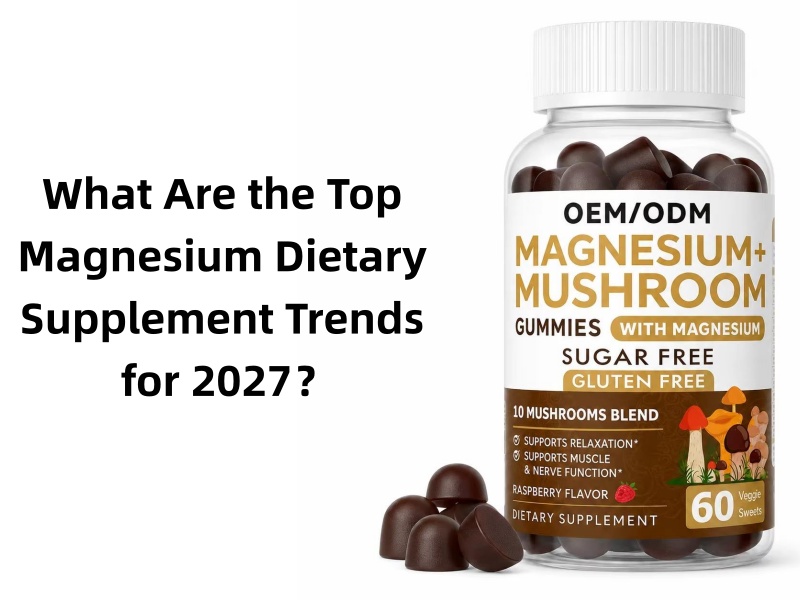
Magnesium is one of those supplement ingredients that looks familiar until you examine what is actually happening around it. For years, the category was largely built around straightforward mineral tablets and capsules. Heading into 2027, consumers are encountering magnesium in very different ways: flavored nighttime powders, magnesium glycinate capsules, electrolyte stick packs, gummies, premium L-threonate formulas, recovery products, and multi-ingredient relaxation blends. The mineral itself has not suddenly changed, but the occasions, formats, expectations, and product-development decisions surrounding it have.
The leading magnesium dietary supplement trends for 2027 are expected to center on premium magnesium forms, sleep and relaxation products, hydration and recovery, powders and drink mixes, clearer elemental-magnesium labeling, smarter ingredient combinations, and stronger quality controls. Magnesium glycinate should remain prominent, while citrate, L-threonate, and multi-form blends will serve different consumer needs rather than one form replacing all others.
The interesting part is that magnesium is becoming harder, not easier, to develop well. As more brands enter the category, simply putting “Magnesium Glycinate” on a bottle will no longer create much distinction. A formula still has to deliver an appropriate elemental amount, fit into a practical serving size, taste acceptable when used in powder or gummy formats, remain stable through its shelf life, and support claims that can withstand scrutiny. That is where the 2027 magnesium story really begins.
What Is Driving Magnesium Demand in 2027?
Magnesium demand in 2027 is likely to come from several overlapping behaviors rather than one headline health benefit. Nutritional awareness, sleep routines, relaxation products, active lifestyles, hydration, healthy aging, and greater recognition of specific magnesium forms are all widening the category. Consumers increasingly compare the magnesium source, elemental amount, dosage form, supporting ingredients, convenience, and intended use instead of shopping only by price or total milligrams.
Demand Is Broader Than Deficiency
Magnesium has a solid nutritional foundation. Adult recommended dietary allowances generally fall between 310 and 420 mg per day depending on age and sex, while population-level dietary surveys have repeatedly shown that many Americans consume less magnesium from food and beverages than recommended. That does not mean everyone with a low dietary intake is clinically magnesium deficient, and responsible supplement communication should keep that distinction clear. It does mean magnesium remains relevant to everyday nutrition rather than depending entirely on a passing social-media trend.
Consumer use has also moved noticeably. Council for Responsible Nutrition survey results reported magnesium use among supplement users increasing from roughly 19% in 2023 to 23% in 2024. Later CRN reporting also indicated higher usage among women than men and substantial interest among older adults. These numbers should not be turned into guaranteed 2027 growth forecasts, but they show that magnesium already has broad consumer familiarity and room to move into more specialized product concepts.
Industry retail data have told a similar story. Form-specific magnesium products, particularly glycinate and bisglycinate, have shown strong recent growth in tracked natural and conventional supplement channels. The numbers vary dramatically by form and starting base, so a 100% or 500% growth figure should never be interpreted as evidence that one magnesium source is clinically superior. Commercially, however, it tells us something important: consumers increasingly recognize magnesium forms by name.
| Market Indicator | Recent Reference Point | Practical Meaning |
| Magnesium use among supplement users | About 19% in 2023 | Already an established specialty supplement |
| Magnesium use among supplement users | About 23% in 2024 | Rising category participation |
| Female supplement users reporting magnesium use | About 27% | Strong relevance in women’s wellness |
| Male supplement users reporting magnesium use | About 19% | Broader growth opportunity remains |
| Adult magnesium RDA | 310–420 mg/day | Nutritional needs vary by age and sex |
| U.S. Daily Value for magnesium | 420 mg | Important reference for Supplement Facts labeling |
These figures are most useful when treated as context rather than sales promises. A brand planning a magnesium launch in 2027 still needs to determine who the product is for, what problem it is intended to address, and how the formulation will compete once the ingredient itself is no longer unusual.
Consumers Are Entering Through Different Doors
There is no single “magnesium consumer.” An older adult taking a once-daily capsule, a woman using a nighttime glycinate powder, and an active consumer drinking a magnesium-containing electrolyte formula may all use the same mineral for completely different reasons. This diversity is helping the category grow because magnesium can appear across several parts of the wellness market without forcing every product into the traditional mineral aisle.
Older consumers remain relevant because magnesium intake may decline with age while physiological and medication-related factors can affect magnesium status. Younger adults often encounter magnesium in a different way. Their first exposure may be a sleep routine, a fitness creator discussing recovery, an electrolyte stick used during travel, or a flavored “calm” drink taken at night. For them, dosage form, convenience, taste, packaging, and an understandable use occasion can carry as much weight as the ingredient itself.
This creates a useful development lesson. Demographics should be considered before formula construction. A magnesium product intended for an established healthy-aging line will probably require a different serving format, package design, supporting ingredients, and communication style than a magnesium hydration stick designed for people exercising several times per week. The mineral can be the same while almost every other commercial decision changes.
Wellness Routines Create More Occasions
Magnesium fits naturally into routines because it can be delivered in several forms and at several times of day. An evening capsule can sit beside a nightly skincare routine. A powder can become part of a wind-down drink. A stick pack can travel in a gym bag. A hydration product can be mixed during a long flight or after exercise. These occasions make the mineral easier to integrate into ordinary life than a product that simply instructs consumers to “take daily.”
Sleep has played a particularly important role in this transition, although the evidence should be discussed carefully. Research has found associations between magnesium status and sleep outcomes, while randomized trials have produced mixed results. A 2025 randomized study of magnesium bisglycinate reported a modest improvement in insomnia severity in adults who reported poor sleep. That finding is useful, but it does not justify presenting magnesium as a universal treatment for insomnia.
The more sustainable commercial position is often less dramatic. A well-formulated nighttime product can be presented as part of an evening wellness routine, with an appropriate magnesium source, transparent elemental amount, convenient serving, and carefully chosen complementary ingredients. The consumer experience then supports repeat use without requiring exaggerated promises.
Growth Will Reward Better Products
Strong category growth often creates a wave of look-alike launches. Once an ingredient becomes popular, brands tend to copy the most recognizable form, increase the number printed on the front label, or combine several trending actives into a single product. This can generate quick listings, but it does not necessarily generate strong repeat-order products.
Heading into 2027, the better question is not simply whether magnesium demand will continue. The more useful question is where meaningful differentiation will come from once hundreds of competing products offer glycinate, sleep positioning, or flavored powders. The answer is likely to involve execution rather than another trend phrase.
A serious development brief should address the intended consumer, magnesium source, target elemental amount, serving size, dosage form, flavor or swallowability, supporting ingredients, stability, analytical specifications, packaging, intended claims, and cost per serving. Those decisions determine whether a concept remains attractive after it leaves the presentation deck and enters commercial production.
Which Magnesium Forms Will Stand Out?
Magnesium glycinate and bisglycinate should remain highly visible through 2027, while citrate is likely to keep an important role in mainstream and soluble products. L-threonate should continue to occupy a more premium cognitive and healthy-aging position, while multi-form blends will remain popular. The strongest form depends on the product brief because absorption, elemental content, dose mass, taste, tolerance, cost, and intended format all matter.
Glycinate Remains Highly Recognizable
Magnesium glycinate has moved from an ingredient familiar mainly to supplement professionals into a name that many consumers recognize. Searches, retail listings, social content, and product launches increasingly use “glycinate” as a front-label differentiator rather than hiding the magnesium source in the Supplement Facts panel. That consumer recognition alone gives the form significant commercial momentum heading into 2027.
Its association with nighttime and relaxation products is especially strong. Recent randomized research using magnesium bisglycinate has produced encouraging but modest sleep-related findings, which is a useful reminder that popularity and evidence are not the same thing. Glycinate can be an appropriate choice for a sleep-oriented product without claiming that it is the universally superior magnesium form or that every consumer will experience the same outcome.
Commercially, the challenge is becoming differentiation within glycinate itself. When dozens of products use the same ingredient name, brands have to compete on serving design, elemental magnesium amount, capsule burden, complementary ingredients, packaging, testing, taste when used in powder formats, and the clarity of the intended use. A generic glycinate capsule may still sell, but the word “glycinate” alone will carry less competitive weight as the category matures.
Citrate Still Matters
Magnesium citrate sometimes receives less attention than glycinate in trend discussions, yet it remains highly relevant from both technical and commercial perspectives. More soluble magnesium forms tend to be absorbed more completely than poorly soluble forms, and citrate has long been among the better-known examples used in comparative absorption discussions.
Its usefulness becomes especially apparent in soluble formats. Powders, drink mixes, and some effervescent products force manufacturers to think about how the mineral behaves in water rather than merely how much can fit inside a capsule. Solubility, acidity, mineral taste, sedimentation, serving volume, and gastrointestinal tolerance all become part of development.
Citrate does not automatically solve every beverage problem. A technically soluble magnesium source can still contribute bitterness or a noticeable mineral profile when used at meaningful amounts. Flavor systems therefore need to be evaluated at the intended commercial dose, not at a diluted laboratory level that will never match the final product.
For 2027, citrate is likely to remain less fashionable than glycinate in some consumer-facing conversations while continuing to be highly practical for formulators. That combination—familiarity, technical flexibility, and a long history of use—gives it staying power even when newer forms receive more headlines.
L-Threonate Holds a Premium Position

Magnesium L-threonate sits in a different part of the category. It is frequently associated with premium cognitive-wellness, brain-health, healthy-aging, and sleep-oriented concepts rather than value-driven mineral supplementation. That gives the form an opportunity to support higher-priced products, particularly when the target audience is already comfortable paying more for research-led ingredients.
Randomized clinical research published in recent years has added to interest in L-threonate, including studies examining sleep and daytime functioning. These findings are commercially relevant, but they should not be converted into claims that L-threonate is categorically superior to every other form. Different studies use different populations, endpoints, durations, and doses, and product claims should remain proportional to the evidence.
L-threonate also creates practical formulation questions that can disappear behind premium marketing. Ingredient cost, elemental magnesium contribution, serving mass, capsule count, complementary actives, and retail price all determine whether the concept works. A sophisticated ingredient name cannot rescue a product whose serving is inconvenient or whose cost structure makes repeat purchase unrealistic.
By 2027, L-threonate may become more familiar outside specialist supplement circles, but its strongest role is still likely to be differentiation rather than universal replacement.
Multi-Form Blends Need a Reason
Multi-magnesium formulas are appealing because the product can display several recognizable forms on one label. Glycinate, citrate, malate, oxide, taurate, and L-threonate can be presented together as a “complex,” which immediately sounds broader than a single-source product. The risk is that ingredient count can become a marketing shortcut.
The meaningful number is still elemental magnesium. A formula containing five sources is not automatically better than one containing a single source, and the weight of each magnesium compound is not equal to the amount of magnesium itself. Each source should contribute for a specific reason: technical feasibility, dose density, solubility, positioning, tolerance, cost, or an evidence-based formulation objective.
| Magnesium Form | Typical 2027 Positioning | Key Product-Development Issue |
| Glycinate / Bisglycinate | Sleep, relaxation, premium daily use | Elemental amount and serving size |
| Citrate | General wellness, powders, drink formats | Taste, solubility, GI tolerance |
| L-Threonate | Cognitive wellness, healthy aging, premium sleep | Cost and research-based positioning |
| Oxide | Value products, high mineral density | Lower relative bioavailability than several soluble forms |
| Malate | Active lifestyle and multi-form concepts | Clear reason for inclusion |
| Multi-form complex | Premium broad-spectrum positioning | Meaningful amounts rather than label decoration |
Consumers are becoming more capable of questioning long ingredient lists. A five-source product will eventually be judged less by the number “five” and more by how much elemental magnesium it supplies, how the sources are distributed, and whether the blend creates a real advantage.
Which Health Needs Are Shaping Formulas?
Sleep and relaxation are likely to remain major magnesium use cases in 2027, but product development is spreading into hydration, exercise recovery, healthy aging, women’s wellness, cognition, and everyday mineral support. Strong formulas will focus on a clearly defined need instead of forcing magnesium into every trending health conversation. The most credible products connect ingredient form, dose, complementary actives, and dosage format to one understandable consumer routine.
Sleep Remains an Important Use Case
Sleep works commercially because it creates a natural time and place for taking a supplement. An evening routine can be built around a capsule, flavored powder, gummy, or warm drink in a way that is harder to achieve with a mineral positioned simply for general nutrition. The product becomes part of a behavior rather than another bottle people occasionally remember to open.
Scientific evidence supports interest but also demands moderation. Observational research has associated magnesium status with aspects of sleep, while randomized studies have produced less consistent results. Recent magnesium bisglycinate research has reported a modest improvement in insomnia severity among adults with poor sleep, but that is not the same as demonstrating that magnesium treats insomnia across the population.
This distinction matters for long-term credibility. A nighttime supplement can support a sleep-focused wellness routine without promising to replace medical assessment, sleep hygiene, or treatment for persistent sleep disorders. In many cases, the practical experience matters just as much as the ingredient story. The serving should be easy to take, the powder should taste pleasant if it is flavored, and the routine should be realistic enough for repeated use.
A successful nighttime magnesium product may ultimately win because consumers enjoy using it consistently, not because the label makes the most aggressive promise.
Stress Positioning Is Becoming More Precise
Magnesium is involved in hundreds of biochemical reactions and plays established roles in normal nerve and muscle function, energy metabolism, and cellular signaling. Those physiological functions make it relevant to broader wellness products, but they do not automatically support every marketing statement made around anxiety, stress, or mood.
This creates an opportunity for more precise product positioning. A daytime calm formula does not need to look like a nighttime sleep formula. The first may prioritize convenience, portability, and ingredients that fit a non-drowsy daily routine, while the second may emphasize an evening sensory experience and a different group of complementary ingredients.
Ingredient combinations should follow the same logic. Magnesium with L-theanine creates a different product concept from magnesium combined with melatonin, tart cherry, electrolytes, or botanical extracts. Each combination changes dose, cost, taste, stability, regulatory review, and the claims the brand may want to make.
The strongest stress-oriented products in 2027 are likely to become more focused rather than more complicated. Consumers have become accustomed to reading Supplement Facts panels and comparing ingredient quantities. A shorter, coherent formula with transparent amounts can be more convincing than an enormous blend trying to address calm, sleep, energy, hormones, cognition, and recovery at the same time.
Recovery and Hydration Are Converging
Magnesium already has a logical place in active-lifestyle nutrition because of its established roles in normal muscle function, nerve transmission, and energy-related biochemical processes. Its presence in electrolyte powders and hydration products therefore feels natural, but a good hydration formula cannot be built around magnesium alone.
Sodium, potassium, serving volume, sweetness, carbohydrate strategy, flavor, and the intended level of physical activity usually determine the character of an electrolyte product. Magnesium becomes one component of that system. Adding excessive magnesium merely to increase the mineral number can make the drink more difficult to formulate and, depending on the source and amount, less pleasant to consume.
Taste is one of the most practical limitations. Magnesium compounds may contribute bitterness, chalkiness, mineral aftertaste, dryness, or salinity. Those characteristics can become much more noticeable when the formula is scaled from a light mineral dose to the amount needed for the final label target. Flavor, sweetener, acid, water volume, sodium, and magnesium source then need to be developed together.
For 2027, there is room for products positioned between traditional sports electrolytes and broader wellness drinks. Travel hydration, everyday mineral replenishment, post-exercise routines, and low-sugar stick packs can all use magnesium without pretending it is the only electrolyte that matters.
Healthy Aging and Women’s Wellness Expand
Healthy aging is one of the more durable opportunities because magnesium intake and physiology become particularly relevant later in life. Older adults may consume less magnesium through diet, intestinal absorption can decrease with age, and urinary losses may increase. These factors make magnesium a reasonable ingredient within broader healthy-aging nutrition without requiring fashionable claims.
Women’s wellness is another established area of interest. Consumer surveys have reported greater magnesium use among female supplement users than among males, suggesting that the ingredient already has strong familiarity with this audience. The opportunity is broader than simply putting pink packaging around a generic mineral product. Format, serving convenience, complementary nutrients, life stage, and the role of the product within a larger wellness routine all deserve consideration.
Cognitive wellness may also continue developing around premium magnesium forms such as L-threonate, although the evidence base should be described carefully. The same is true for emerging concepts around metabolic wellness, bone health, and broader daily resilience. Magnesium can participate in these product areas without carrying every claim by itself.
A simple test helps keep development disciplined: remove every trend phrase from the concept and look only at the formula. If the ingredients, quantities, dosage form, and intended consumer still make sense, the product has a stronger foundation.
How Are Magnesium Formats Evolving?
Magnesium products in 2027 are likely to appear increasingly in powders, single-serve sticks, gummies, drink mixes, tablets, and other convenient formats alongside traditional capsules. Powders provide more room for mineral loading and supporting ingredients, while gummies emphasize experience and convenience but have stricter loading limits. The appropriate format should follow the target elemental dose, ingredient mass, taste, stability, serving routine, and manufacturing feasibility.
Powders Provide More Physical Space

One of magnesium’s most important formulation realities is easy to miss when looking at a Supplement Facts panel. A magnesium compound contains more than elemental magnesium, so the amount of raw material needed to supply a specific elemental target can be substantially greater than the number ultimately declared on the label.
Capsule products feel this constraint quickly. Once the correct quantity of magnesium raw material is calculated, the formulation may require multiple capsules per serving. Supporting ingredients increase that burden further. Larger capsules can only solve the problem to a point because swallowability and consumer compliance start to suffer.
Powders remove much of that physical limitation. A scoop or stick pack has room for magnesium, electrolytes, amino acids, flavor systems, acids, sweeteners, and complementary actives. That space makes powders particularly attractive for hydration and nighttime products where consumers are already comfortable mixing something into water.
The trade-off is that every ingredient becomes part of the sensory experience. A mineral hidden inside a capsule does not need to taste pleasant. A drink powder does. Flowability, moisture sensitivity, caking, flavor masking, solubility, sedimentation, and packaging barrier properties therefore become part of product development.
The manufacturer’s role becomes more valuable at this stage because successful scale-up depends on balancing nutritional targets with what the finished product can physically and sensorially handle.
Gummies Still Have a Place
Gummies remain popular because they make supplementation feel easy. They are familiar, portable, and approachable for consumers who dislike swallowing tablets or capsules. Magnesium, however, demonstrates the physical limits of the format more clearly than many low-dose vitamins do.
A gummy has finite mass. The magnesium compound must compete for that space with the gelling system, sweeteners, flavor, acids, processing ingredients, and any additional active components. Increasing the mineral load can alter taste, mouthfeel, texture, and processing behavior, particularly when the brief also calls for low sugar and a small number of gummies per serving.
This creates a common product-development conflict. A brand may request a premium magnesium form, a high elemental amount, two gummies per serving, several complementary ingredients, very low sugar, and a soft fruit texture. Each requirement sounds reasonable alone. Together, they may be unrealistic.
The better approach is to decide what the gummy needs to accomplish. If convenience and enjoyable daily use matter most, a moderate magnesium amount can be appropriate. If delivering a much higher elemental dose is essential, a powder, tablet, capsule, or larger serving may be technically more sensible.
Shelf life should also be evaluated carefully. Mineral-containing gummies still need to maintain texture, appearance, flavor, and potency well beyond the first sample approval.
Drink Mixes Create a Strong Routine
Drink mixes give magnesium something that capsules cannot easily provide: an experience. Preparing a nighttime drink or mixing a hydration stick after training creates a defined behavioral moment. That can make the product easier to remember and more emotionally connected to a daily routine.
Several magnesium concepts fit naturally into this format. Electrolyte powders can combine magnesium with sodium and potassium. Evening formulas can use flavors suited to a wind-down routine. Single-serve sticks can serve travel, gym, office, and on-the-go consumers. Effervescent products can turn dissolution itself into part of the experience.
These formulas are more complicated than they look. Water volume, temperature, dissolution, sweetness, acidity, sediment, foam, aroma, aftertaste, and appearance all affect how consumers judge the product. A formula developed for 500 mL of cold water should not be evaluated only in a tiny laboratory cup, just as an evening drink designed for warm water should not be tested solely under sports-drink conditions.
The more ingredients added, the harder sensory development becomes. Magnesium, botanicals, amino acids, vitamins, sodium, potassium, sweeteners, and acids all contribute their own characteristics. The best drink formulas therefore tend to be deliberate rather than overloaded.
Format Should Follow the Formula
Choosing the package and dosage form before calculating the real formula is one of the easiest ways to create expensive development problems. A brand may decide it wants a gummy because gummies are popular or a stick pack because the package looks modern, only to discover later that the required ingredient mass does not fit comfortably.
A more reliable process starts with the intended consumer, elemental magnesium target, magnesium source, serving frequency, and supporting ingredients. The raw-material assay can then be used to calculate the actual magnesium-compound quantity. Once the total formulation mass is visible, realistic dosage-form options become much easier to evaluate.
Capsules work well when flavor avoidance and simple ingredient systems are priorities. Powders work particularly well when the formula is physically large or built around hydration and nighttime beverages. Gummies perform best when convenience and experience are more important than maximizing mineral load. Tablets can be effective where compression and density help accommodate the dose.
Zoxizo’s documented manufacturing scope includes powders, capsules, tablets, gummies, liquid drops, instant drinks, and other functional formats, alongside formulation, sampling, packaging, and batch production support. This type of multi-format development capability matters when the original concept needs to change after the real serving size is calculated rather than being forced into an unsuitable delivery form.
How Are Brands Differentiating Magnesium Products?
Magnesium brands are increasingly differentiating through mineral form, a clearly defined use occasion, supporting ingredients, elemental-dose transparency, taste, dosage format, packaging, and quality rather than simply advertising more milligrams. Single-ingredient magnesium can still work well when its purpose is clear. Multi-ingredient formulas require stronger logic because consumers increasingly compare quantities, forms, claims, and ingredient relevance before making a purchase.
Simple Products Can Still Be Strong
A crowded category creates pressure to add more ingredients, but complexity is not automatically value. A single-form magnesium product can remain highly competitive when consumers immediately understand which magnesium source is used, how much elemental magnesium one serving provides, how many capsules or scoops make a serving, and where the product fits into their routine.
Simpler formulas can also be easier to execute consistently. Fewer active ingredients mean fewer raw-material suppliers, fewer possible interactions, simpler analytical requirements, and less complexity when investigating a quality deviation. This becomes especially valuable for products intended for regular repeat ordering rather than short-term trend launches.
Commercial differentiation still matters. A generic bottle containing an ordinary magnesium form can easily become a price-comparison product. A clear glycinate proposition, convenient capsule count, quality documentation, vegan capsule system, transparent source information, or defined evening use can create a stronger reason to choose one product over another.
The lesson from form-specific magnesium growth is not that every brand should copy the fastest-growing form. It is that consumers increasingly notice the distinction. A product can therefore be simple while still being intentionally designed.
Ingredient Pairings Need Discipline
Combination products give magnesium access to more specific wellness routines. Magnesium with L-theanine may suit a relaxation concept. Magnesium combined with sodium and potassium can belong in hydration. Vitamin B6 or zinc may appear in broader mineral formulas, while tart cherry or selected botanicals can support an evening product concept.
Each additional active creates consequences. Cost increases, the serving becomes heavier, sensory work gets harder, analytical testing can become more complex, and the claims strategy may need additional review. A trendy ingredient included at a token amount may improve the front-label appearance while adding very little to the real formulation.
This is increasingly visible because consumers can compare quantities more easily than ever. Search engines, retailer pages, review sites, and AI tools can explain a Supplement Facts panel within seconds. People are beginning to ask whether the stated amount of an ingredient is meaningful, whether a premium magnesium source contributes much of the total elemental amount, and whether a large blend simply disguises very low individual doses.
Zoxizo’s product-development framework is built around the target market, consumer group, dosage form, ingredient strategy, cost, flavor, stability, packaging, and compliance requirements, supported by a documented R&D team and formula library. For a custom magnesium project, these variables are more important than copying the ingredient list of a popular retail product.
Taste Can Decide Repeat Purchase
Taste is one of the most practical reasons a technically impressive magnesium product can underperform. Magnesium salts may contribute bitterness, chalkiness, salinity, dryness, acidity, or a lingering mineral aftertaste. At a small development dose, these characteristics may be easy to mask. At the final commercial dose, the sensory profile can change significantly.
More sweetener is not always the solution. A heavily sweet nighttime product can feel unpleasant before bed, while stronger acids may create a flavor that feels more like an electrolyte drink than an evening wellness product. Sodium, potassium, zinc, botanical extracts, amino acids, and vitamins can make the flavor challenge more complicated.
Stability also affects sensory quality over time. Powders can absorb moisture and clump. Flavor intensity can decline. Natural colors may shift. Gummies can harden, soften, or become sticky. Hygroscopic ingredients can change powder flow during manufacturing and storage. Packaging material therefore becomes part of formulation performance rather than a separate graphic-design decision.
Zoxizo’s documented R&D approach specifically considers flavor, solubility, moisture, sedimentation, ingredient stability, dosage-form suitability, and cost when developing custom products. These are the less visible variables that often determine whether consumers reorder a magnesium product after the first container.
Clean Label Is Becoming Transparency
“Clean label” is widely used in the supplement market, but the phrase does not represent one universal technical standard. Consumers may interpret it as fewer artificial ingredients, lower sugar, recognizable excipients, vegan ingredients, transparent sourcing, no unnecessary colors, or simply an ingredient panel they can understand.
For magnesium, transparency may ultimately matter more than aggressive ingredient removal. Consumers should be able to see which magnesium form is used, how much elemental magnesium each serving provides, what one serving actually consists of, and which other active ingredients are present.
Necessary excipients should not automatically be treated as undesirable. Flow aids, anti-caking agents, binders, acids, flavors, coatings, and sweeteners can serve legitimate technical functions. Removing an ingredient only to shorten the label can lead to poor powder flow, unstable tablets, unpleasant taste, weak texture, or reduced shelf-life performance.
A more useful 2027 standard is an explainable formula. Every meaningful ingredient should have a clear reason for being there. Nothing should exist merely to lengthen the front-label story, but necessary technology should not be removed just to satisfy vague marketing language.
As consumers become more skilled at interrogating labels, explainability becomes part of brand credibility.
What Will Define a Credible Magnesium Product?

A credible magnesium product in 2027 will combine accurate elemental-magnesium labeling, a sensible magnesium source and dose, evidence-based claims, raw-material controls, appropriate testing, traceable batch records, stable packaging, and reproducible manufacturing. Marketing may generate the first purchase, but long-term credibility depends on whether the formula specification, Supplement Facts panel, production record, test results, packaging, and consumer-facing claims all describe the same product.
Elemental Magnesium Must Be Clear
The most important magnesium number is often the one consumers understand least. A magnesium ingredient is a compound, meaning the raw-material weight includes magnesium plus another component. As a result, 1,000 mg of magnesium glycinate, citrate, or another compound does not mean that the consumer receives 1,000 mg of elemental magnesium.
The Supplement Facts panel in the United States declares elemental magnesium. This distinction matters because two products can use very different amounts of magnesium raw material while providing the same declared magnesium amount. The actual elemental percentage of the supplier’s ingredient determines how much compound must be added to the formulation.
Several numbers therefore need to stay connected through product development: the raw-material weight, supplier assay, calculated elemental magnesium, theoretical formula target, analytical specification, and final Supplement Facts declaration. A discrepancy at any point can become a label-accuracy problem.
The adult U.S. Daily Value for magnesium is 420 mg, while adult dietary recommendations generally fall between 310 and 420 mg depending on age and sex. These values provide context, but they do not mean every magnesium supplement should supply the maximum amount in one serving.
In the United States, the long-established tolerable upper intake level for magnesium from supplements and medications is 350 mg per day for adults. This value applies to supplemental magnesium rather than magnesium naturally occurring in foods, which is another reason that bigger front-label numbers should not automatically be treated as better formulation.
Testing Needs to Follow the Product
A credible quality program asks more than whether a manufacturer can provide a COA. The useful question is what was tested, against which specification, using which method, on which lot, and how the result connects back to the actual product being shipped.
For U.S.-market dietary supplements, current good manufacturing practice requirements under 21 CFR Part 111 cover component controls, specifications, quality operations, manufacturing records, packaging and labeling, finished batches, reserve samples, and related documentation. The exact testing plan varies by dosage form, ingredients, intended market, risk profile, and product specification.
| Quality Control Point | Practical Focus | Commercial Importance |
| Raw-material identity | Confirm the correct magnesium source | Prevents ingredient substitution and mix-ups |
| Raw-material assay | Verify magnesium content against specification | Supports correct elemental-dose calculation |
| Contaminant testing | Heavy metals and other relevant risks | Particularly important for mineral raw materials |
| Microbiological testing | Product-specific microbial specifications | Supports finished-product release |
| Finished-product potency | Compare actual mineral content with label target | Supports label accuracy |
| Batch documentation | Lot numbers, manufacturing records, results | Enables traceability |
| Packaging inspection | Label, seal, lot code, expiry and container | Prevents packaging and identification errors |
| Retained samples | Preserve representative batch samples | Supports later investigations |
The testing plan should be tied to the risk profile rather than treated as a decorative list of laboratory services. A single-ingredient capsule and a flavored powder containing magnesium, botanicals, vitamins, and electrolytes will not necessarily require the same development or testing approach.
The uploaded company documentation describes Zoxizo’s manufacturing positioning around formula development, scalable production, batch quality control, compliance documentation, and long-term supply support for established supplement programs. That type of batch-focused manufacturing becomes increasingly important as magnesium products move from simple formulations into more technically complex formats.
Claims Must Match Evidence
Magnesium’s popularity creates an obvious marketing temptation. Sleep, stress, mood, cognition, muscle recovery, and dozens of other benefits can easily become attached to the ingredient, especially when a product needs a dramatic point of differentiation.
There is an important difference between describing a nutrient’s normal physiological role and presenting a dietary supplement as a treatment for a disease or medical condition. U.S. structure/function claim rules allow certain statements when applicable requirements are satisfied, but dietary supplements cannot simply be marketed as products that diagnose, treat, cure, or prevent disease.
Sleep research demonstrates the need for this distinction. Recent clinical work with certain magnesium forms has produced encouraging findings, while systematic reviews have continued to describe limitations and inconsistencies in the broader evidence. A modest improvement in one trial is not evidence that every magnesium form treats insomnia.
The same restraint should apply to claims such as “maximum absorption,” “best magnesium for anxiety,” or broad statements about brain performance. A claim should be checked against the specific form, amount, population, endpoint, and study design behind the supporting research.
This is increasingly important because claims are easier to verify. Consumers no longer have to read an entire clinical paper. Search engines and AI tools can summarize the evidence within seconds. A product story that only works when nobody checks it is becoming a much riskier strategy.
Scale Requires Repeatability
A sample that tastes good is not yet a finished commercial product. The real test is whether batch ten can match batch one after raw-material lots change, equipment scale increases, operators rotate, packaging is produced in larger quantities, and the product has spent months in storage and transport.
Scale reveals problems that laboratory development can hide. A powder that flows perfectly in a small container may bridge or clump in production equipment. A flavor system may change when a mineral raw-material lot has a slightly different sensory profile. A gummy may behave differently at full kettle scale. A premium magnesium ingredient may become difficult to secure when order volume suddenly rises.
Packaging creates another layer of risk. A moisture-sensitive magnesium powder placed in a package with an inadequate barrier can cake long before the intended shelf life. A label change that is not tightly controlled can leave an obsolete Supplement Facts panel on new production. These failures are not formulation problems alone; they are system problems.
For repeat-order programs, the approved formulation, raw-material specifications, manufacturing instructions, packaging specification, artwork version, testing plan, finished-product specification, batch record, COA, and retained sample should form one connected quality chain.
The company’s documented service model covers formula development, sampling, packaging and labeling, bulk production, quality testing, compliance-document support, and international product delivery. For established brands considering a custom magnesium line, discussing these elements early can prevent a concept that works beautifully at sample scale from becoming difficult to reproduce once demand grows.
Final Thoughts
Magnesium should remain one of the supplement industry’s most closely watched minerals in 2027, but the market is moving beyond a simple question of whether consumers want magnesium. They already know the ingredient. Increasingly, they want to understand which form they are taking, how much elemental magnesium is actually present, when the product should fit into their routine, what else is in the formula, and whether the product’s claims make sense.
That change raises the standard for product development. Glycinate, citrate, L-threonate, powders, gummies, sleep formulas, and hydration products can all find space in the market, but none of them automatically creates a strong product. The commercial value comes from connecting the right magnesium source with a practical dose, an appropriate format, a coherent use case, good sensory performance, accurate labeling, effective quality control, and reliable repeat production.
For brands planning magnesium products for 2027, it may be more useful to stop asking, “Which magnesium trend should we copy?” and instead ask, “Which magnesium product would genuinely make sense for our consumer and channel?” That question leads naturally into better formulation decisions and is far more likely to produce a product that remains relevant after the current trend cycle has moved on.
Frequently Asked Questions
Which magnesium form is likely to be most popular in 2027?
Magnesium glycinate and bisglycinate are likely to remain highly visible because consumer awareness has grown quickly and these forms fit naturally into premium, relaxation, and nighttime product positioning. Magnesium citrate should continue to have an important role because it is well established and useful in several dosage formats. L-threonate is likely to remain more premium and research-led. No single form is likely to replace every other magnesium source because commercial suitability depends on dose, format, cost, evidence, tolerance, and intended use.
Is magnesium glycinate better than magnesium citrate?
Neither form is automatically better for every product or consumer. Magnesium glycinate is widely used in premium daily-use and nighttime concepts and has strong consumer recognition, while citrate is an established, relatively soluble form that works well in many mainstream and powdered products. Product developers should compare elemental magnesium yield, serving size, intended benefit, tolerability, solubility, flavor impact, ingredient cost, and the research supporting the intended positioning rather than choosing only by current popularity.
How much elemental magnesium should a supplement contain?
There is no universal dose that fits every magnesium product. Adult dietary recommendations generally range from 310 to 420 mg per day depending on age and sex, while the U.S. Daily Value is 420 mg. The long-established adult upper limit for magnesium from supplements and medications is 350 mg per day, excluding magnesium naturally present in food. Actual supplement design should also consider the target consumer, other dietary sources, dosage form, serving frequency, intended market, magnesium form, and applicable regulatory requirements.
Are magnesium powders better than capsules?
Powders are often more practical when a formula requires a larger amount of magnesium compound or several supporting ingredients because they are not limited by capsule volume. They also work well for hydration products and nighttime drink routines. Capsules avoid taste problems and offer simple, familiar dosing, but high mineral loads may require several capsules per serving. The better format depends on elemental-dose targets, total ingredient mass, flavor requirements, consumer preferences, packaging, cost, and the intended use occasion.
Are magnesium gummies expected to grow in 2027?
Magnesium gummies should remain commercially relevant because consumers value convenient and enjoyable dosage formats. Their main limitation is physical loading capacity. Delivering a high elemental magnesium amount can require a large quantity of magnesium compound, leaving less room for the gummy matrix, flavor system, sweeteners, and complementary ingredients. Successful magnesium gummies are therefore likely to focus on realistic dosing, acceptable serving counts, good texture, taste, and shelf-life performance rather than simply trying to maximize the mineral number on the label.
What should brands check before launching a magnesium supplement?
A serious product-development review should confirm the magnesium form, raw-material assay, elemental magnesium target, serving size, dosage form, supporting ingredients, flavor or swallowability, stability, finished-product specifications, packaging, claims, target-market labeling requirements, and testing strategy. Brands should also evaluate whether the formula can be reproduced consistently at commercial scale and whether ingredient supply can support repeat orders. These details are usually more important to long-term success than simply selecting whichever magnesium form is currently trending.
Will magnesium supplements continue to grow after 2027?
Magnesium has several characteristics that support longer-term relevance: it is an essential mineral, consumers already recognize the ingredient, multiple magnesium forms can serve different product positions, and the category can participate in sleep, relaxation, hydration, active lifestyle, healthy aging, and daily nutrition. Growth rates will not necessarily remain as high as those reported for some emerging forms during their early expansion. As the category matures, stronger products are likely to compete more on formulation quality, transparency, convenience, evidence, and repeat-use experience than on ingredient novelty alone.



