Skip to content
Functional mushrooms have moved well beyond the small herbal section where consumers once discovered Reishi or Cordyceps by accident. Lion’s Mane now appears in morning coffee, cognition-focused capsules and powdered drink mixes. Cordyceps is entering active-lifestyle formulas. Reishi is increasingly presented as part of evening wellness routines. Gummies, instant beverages and multi-mushroom blends are making the category easier to consume, while better-informed consumers are asking questions that rarely appeared on a front label several years ago: Is the material fruiting body or mycelium? Is it an extract? How much beta-glucan does it contain? What does the daily serving actually provide?
The strongest functional mushroom dietary supplement trends for 2027 are likely to center on Lion’s Mane-led cognitive wellness, broader Reishi and Cordyceps applications, carefully designed multi-mushroom formulas, convenient formats such as gummies and instant drinks, and stronger scrutiny of ingredient identity, extraction, beta-glucan testing, batch documentation, realistic serving levels, and scientifically responsible claims.
That shift changes the commercial question. Adding a famous mushroom name to a label may still attract attention, but attention alone does not create repeat purchases. As the category becomes more familiar, the products that survive will probably be the ones that make sense after the novelty disappears. A useful 2027 product will need a clear reason to exist, a format people actually enjoy using, ingredient specifications that stand up to scrutiny and a manufacturing system capable of reproducing the same result when a successful first order becomes an ongoing product line.
What Will Drive Functional Mushroom Growth in 2027?
Functional mushroom growth in 2027 will likely come from a combination of cognitive wellness, active-lifestyle nutrition, stress-oriented routines, immune support and the continued movement of supplements into foods and beverages. The category is becoming less dependent on consumers deliberately shopping for “medicinal mushrooms” and more dependent on products that fit recognizable daily occasions such as morning focus, exercise, afternoon energy and evening wellness.
Is Demand Still Growing?
The broad direction remains positive, although published market-size estimates should be read with care. Different research firms include different combinations of dietary supplements, mushroom extracts, functional foods, beverages and culinary applications when defining the functional mushroom market. As a result, two credible market reports may produce very different headline numbers without either necessarily being wrong. For brands planning products, the direction of demand is more useful than treating one market valuation as an exact measurement.
Retail behavior gives a clearer picture of how the category is evolving. Functional mushrooms are appearing across capsules, powders, coffee, drink mixes, gummies, snacks and general wellness products rather than remaining confined to traditional supplement formats. Lion’s Mane, Reishi and Chaga have become increasingly recognizable to consumers who may not think of themselves as herbal supplement enthusiasts. As the ingredients appear in familiar daily formats, the addressable audience becomes larger than the conventional mushroom-supplement shopper.
Growth, however, also brings tougher competition. A few years ago, simply placing Lion’s Mane or a “10 Mushroom Complex” on the front of a package could provide meaningful differentiation. By 2027, those messages will be easier for competitors to reproduce. Stronger differentiation is likely to come from ingredient specification, formulation logic, sensory quality, transparent dosing and a clear connection between the product and a specific daily need.
Brands should therefore avoid interpreting category growth as permission to launch almost any mushroom formula. The market may expand while poorly differentiated products still struggle. The better question is whether a proposed formula solves a recognizable consumer problem, provides enough value at the intended serving size and remains commercially sensible after packaging, testing, channel margins and repeat-purchase behavior are taken into account.
Which Consumers Are Driving Adoption?
There is no single functional mushroom consumer, and that is one reason the category continues to expand. A knowledge worker looking for a morning focus product has different expectations from someone interested in immune wellness. A recreational athlete considering Cordyceps may prioritize convenience and active-lifestyle positioning. Someone choosing Reishi for an evening routine may care more about a calm sensory experience and compatibility with other relaxation-oriented ingredients.
The practical change is that mushrooms are increasingly purchased according to usage occasion rather than ingredient curiosity. Consumers do not always begin with the question, “Which mushroom should I buy?” They may begin with “What can I take in the morning without adding another complicated routine?” or “What product fits my evening wellness habits?” The ingredient becomes part of the answer rather than the entire reason for purchasing.
For product teams, this makes broad demographic descriptions such as “health-conscious adults” less useful. A stronger brief identifies the moment of use, the desired experience and the format consumers already understand. Those factors influence everything from ingredient selection to packaging size, flavor and serving instructions.
Common 2027 usage occasions are likely to include:
- Morning focus before work or study
- Midday productivity and mental clarity
- Active-lifestyle and pre-activity routines
- Everyday immune and general wellness
- Evening relaxation-oriented routines
- Coffee replacement or coffee enhancement
- Portable functional drinks and stick packs
- Multi-benefit daily mushroom supplementation
A manufacturer or formulation partner receiving a clearly defined use occasion can make much better decisions about ingredient concentration, complementary actives and dosage form than one receiving only a request for “a trending mushroom supplement.”
How Is Demand Moving Beyond Immunity?
Immune wellness played an important role in establishing functional mushrooms, but the category is now expanding into cognitive wellness, focus, stress-oriented products and active-lifestyle nutrition. Lion’s Mane is especially important because consumers can easily understand its connection with mental performance. Cordyceps provides a different story around activity and energy, while Reishi is frequently used in broader wellness or evening-oriented formulas.
Human research supports interest in these directions, although the evidence is not uniform. A randomized pilot study involving 41 healthy adults aged 18 to 45 used 1.8 grams of Lion’s Mane and reported faster performance on one cognitive task following an acute dose. The 28-day stress result showed a statistical trend rather than a conventional significant finding, and the researchers noted the limitations of the small study. Other recent human research has produced more modest or null results.
Those differences are important. They show why “Lion’s Mane has research” and “every Lion’s Mane product improves cognition” are very different statements. Mushroom preparations can vary in raw material, fungal stage, extraction method, concentration and dosage. Evidence from one preparation cannot automatically validate every other material sold under the same common name.
The same caution applies to Cordyceps. Human exercise studies have produced mixed outcomes depending on the preparation, population, duration and measurement used. For commercial development, this supports an active-lifestyle positioning more comfortably than aggressive promises of guaranteed endurance improvement or dramatic athletic performance.
The opportunity in 2027 is therefore broader than immunity, but responsible communication will matter more as claims become more specific.
How Will Functional Nutrition Affect Mushrooms?
Functional mushrooms increasingly compete in the larger functional-nutrition market. Consumers already encounter probiotics in drinks, collagen in coffee, electrolytes in stick packs, creatine in gummies and nootropic ingredients in beverages. Mushrooms are entering the same environment, which means they are no longer judged only as supplements. They are also judged as foods, drinks and everyday experiences.
A capsule can largely avoid problems such as bitterness, aroma and dispersibility because the consumer swallows the ingredient. A mushroom beverage cannot. If an instant drink settles quickly, tastes excessively earthy or leaves an unpleasant aftertaste, a scientifically interesting ingredient list will not necessarily produce repeat purchases. Functional nutrition therefore forces supplement developers to think about consumer experience with the same seriousness as the ingredient panel.
| Market Signal | Likely 2027 Meaning | Product Development Implication |
| Mushrooms moving beyond capsules | Broader mainstream exposure | Design around daily routines |
| Lion’s Mane recognition rising | Strong cognitive association | Define material and serving clearly |
| Cordyceps entering active formulas | More sports-adjacent concepts | Keep performance claims measured |
| Reishi appearing in evening wellness | Wider need-state positioning | Build a coherent relaxation concept |
| Growth of functional beverages | More competition on experience | Taste and dispersibility become critical |
| Greater ingredient awareness | Less tolerance for vague formulas | Improve specifications and documentation |
The larger lesson is that a functional mushroom product must work as a product before it works as a trend. By 2027, consumers will have enough alternatives to abandon a formula that is inconvenient, confusing or unpleasant even when they remain interested in the mushroom category itself.
Which Functional Mushrooms Will Lead in 2027?

Lion’s Mane is positioned to remain one of the most visible mushrooms because cognitive wellness provides a clear consumer story. Cordyceps can expand through active-lifestyle formulas, while Reishi remains well suited to broader wellness and evening routines. Turkey Tail, Chaga and Maitake should continue to appear in immune and general mushroom formulas, but species selection will increasingly need a defined purpose.
Is Lion’s Mane Becoming the Cognitive Leader?
Lion’s Mane has become the most recognizable cognitive-positioned mushroom because its commercial story is simple. Consumers immediately understand phrases such as focus, clarity and cognitive wellness, and those benefits fit work, study, gaming, healthy-aging and productivity routines. The ingredient can also be used across capsules, powders, instant drinks and coffee, giving brands more flexibility than a mushroom that consumers associate with only one traditional use.
The research remains encouraging rather than conclusive. One randomized pilot in healthy adults used 1.8 grams and produced a positive result on one acute cognitive task, while other outcomes were more limited. A later randomized study did not demonstrate significant overall acute cognitive improvement. These findings do not make Lion’s Mane commercially unattractive; they demonstrate why formulation quality and restrained communication matter.
The amount printed on a Supplement Facts panel should therefore be interpreted together with the ingredient specification. “500 mg Lion’s Mane” provides less information than many consumers assume. The formulation team still needs to know whether the ingredient is fruiting body, mycelium or another fungal material, whether it is a whole powder or extract, whether substrate is present, what extraction method was used and what compositional markers are controlled.
As Lion’s Mane becomes more common, its name alone will provide less differentiation. By 2027, brands capable of explaining exactly what type of Lion’s Mane they use and how it fits the finished formula will have a stronger credibility story than products relying on the ingredient name as a marketing shortcut.
How Are Reishi and Cordyceps Positioned?
Reishi and Cordyceps are useful because they allow brands to build mushroom products around very different occasions. Reishi fits naturally within general wellness and evening-oriented concepts. Cordyceps has a clearer connection with activity, exercise routines and natural-energy positioning. A product portfolio can therefore use the mushrooms to create separate use cases rather than launching several SKUs that all compete for the same focus-oriented consumer.
Scientific restraint remains necessary. Reishi has a long history of traditional use, but many commonly repeated sleep-related statements rely heavily on preclinical research rather than large, modern human trials. A brand can build an evening wellness product around Reishi without presenting the mushroom as a treatment for insomnia or anxiety. Complementary ingredients may also provide a more coherent formula when their doses and regulatory status are appropriate.
Cordyceps has been tested in exercise-related human studies with mixed results. One study using a Cordyceps-containing mushroom blend found limited effects after one week, with some additional improvements appearing in a smaller subgroup after longer use. An older controlled trial using three grams per day of a Cs-4 Cordyceps preparation in trained cyclists found no meaningful improvement in aerobic capacity or endurance.
More recent work has continued to produce interesting but selective signals rather than universal performance benefits. For 2027, that supports an “active lifestyle” narrative more convincingly than a promise that Cordyceps will dramatically increase VO₂max or transform endurance.
Where Do Turkey Tail, Chaga and Maitake Fit?
Turkey Tail, Chaga and Maitake will continue to matter, but they are less likely to match Lion’s Mane in mainstream benefit recognition unless product communication gives them a clearly defined role. In many commercial formulas, these mushrooms work best as part of an immune-oriented or broader daily mushroom concept rather than carrying the entire product story on their own.
Turkey Tail has attracted considerable research interest because of polysaccharide preparations studied in immunology and medical contexts. Those studies are scientifically relevant, but many involve specific preparations and populations that differ substantially from ordinary retail dietary supplements. It is therefore inappropriate to assume that every Turkey Tail capsule inherits the clinical relevance of specialized extracts used in published research.
Chaga has strong visibility within natural-wellness circles and substantial laboratory research around antioxidant and other biological activities. Human clinical evidence is much more limited. That makes Chaga suitable for carefully framed general wellness products, but it argues against highly specific health promises that exceed the evidence available for the actual ingredient being sold.
Maitake benefits from familiarity as both a culinary and functional mushroom. Its role in a supplement can be valuable, but inclusion should still answer a basic question: what does Maitake contribute to the concept that would be missing without it?
By 2027, the stronger multi-mushroom products will probably be those where every species earns its place.
Are Multi-Mushroom Blends Gaining Ground?
Multi-mushroom formulas are likely to remain popular because consumers often interpret a larger number of mushrooms as broader value. A package highlighting five, seven or ten species can look impressive, particularly to shoppers comparing products quickly. The formulation challenge begins when the daily serving has to accommodate all those ingredients at meaningful levels.
Capsules and gummies have limited physical capacity. If more mushrooms are added while the serving remains unchanged, the available mass for each ingredient inevitably becomes smaller. A ten-mushroom proprietary blend can therefore look comprehensive while providing very little information about how much of any individual mushroom is present.
A more mature formulation strategy is to build combinations around purpose rather than count. A formula using three mushrooms with clearly defined specifications and deliberate roles may offer a more credible product story than a twelve-mushroom complex designed primarily to make the label look extensive.
Human studies also illustrate why blend design deserves caution. Published Lion’s Mane and Cordyceps studies use different species, ingredient forms and serving amounts. Those studies cannot be transferred directly to a generic multi-mushroom blend containing undisclosed quantities.
| Mushroom Preparation | Human Research Example | Approximate Study Amount | Useful Interpretation |
| Lion’s Mane preparation | Healthy-adult pilot | 1.8 g/day | Some cognitive signals; evidence still developing |
| Cordyceps mushroom blend | Exercise study | 4 g/day | Mixed results; duration may matter |
| Cs-4 Cordyceps | Trained cyclist study | 3 g/day | No meaningful endurance improvement |
| Standardized C. militaris extract | Acute exercise study | 1 g | Selective post-exercise findings, not broad performance gains |
The numbers should not be used as universal formulation instructions. They illustrate a more important point: ingredient form and research context matter. A commercial formula needs to be evaluated according to the exact raw material being used, not simply the mushroom name appearing in a published paper.
Which Benefits Will Shape Consumer Demand?
Cognitive wellness, focus, stress-oriented routines, active-lifestyle nutrition and immune support are likely to remain the strongest benefit territories for functional mushrooms in 2027. The most convincing products will avoid claiming everything at once. A clear primary purpose, suitable mushroom species, reasonable daily serving and complementary ingredients can create a more memorable and defensible product than a formula attempting to cover ten unrelated health outcomes.
Are Focus and Mental Clarity Becoming Core?
Focus is one of the easiest functional-mushroom benefits for consumers to understand because it connects with everyday situations rather than a narrow health condition. Professionals, students, gamers, creators and older adults can all recognize the value of maintaining concentration and mental performance, even if their lifestyles are very different. Lion’s Mane has consequently become an obvious ingredient for brands developing cognitive or nootropic-oriented mushroom products.
Formulators still need to distinguish a product concept from a clinical conclusion. Human Lion’s Mane studies have produced interesting cognitive findings, but they vary considerably in preparation, dose and participant characteristics. Research using one specific 1.8-gram preparation does not establish that every 500-milligram extract or mycelium powder will create the same effect.
This creates an opportunity for better-developed products. Instead of hiding behind a proprietary blend, brands can specify the type of material, daily serving and complementary ingredients more clearly. A morning focus formula might combine Lion’s Mane with caffeine and L-theanine, while a caffeine-free product could use a different supporting system. The decision should come from the intended experience rather than a desire to place as many recognizable ingredients as possible on the front panel.
Claims require equal care. In the United States, appropriate structure/function claims must be substantiated and cannot become disease-treatment or prevention claims. “Supports cognitive wellness” and “treats cognitive decline” belong in very different regulatory categories.
How Important Are Stress and Sleep Formulas?
Stress-support and evening-wellness products are attractive because they create a simple habit. Consumers immediately understand when to use the product, which makes it easier to build repeat behavior. Reishi can fit naturally into this setting, especially when combined with other ingredients selected for a coherent evening experience rather than added only for label appeal.
The scientific limitations should remain visible during development. Reishi has interesting biological and traditional-use data, but human evidence for specific sleep outcomes is not strong enough to justify treating the ingredient like a pharmaceutical sleep aid. An evening formula can be credible without claiming to cure insomnia, dramatically alter cortisol or treat anxiety.
Formulation also becomes easier when the product has one dominant purpose. A supplement positioned simultaneously for sleep, stress, immunity, liver health, energy and focus may appear versatile, yet the consumer may struggle to understand when or why to take it. Narrower positioning can make both the formula and the marketing more coherent.
Complementary ingredients deserve the same scrutiny as the mushroom. Magnesium, L-theanine or other compounds may fit an evening concept, but their serving levels, sensory effects and regulatory status must be considered alongside Reishi. The finished product should be developed as one formula, not as several isolated ingredient stories placed together.
Do Energy and Performance Create New Growth?
Cordyceps gives functional mushrooms access to active-lifestyle nutrition, but brands should distinguish an appealing energy story from proven athletic-performance enhancement. Exercise studies have produced inconsistent results, which means the strongest commercial approach is generally to position Cordyceps within an active routine rather than promise dramatic gains in endurance, oxygen utilization or competitive performance.
The dosage form strongly influences whether such a product feels appropriate. Active consumers are already familiar with powders, stick packs, gels and pre-activity drinks, making those formats natural places for Cordyceps. A product can also include established sports-nutrition ingredients when the concept, serving capacity and target-market regulations support them.
Sensory quality is especially important in products intended for frequent physical activity. A powder that is technically sophisticated but leaves persistent sediment or an earthy aftertaste may have poor repeat-purchase potential. Athletes and recreational users often consume the same product several times each week, so small sensory problems become more noticeable over time.
For 2027, the opportunity is therefore not simply “Cordyceps for performance.” It is developing a credible active-lifestyle product where Cordyceps has a clear role, the formulation delivers an acceptable experience and the claims remain consistent with the evidence behind the exact preparation used.
Is Immune Support Still a Core Use Case?
Immune support remains an important mushroom category, but it is no longer the only major entry point. Consumers now encounter functional mushrooms in cognition, stress, coffee and performance concepts, allowing immune-oriented products to become one part of a broader portfolio rather than the default positioning for every mushroom formula.
Beta-glucans remain central to immune-related discussions because fungal cell walls contain structurally diverse beta-glucans. Their biological effects can depend on molecular structure, source, processing and preparation. Evidence involving yeast or cereal beta-glucans should not automatically be applied to mushroom-derived material, and evidence involving one mushroom extract should not automatically validate every other powder or mycelial product.
This is where ingredient characterization becomes important commercially. A label stating only “mushroom complex” provides little information about fungal material, extraction or measurable beta-glucan content. A more carefully specified ingredient allows the formulation team to connect the product with relevant research more responsibly.
Immune support is therefore unlikely to disappear in 2027. Instead, the standard for using it well may rise. The strongest formulas will increasingly connect the claim, raw-material specification, analytical testing and serving size rather than relying on a familiar mushroom name and a broad immune message.
How Will Mushroom Supplement Formats Evolve?

Capsules will remain a practical core format, but gummies, powders, stick packs, mushroom coffee and functional beverages are likely to take a larger share of product development attention in 2027. Each format creates different limits around active load, flavor, moisture, stability and packaging. The most effective dosage form will be the one that delivers the intended serving consistently while remaining easy enough for consumers to use repeatedly.
Are Gummies Gaining Share?
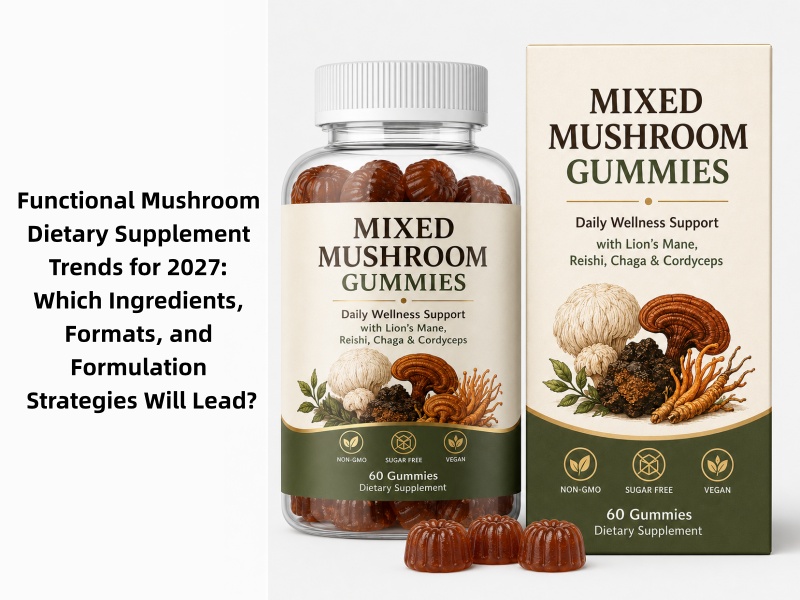
Gummies make functional mushrooms less intimidating to consumers who do not like swallowing capsules. They also give brands more freedom with flavor, shape, color and lifestyle-oriented packaging. Those advantages explain why mushroom gummies have expanded from a novelty into a recognizable product category.
The formulation limits are equally real. A gummy must contain much more than the mushroom active. Gelling agents, sweeteners or sugars, acids, flavors and other components consume part of the piece weight. When the desired daily mushroom amount is relatively high, the number of gummies required can become impractical.
A formula requiring six gummies per day may look attractive during concept development but feel inconvenient in actual use. Higher mushroom loading can also intensify earthy or bitter notes and alter color or texture. A product team therefore needs to determine the target mushroom amount before deciding that gummies are the preferred format.
Moisture and stability add another layer. Gummies behave differently from dry powders and capsules, and packaging needs to account for temperature, water activity and potential texture changes over time. The stability of an isolated raw mushroom ingredient does not automatically establish the shelf life of the finished gummy.
A successful mushroom gummy is therefore a dosage-form engineering project, not merely a capsule formula converted into candy.
Is Mushroom Coffee Becoming Mainstream?
Mushroom coffee benefits from something most dietary supplements spend heavily to create: an existing habit. Millions of people already begin the day with coffee, so a functional mushroom coffee does not necessarily ask them to remember another pill or establish an unfamiliar routine. It modifies something they already do.
That does not make development simple. Coffee has its own sensory identity, and adding mushroom ingredients changes aroma, bitterness, color and mouthfeel. A low mushroom load may be easy to mask but provide little differentiation. A higher load can make the functional story stronger while creating sensory challenges.
The product also needs a clear identity. Some formulas are primarily coffee with an added mushroom extract. Others are functional mushroom drinks containing coffee. Still others combine mushrooms, coffee, creamers, sweeteners and additional nootropic ingredients. Each approach produces a different caffeine level, serving size, cost structure and consumer expectation.
Instant mushroom coffee brings further technical considerations around dispersibility, powder flow and sachet size. Ground-coffee blends create different extraction and brewing questions. Products containing dairy or plant-based creamer systems introduce additional stability and allergen considerations.
By 2027, simply printing “mushroom coffee” on the front of a pouch will provide less differentiation. Taste, mushroom specification, meaningful serving levels and clarity around what the consumer actually drinks will matter more.
How Are Powders and Capsules Changing?
Capsules remain one of the simplest ways to deliver concentrated mushroom ingredients. The consumer does not taste the active, formulation complexity can be relatively low, and packaging is familiar. The main limitation is capacity. When a formula requires several grams of mushroom material or includes many supporting ingredients, the daily capsule count can become uncomfortable.
Powders solve part of that problem by allowing much larger serving weights. A scoop or stick pack can accommodate several grams, making powders particularly suitable for multi-ingredient formulas. The trade-off is that taste, aroma and dispersibility can no longer be hidden.
A highly concentrated extract may reduce the required serving size, but concentration can influence bitterness or other sensory properties. A whole mushroom powder may support a simpler ingredient story while requiring a larger daily mass. The right choice therefore depends on the complete product rather than an assumption that extracts are always superior.
Powders also work well when mushrooms are combined with coffee, cocoa, electrolytes or other drink-compatible ingredients. Capsules remain attractive when a brand wants a concentrated, straightforward supplement without a major sensory-development project.
The relevant question for 2027 is not whether capsules or powders are more fashionable. It is which format can realistically deliver the intended amount while remaining acceptable for repeated daily use.
Do Functional Beverages Create New Opportunities?
Functional beverages may create one of the largest opportunities for mushrooms because they can reach consumers who rarely purchase traditional supplements. Coffee, hydration drinks, cocoa-style beverages and instant functional mixes all provide familiar environments where mushrooms can be introduced without asking consumers to adopt a completely new wellness behavior.
Beverages are also unforgiving. A capsule can hide unpleasant taste, poor solubility and an unattractive ingredient color. A drink makes those properties visible immediately. Sedimentation, foam, bitterness, aftertaste and color change can all affect the perceived quality of the product even when the nutritional formulation looks excellent on paper.
Development should therefore move through a deliberate sequence. The formulation team first defines the desired mushroom serving, then evaluates the raw material in the intended beverage system. Flavor adjustment should happen at the actual target concentration rather than at a diluted laboratory level that will not represent commercial use.
| Format | Main Advantage | Main Limitation | Critical Development Check |
| Capsules | Simple and flavor-free | Limited fill capacity | Total daily capsule count |
| Powder jars | Flexible serving weight | Taste and dispersibility | Test full serving in intended liquid |
| Stick packs | Portable and portioned | Fill weight and powder flow | Confirm pack size after formula is finalized |
| Gummies | Familiar consumer experience | Limited active payload | Validate practical daily piece count |
| Mushroom coffee | Fits an existing habit | Sensory balance | Test coffee profile at target mushroom load |
| Ready-to-drink | Maximum convenience | Stability and processing complexity | Validate shelf-life in final packaging |
Functional beverages will reward brands that treat sensory development as part of efficacy and repeat purchase rather than as decoration added after the formula is finished.
How Will Mushroom Formulation Quality Change?
Mushroom quality will receive greater attention in 2027 as consumers and commercial product teams learn that species name alone is not enough. Fruiting body, mycelium, residual substrate, powder, extract, beta-glucan content, identity testing, contaminants and batch traceability can substantially change the characteristics of ingredients sold under the same familiar mushroom name.
Do Fruiting Body and Mycelium Choices Matter?
Fruiting body and mycelium are biologically different parts or stages of a fungus, and the distinction matters when comparing commercial ingredients. The fruiting body is the reproductive structure people normally identify as the mushroom. Mycelium is the vegetative network of fungal hyphae that grows through a substrate.
The discussion often becomes unnecessarily simplistic, with fruiting body described as automatically superior and mycelium dismissed entirely. Actual ingredient evaluation needs more detail. Composition can vary by species, fungal stage, cultivation method, substrate and processing. A well-characterized material should be judged according to what it actually contains and how consistently it is produced.
Mycelium grown on grain creates an additional consideration because the final ingredient can contain residual growth substrate. This changes the carbohydrate profile and may affect interpretation of broad polysaccharide measurements. A specification should therefore state clearly whether the material is fruiting body, mycelium, myceliated substrate or a combination.
Commercial sourcing becomes easier when the questions are precise:
- Which scientific species is supplied?
- Which fungal material is used?
- Is growth substrate present in the final ingredient?
- Is the ingredient whole powder or extract?
- Which analytical markers are controlled?
- How is identity verified from batch to batch?
Those questions tell a product team far more than descriptions such as “premium mushroom extract” or “high-potency mushroom powder.”
Which Extract Specifications Matter?
Extract ratio attracts attention because numbers such as 5:1, 8:1 or 10:1 appear easy to compare. In reality, the ratio alone cannot establish product quality. A 10:1 extract does not automatically provide twice the useful value of a 5:1 extract, and neither number explains which compounds were extracted or how the finished material was standardized.
A useful specification can include starting material, extraction method, solvent system where applicable, extract ratio, beta-glucan content, moisture, microbiological limits and relevant contaminant testing. For certain ingredients, additional species-specific markers may be useful when suitable analytical methods exist.
Beta-glucans have become an important part of mushroom quality discussions because they provide a more meaningful measurement than vague “total polysaccharides” in many situations. Analytical methods for mushroom materials typically attempt to distinguish beta-glucans from alpha-glucans and starch rather than grouping all carbohydrates together.
The analytical matrix still matters. Ingredients used in gummies or complex drink powders may contain resistant starches, sweeteners or other carbohydrates that complicate interpretation. Results should therefore be read together with the method used rather than treated as an absolute number without context.
For 2027 sourcing, a good specification sheet will become more valuable than a dramatic extract ratio printed in large type on marketing material.
How Important Are Beta-Glucan Testing and COAs?
A Certificate of Analysis is useful only when it reports specifications that actually matter. Collecting a COA without understanding what was tested can give a false sense of quality assurance. For mushroom ingredients, a meaningful document may include identity, moisture, microbiological limits, heavy metals and relevant compositional markers such as beta-glucans.
Additional testing may be appropriate depending on origin, cultivation, processing and target market. Pesticides, solvent residues, mycotoxins or other contaminants can become relevant in particular supply chains. The testing plan should be based on risk rather than copying the same panel onto every raw material.
Beta-glucan analysis deserves careful interpretation because a broad “polysaccharide” result can include starch and other carbohydrates. Methods that separate total glucans and alpha-glucans can provide a more useful estimate of beta-glucans in mushroom and mycelial materials.
Finished-product quality should also extend beyond the raw material. Production records, in-process controls, finished-product specifications, batch documentation and traceability become especially important when a formula combines several mushroom ingredients from different suppliers.
For established supplement programs, the quality chain should connect the raw-material specification with incoming verification, manufacturing records and finished-product testing. That connection becomes particularly valuable when a complaint, unexpected laboratory result or supplier change has to be investigated months after production.
Are Clean-Label and Organic Positions Growing?
Clean-label and organic positioning fit naturally with the image of functional mushrooms, but neither should replace technical product quality. “Clean” does not have one universal regulatory or scientific definition. One brand may use the term to mean no artificial colors, while another may emphasize fewer excipients, recognizable ingredients or minimal processing.
Organic certification can strengthen a sourcing story where applicable, but it does not automatically establish extract potency, beta-glucan content or manufacturing consistency. An organic mushroom ingredient can still require careful identity verification and analytical testing.
Transparency is therefore more useful than vague purity language. A clearly characterized capsule containing one or two mushroom extracts may provide a stronger quality story than a complex beverage with a long list of fashionable ingredients and little information about how any of them are specified.
| Specification Area | Information to Request | Commercial Value |
| Identity | Common and scientific species name | Reduces species ambiguity |
| Fungal material | Fruiting body, mycelium or combination | Clarifies ingredient composition |
| Substrate | Presence and type where relevant | Helps interpret carbohydrate profile |
| Ingredient form | Whole powder or extract | Influences serving and positioning |
| Extraction | Method and ratio where meaningful | Improves supplier comparison |
| Beta-glucans | Test method and result | More informative than vague polysaccharides |
| Microbiology | Defined acceptance limits | Supports product safety |
| Heavy metals | Relevant elements and limits | Supports raw-material qualification |
| Lot traceability | Batch identification | Enables investigation and recall control |
| COA verification | Defined testing or verification plan | Strengthens ongoing supplier control |
By 2027, consumers may not understand every laboratory term, but professional sourcing teams increasingly will. Brands that build transparent specifications early will be better positioned when retailers, distributors and larger commercial partners request more detailed documentation later.
What Should Supplement Brands Prioritize for 2027?
Brands planning mushroom supplements for 2027 should begin with product-market fit rather than the longest ingredient list. Define the consumer, use occasion and desired experience first. Then select the mushroom material, serving size, dosage form, complementary ingredients and packaging. Evidence, cost, taste, manufacturing feasibility and compliant claims should be evaluated together instead of being solved independently at the end.
Which Mushroom Fits Each Product Position?
A strong mushroom product often begins before a mushroom has been selected. The first question is who will use the finished product and at what moment. A morning focus product for office workers has different requirements from an active-lifestyle powder or an evening wellness capsule.
Once the occasion is clear, species selection becomes easier. Lion’s Mane naturally fits cognitive-wellness concepts because consumer recognition and human research point in that direction, even though the evidence remains incomplete. Cordyceps has a clearer place in active-lifestyle products. Reishi can support an evening or broader wellness concept. Turkey Tail, Chaga and Maitake may strengthen immune or daily mushroom formulas when they serve a defined role.
Multi-mushroom products should apply the same test to every ingredient. If removing one mushroom would make no meaningful difference to the concept, the development team should consider whether it belongs in the formula at all.
A useful sequence is:
Need state → target consumer → use occasion → mushroom selection → raw-material specification → daily serving → complementary ingredients → dosage form → flavor → packaging → claims
This sequence also reduces expensive reformulation. When format and packaging are selected before the target serving is understood, product teams can discover late in development that the formula does not fit the chosen capsule size, gummy count or stick-pack dimensions.
How Should Brands Choose Dosage Form?
Dosage form should be selected by working backward from the formula. Determine how much mushroom material the consumer needs to take each day and add the intended complementary ingredients. Only then decide whether the serving fits comfortably into capsules, gummies, powder, coffee or another format.
Several grams of combined whole mushroom powders may require an inconvenient number of capsules. Moving the same formula into gummies does not automatically solve the problem because gummies have limited active capacity and must accommodate the entire confectionery matrix. A powder may handle the serving easily while creating much greater flavor-development work.
The daily routine also matters. A cognitive product intended for the office may fit capsules or a portable stick pack. A mushroom coffee belongs naturally in a morning beverage system. An evening product may favor capsules or another format that does not introduce caffeine or a large volume of fluid immediately before bed.
Packaging should follow the final product rather than being treated as decoration. Hygroscopic powders need moisture protection. Aromatic coffee products need packaging that protects sensory quality. Gummies require attention to temperature and moisture behavior.
Choosing a trendy format before understanding the formula can create a product that looks excellent in a rendering but performs poorly when consumers actually use it.
How Can Formulas Balance Evidence and Cost?
Evidence and commercial economics have to meet in the same serving. An expensive standardized extract may have strong documentation but make the target retail price unrealistic at the desired amount. Reducing the serving solely to protect margin may create a formula that appears scientifically sophisticated while having little relationship to the research referenced in marketing.
Product teams should therefore calculate ingredient cost per daily serving rather than focusing only on price per kilogram. That serving must then fit within the required package count, channel margin and expected retail price. Testing, packaging, flavor systems and manufacturing costs also need to be included before deciding whether the formula is commercially viable.
Research should be matched to the actual raw material rather than the common ingredient name. A study using 1.8 grams of a particular Lion’s Mane preparation does not mean every Lion’s Mane extract requires exactly 1.8 grams. Cordyceps studies using one gram of standardized extract, three grams of Cs-4 or several grams of a mushroom blend likewise cannot be treated as interchangeable dosing instructions.
Claims should be reviewed alongside the formula. A product can be commercially compelling without making disease claims or presenting early scientific signals as established clinical outcomes. In mature markets, restraint often increases long-term credibility.
What Should Brands Verify in a Manufacturer?
Functional mushroom manufacturing requires more than the ability to purchase a mushroom ingredient and put it into capsules. The development partner should be able to discuss raw-material identity, extraction specifications, dosage-form feasibility, sensory performance, quality controls, packaging and scale-up.
Raw-material qualification should come first. Brands should understand how suppliers are evaluated, what documentation accompanies incoming materials and which specifications are verified. If the product relies heavily on a beta-glucan claim or a particular fungal material, those attributes should be defined before commercial production begins.
Manufacturing controls become increasingly important when the project moves from laboratory sample to large-scale production. A formula that works in a small bench batch may behave differently when mixing time, equipment capacity and production environment change. Finished-product specifications should therefore be connected with the actual manufacturing process.
A practical supplier review can cover:
- Raw-material supplier qualification
- Scientific species identification
- Fruiting body or mycelium disclosure
- Extract and beta-glucan specifications
- Incoming material testing or verification
- Formula-development records
- Pilot and scale-up capability
- Finished-product specifications
- Batch manufacturing records
- Packaging compatibility
- Stability planning where appropriate
- COA and traceability documentation
- Change-control procedures
- Capacity for repeat orders and multi-SKU programs
The final point is especially important for established brands. A successful launch can become a supply-chain problem if the mushroom source, extract specification or manufacturing process changes during subsequent orders. The right manufacturing partner should therefore be evaluated not only on whether the first batch can be produced, but on whether the formula can remain consistent when the product becomes commercially successful.
Functional mushrooms are unlikely to disappear when the current wave of wellness attention moves to the next fashionable ingredient. The category has already spread too far across capsules, coffee, powders, gummies and functional beverages to be treated as a short-lived curiosity. What is changing is the standard against which products are judged.
In the earlier phase of a trend, simply containing Lion’s Mane, Reishi or Cordyceps could attract meaningful interest. By 2027, consumers and commercial partners will have seen enough similar products to ask better questions. They will want to know what material is used, how much is delivered, whether the product tastes good, how the formula fits into a daily routine and whether the claims make sense.
For supplement brands, that is a positive development. It shifts competition away from who can add the largest number of mushroom names to a front label and toward who can develop a better product. Clear purpose, well-defined ingredients, realistic serving sizes, responsible claims, effective quality control and repeatable manufacturing will matter more than trend language. The strongest functional mushroom products of 2027 may not look the most complicated. They will simply give consumers fewer reasons to stop using them after the first bottle.
Frequently Asked Questions
What are the biggest functional mushroom supplement trends for 2027?
The major trends are likely to include continued growth of Lion’s Mane for cognitive wellness, greater use of Cordyceps in active-lifestyle formulas, Reishi in evening-oriented products, more carefully designed multi-mushroom blends, and wider adoption of gummies, stick packs, mushroom coffee and functional beverages. Ingredient transparency will also become more important, particularly around fruiting body versus mycelium, extraction methods, beta-glucan testing, realistic daily servings and batch-level quality documentation.
Which functional mushroom is likely to be most popular in 2027?
Lion’s Mane is positioned to remain one of the most visible mushrooms because consumers increasingly associate it with focus, mental clarity and cognitive wellness. Its ability to work across capsules, powders, coffee and drink mixes gives it unusually broad commercial flexibility. Reishi and Cordyceps should also remain important, but their strongest opportunities are likely to come from more defined evening-wellness and active-lifestyle applications rather than trying to compete directly with Lion’s Mane in the same cognitive space.
Are fruiting body mushroom supplements better than mycelium supplements?
Neither material should automatically be judged as universally better. Fruiting body and mycelium are biologically different fungal materials and can contain different chemical profiles depending on species, cultivation and processing. The more useful question is whether the ingredient is clearly identified and analytically characterized. Brands should ask whether residual substrate is present, whether the material is a whole powder or extract, which compounds are measured and how consistently the specification can be reproduced between production lots.
What is a good beta-glucan level in a mushroom supplement?
There is no universal beta-glucan percentage that automatically defines a high-quality mushroom supplement because species, fungal material, extraction and intended product format differ. The test method also matters. A meaningful specification should report beta-glucans using an appropriate analytical method rather than relying only on broad “polysaccharide” values that may include starch or other carbohydrates. Brands should compare ingredients using the complete specification, raw-material identity and intended serving rather than selecting suppliers based solely on the highest percentage shown on a sales sheet.
Are mushroom gummies as effective as mushroom capsules?
A gummy can be a suitable delivery format when it contains the intended amount of a well-defined mushroom ingredient and remains stable through its shelf life. The main limitation is active capacity. Gummies must also contain the components needed to create their texture and flavor, leaving less room for mushroom material than many capsule or powder formats. If the desired daily mushroom amount requires an impractical number of gummies, capsules or drink powders may provide a more efficient delivery system.
Is mushroom coffee expected to keep growing in 2027?
Mushroom coffee is likely to remain an important format because it fits into an existing morning habit instead of requiring consumers to remember another supplement. Future competition will probably move beyond simply adding Lion’s Mane or Reishi to coffee. Flavor quality, caffeine level, meaningful mushroom servings, extract specifications, solubility and complementary ingredients will become more important as the category becomes crowded. Products that taste like something consumers genuinely want to drink every morning should have a stronger chance of repeat use.
What should brands look for in a functional mushroom supplement manufacturer?
Brands should evaluate raw-material sourcing, species identification, fruiting body or mycelium disclosure, extract specifications, beta-glucan testing, incoming quality controls, formulation capability, pilot production, finished-product testing, batch documentation, traceability and scale-up capacity. The manufacturer should also understand the chosen dosage form because capsules, gummies, powders and mushroom beverages create very different technical challenges. For growing brands, the ability to maintain the same ingredient specification and finished-product quality across repeat orders is just as important as producing the first batch successfully.