Skip to content
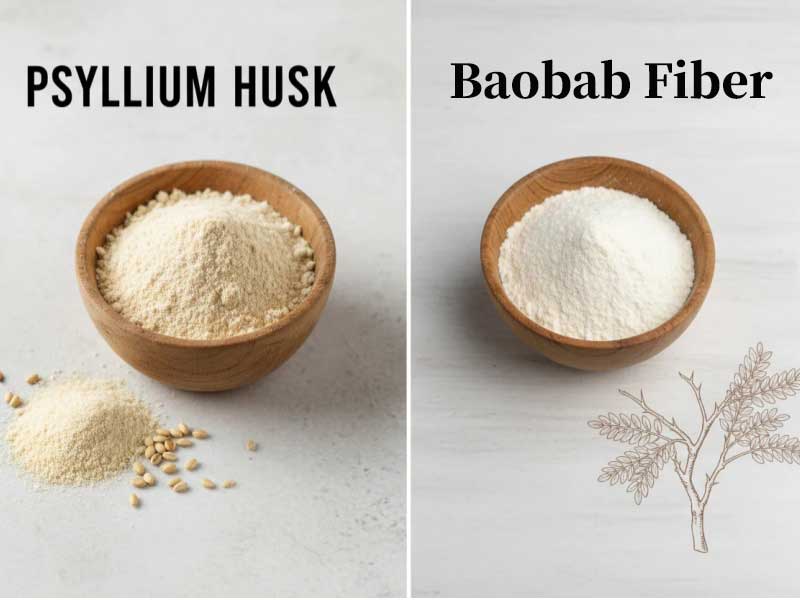
Fiber products often look straightforward on the label, but they become more complicated once formulation, evidence, and real consumer use enter the picture. Baobab fruit powder and psyllium husk can both increase dietary fiber in a finished product, yet they do not behave the same in water, in the digestive tract, or on a production line. One is a fruit-derived powder with pectic fiber, natural acids, sugars, and polyphenols; the other is a highly viscous seed-husk fiber known for strong hydration and gel formation. Treating them as interchangeable can create the wrong texture, the wrong claim strategy, or a serving format people will not use consistently.
Baobab and psyllium are not universal substitutes. Psyllium is usually stronger when a product depends on viscous, gel-forming fiber, regularity-focused positioning, and mature human evidence. Baobab is more attractive when the goal is a fruit-derived ingredient, pectin-rich fiber, a naturally tart flavor, and differentiated gut-health or microbiome positioning. The better choice depends on intended benefit, evidence standard, serving size, dosage form, sensory target, and manufacturing behavior.
The practical difference becomes obvious during development. A beverage can look ideal during a quick bench test and become unpleasantly thick two or three minutes later once psyllium hydrates. A baobab concept can sound highly differentiated until the team realizes that the finished label relies on microbiome language that exceeds the human evidence. The useful question is not simply which fiber is “better,” but which fiber performs the right job for the exact product you are trying to build, and whether that performance still makes sense after flavoring, filling, packaging, labeling, and repeat use are considered together.
What Is the Difference Between Baobab and Psyllium?
Baobab fruit powder and psyllium husk can both contribute dietary fiber, but they are fundamentally different ingredients. Baobab is a complex fruit-derived powder containing pectic fiber, insoluble fiber, naturally occurring sugars, organic acids, minerals, and polyphenols. Psyllium is a concentrated seed-husk fiber valued mainly for high water uptake, viscosity, and gel formation. Their composition, digestive behavior, sensory impact, and ideal applications therefore differ substantially.
Ingredient Identity
Commercial “baobab fiber” usually refers to the fiber naturally present in dried baobab fruit pulp rather than to a purified isolated fiber in the same sense as inulin, resistant dextrin, or a standardized hydrocolloid. That distinction matters because the purchased raw material is a whole-food-derived powder with several nutritional and physical components. Published research illustrates the complexity. In one baobab fruit pulp powder used for an in-vitro microbiome study, researchers reported 42.5% pectic polysaccharides and 13% insoluble fiber on a dry-mass basis, alongside starch, protein, and about 30% glucose, fructose, and sucrose. Those figures describe that tested material, not every commercial baobab grade, which is why the supplier specification and actual analytical results must drive label calculations.
Psyllium husk comes from the seed coat of Plantago ovata and is much closer to what formulators think of as a dedicated functional fiber ingredient. Reviews commonly describe psyllium husk as exceptionally fiber-rich, with some grades reported above 90% total fiber depending on processing and analytical method. Its mucilage contains complex arabinoxylan-rich polysaccharides that swell strongly in water and form a viscous gel. This physical behavior is not a side effect; it is one of the main reasons psyllium is selected. A formulator choosing psyllium is usually buying concentrated fiber plus a very specific hydration function, whereas a formulator choosing baobab is buying fiber as part of a broader fruit matrix.
The difference also affects quality control. With baobab, origin, maturity, drying, milling, moisture, color, acidity, sugar content, and particle-size distribution can influence the finished product. With psyllium, grade, purity, particle size, swelling capacity, microbial quality, moisture, and hydration rate can be particularly important. Neither raw material should be approved solely because the ingredient name on a supplier brochure looks familiar. For commercial development, the actual specification, certificate of analysis, microbiological limits, and relevant contaminant testing matter more than generalized nutrition numbers found online.
Fiber Structure and Function
The traditional soluble-versus-insoluble classification is useful, but it does not fully explain how these two fibers behave. Function is shaped by viscosity, gel formation, fermentability, water-holding capacity, molecular structure, particle size, and dose. Psyllium is notable because it forms a strong hydrated gel and is relatively resistant to fermentation compared with many rapidly fermentable soluble fibers. That helps it retain water as it moves through the gastrointestinal tract, a feature that is central to its effects on stool consistency and to some of the metabolic outcomes observed in clinical research.
Baobab contains a substantial pectic fraction, but its behavior is different. Pectins can be fermented by intestinal microorganisms, while the insoluble fraction contributes suspended plant material and bulk. In a beverage, baobab therefore tends to behave more like a whole-fruit fiber ingredient than like a concentrated psyllium gel. It may add cloudiness, fine sediment, and natural tartness without producing the same rapid viscosity increase. That can be an advantage in daily wellness powders, fruit drinks, greens blends, or smoothie products where a lighter texture and recognizable fruit identity are more important than a strong gel-forming effect.
| Practical Variable | Baobab Fruit Powder | Psyllium Husk |
| Ingredient form | Whole fruit-pulp-derived powder | Seed-husk functional fiber |
| Published fiber composition | Highly variable by source and method; one study reported 42.5% pectic polysaccharides plus 13% insoluble fiber | Often very high total fiber; some commercial and research grades exceed 90% |
| Main functional behavior | Fermentable pectic fractions plus insoluble plant solids | Strong hydration, viscosity, and gel formation |
| Fermentation relevance | Important to current microbiome research | Relatively limited compared with many prebiotic fibers |
| Sensory effect | Tart, fruity, acidic, potentially cloudy | Mild flavor, stronger texture and mouth-coating effect |
| Key development risk | Raw-material variability, sediment, acidity, grittiness | Clumping, rapid thickening, gumminess, short drinking window |
| Best-fit positioning | Fruit-derived fiber, daily gut wellness, differentiated microbiome concepts | Regularity, viscous soluble fiber, high-fiber functional products |
Are They Direct Substitutes?
In most formulations, baobab and psyllium should not be treated as one-for-one substitutes. Replacing 5 grams of psyllium with 5 grams of baobab can change the amount of declared dietary fiber, total carbohydrate, sugar contribution, acidity, bulk density, viscosity, and the mechanism that supports the product story. The reverse substitution creates its own problems: a light baobab drink may become dramatically thicker if a meaningful psyllium dose is introduced, while the original fruit character and whole-food positioning can be reduced or lost. Matching ingredient weight is therefore not the same as matching nutritional or technical function.
A better substitution question is to identify the job the ingredient must perform. Psyllium may be selected to provide concentrated fiber, water-holding capacity, stool-normalizing functionality, and a strong evidence base for a regularity-focused concept. Baobab may be selected to provide fruit-derived fiber, pectic fermentable material, natural acidity, and a differentiated story for a broader gut-health routine. When those roles are defined first, the decision becomes much more practical. In some products, the answer will be one ingredient. In others, a carefully tested blend can make sense because the two fibers contribute different properties rather than attempting to imitate each other.
How Do They Work in the Gut?
Psyllium works mainly through physical water retention and gel formation, while baobab is more interesting for its combination of pectic fiber, insoluble plant material, and fermentable substrates. Psyllium can remain structurally functional through the colon because it is relatively resistant to fermentation. Portions of baobab fiber can be metabolized by gut microorganisms, which changes the discussion around regularity, short-chain fatty acids, gas, and microbiome positioning.
Psyllium and Regularity

Psyllium is often discussed as a bulk-forming fiber, but that phrase understates its mechanism. When enough water is available, psyllium mucilage hydrates and creates a viscous gel that can retain water through the digestive tract. Because it is comparatively resistant to fermentation, a meaningful portion of that gel can continue to influence stool water and consistency in the large intestine instead of disappearing rapidly through microbial breakdown. This is one reason psyllium behaves differently from fibers that are highly fermentable but have little persistent gel structure.
The clinical literature reflects that practical role. The 2023 joint American Gastroenterological Association and American College of Gastroenterology guidance on chronic idiopathic constipation included fiber supplementation and specifically identified psyllium among the fiber options with supportive evidence. The recommendation was conditional because the certainty of evidence was low or very low rather than definitive. That nuance matters for supplement brands: psyllium has an established clinical history, but it should not be presented as a guaranteed solution for every person or every digestive complaint.
For product development, hydration instructions are part of the formulation rather than an afterthought. A psyllium powder should be evaluated using the exact serving size, water volume, mixing method, and consumption time expected in real life. A formula may be drinkable immediately after shaking and noticeably thicker two minutes later, then much more difficult to consume after five minutes. Testing at several time points can reveal whether the product provides a pleasant, predictable experience or whether its viscosity rises too quickly for the intended format. Consumer adherence often depends on this practical behavior more than on the theoretical fiber number printed on the label.
Baobab and the Microbiome
Baobab attracts attention in gut-health development because its fruit pulp contains substantial pectic polysaccharides that can be fermented by intestinal microorganisms. In a 48-hour in-vitro fermentation study, the tested baobab fruit pulp powder contained 42.5% pectic polysaccharides and 13% insoluble fiber. Researchers reported increases in several short-chain fatty acids during fermentation, including approximately 18.4 mM acetate, 5.5 mM propionate, and 0.9 mM butyrate relative to baseline conditions. The study also observed donor-dependent changes in microbial groups, showing both the potential and the variability of microbiome responses.
Those numbers are useful for understanding mechanism, but they should not be translated directly into consumer promises. The study was conducted in laboratory fermentation systems using fecal microbiota, not as a controlled human intervention in which people consumed a finished baobab supplement. This is an important distinction for brands that want to use terms such as “microbiome support” or “prebiotic.” In-vitro evidence can show that an ingredient is fermentable and can influence microbial metabolism, but it does not by itself prove a specific health benefit in the target population.
The 2017 International Scientific Association for Probiotics and Prebiotics consensus defined a prebiotic as a substrate selectively utilized by host microorganisms that confers a health benefit. Under that definition, microbial utilization alone is not enough; the health benefit must also be demonstrated in the target host. Baobab therefore has an interesting scientific basis for prebiotic-oriented development, but product teams should distinguish “pectin-rich fermentable fiber with emerging microbiome research” from stronger statements that imply established human prebiotic efficacy. That difference makes the communication more accurate and usually more credible.
Fermentation and Tolerance
Tolerance is more complicated than labeling one fiber “gentle” and the other “bloating.” Fermentation can be beneficial because bacterial metabolism of dietary fibers can generate short-chain fatty acids, but fermentation can also produce gas. The amount of gas and discomfort varies with dose, individual microbiota, adaptation, baseline diet, transit time, and the other ingredients consumed at the same time. A fermentable fiber that is well tolerated at 2 grams may feel very different at 8 grams, particularly when combined with other rapidly fermentable carbohydrates.
Psyllium is relatively resistant to fermentation, so its main function does not depend on rapid microbial metabolism. That means it can provide a strong fiber effect without the same fermentation profile as inulin or certain oligosaccharides. Baobab contains fermentable pectic fractions, so tolerance should be assessed at the actual finished-product serving. The need becomes more important when the formula also contains inulin, FOS, GOS, resistant dextrin, probiotics, sugar alcohols, magnesium salts, or botanical ingredients that can influence digestive comfort.
A mature formulation team evaluates tolerance as a property of the whole formula, not as a reputation attached to one raw material. If a product combines multiple fibers, the total fermentable load, serving frequency, sweetness system, and suggested use all need to be considered together. For daily-use products, it can be more commercially valuable to deliver a moderate amount that consumers tolerate consistently than to maximize the number of “gut health” ingredients on the label. Long-term repeat use depends on how the product feels in ordinary life, not only on how impressive the ingredient list looks in a marketing meeting.
Which Has Stronger Scientific Evidence?
Psyllium has the stronger and more mature human evidence base. It has been evaluated in randomized controlled trials, systematic reviews, meta-analyses, and gastrointestinal guidelines. Baobab has promising human studies and microbiome research, but the evidence is smaller, more heterogeneous, and often acute or exploratory. Baobab remains scientifically interesting, yet the two ingredients should not be presented as having equivalent levels of clinical validation.
Psyllium Evidence
Psyllium has decades of research across digestive and metabolic outcomes, giving formulation and regulatory teams a much larger evidence base to review. One 2018 systematic review and meta-analysis included 28 randomized controlled trials with 1,924 participants. The median psyllium dose was about 10.2 grams per day. Compared with control, psyllium reduced LDL cholesterol by an average of 0.33 mmol/L, non-HDL cholesterol by 0.39 mmol/L, and apolipoprotein B by 0.05 g/L. The investigators graded evidence for some lipid outcomes as moderate or high, although individual trials still differed in design, population, dose, duration, and background diet.
Digestive research is also extensive, though not perfectly uniform. Trials have used a range of doses and different constipation definitions, stool outcomes, and treatment durations. The resulting guidelines therefore describe psyllium as a supported option rather than as a guaranteed treatment. That is a useful model for commercial communication. A credible brand does not need to exaggerate an ingredient that already has substantial evidence; it can explain the strength of the literature while still acknowledging that outcomes depend on dose, hydration, individual response, and the finished product.
The depth of evidence can also be commercially important beyond consumer marketing. Established retailers, pharmacies, professional-health brands, and larger supplement companies often look at the maturity of human evidence when deciding how aggressively to position an ingredient. Psyllium offers a larger body of randomized studies, systematic reviews, and clinical guidance than most newer fiber ingredients. This does not make it the right choice for every product, but it does make evidence review easier when the development brief prioritizes a well-established mechanism and a long clinical history.
Baobab Evidence
Baobab has human research, but the scale is much smaller. In one single-blind crossover study, 20 healthy adults consumed either a smoothie containing 15 grams of baobab extract or a control smoothie. Subjective hunger ratings were lower after the baobab drink, but calorie intake at the subsequent meal was not significantly different. The study is useful because it provides human data, yet it was an acute experiment in a small healthy population rather than a long-term trial designed to establish a durable clinical outcome.
Another human study evaluated baobab fruit extract at 18.5 grams and 37 grams in 250 mL of water consumed with white bread. Both doses reduced postprandial glycemic response under the study conditions. That finding is scientifically interesting, but the experiment again represents a specific acute meal context. It does not establish that every baobab powder, at every dose, will produce the same response in everyday use, nor does it justify broad disease-oriented marketing claims. Raw-material composition can differ, and finished formulations can contain many other ingredients that influence the consumer experience and the product’s nutritional profile.
The microbiome research adds another layer but is still emerging. Laboratory fermentation studies provide a plausible mechanism for the pectic fraction of baobab to influence microbial metabolism and short-chain fatty acid production. Human intervention evidence focused specifically on microbiome outcomes remains much thinner than the psyllium literature on regularity and metabolic markers. The commercially useful conclusion is therefore not that baobab lacks value; it is that baobab’s differentiation currently rests more on its whole-fruit identity, composition, sensory profile, and developing microbiome science than on a large portfolio of long-term clinical trials.
| Evidence Indicator | Psyllium | Baobab |
| Decades of human research | Yes | Limited compared with psyllium |
| Randomized human studies | Numerous across multiple outcomes | Several smaller or acute studies |
| Meta-analyses | Multiple | Not yet comparable in scale |
| Constipation guideline recognition | Yes; psyllium is included in conditional fiber recommendations | No comparable guideline position |
| Human lipid evidence | Substantial | Limited |
| Human glycemic research | Substantial | Promising but relatively small |
| In-vitro microbiome research | Available, but not its main positioning | Important emerging research area |
| Overall evidence maturity | High relative to most supplemental fibers | Developing |
Evidence and Claims
Scientific evidence and marketable claims are related, but they are not the same thing. Clinical papers may investigate constipation, cholesterol, glycemic response, insulin resistance, or other disease-related endpoints because researchers need measurable outcomes. A finished dietary supplement cannot automatically copy those endpoints into advertising language. Claim rules depend on the target country, product category, ingredient dose, finished formula, label context, and the type of evidence available. A study on psyllium and LDL cholesterol or a baobab study on acute glycemic response should therefore inform development without becoming an unrestricted claims library.
Support-oriented language is usually more defensible for general supplement content. Phrases such as “supports digestive regularity,” “helps support daily fiber intake,” “provides dietary fiber,” “formulated for digestive wellness,” or “contains fruit-derived fiber from baobab” describe the role of the product without presenting it as a drug. Disease-treatment statements, guaranteed outcomes, or broad “clinically proven” language should be avoided unless the exact claim has an appropriate legal and evidentiary basis in the target market.
This claim discipline also matters for search visibility and AI citation. Search engines and generative systems can compare a page’s assertions with authoritative sources. Pages that distinguish between human trials, in-vitro findings, guideline recommendations, and commercial interpretation are easier to trust than pages that flatten every study into a promotional promise. For brands, that approach reduces regulatory risk and creates better educational content at the same time. It also prevents expensive late-stage revisions when a formula has already been approved but the packaging language cannot be supported.
How Do They Compare in Formulation?
Psyllium usually creates the greater viscosity and hydration challenge, while baobab creates more questions around natural acidity, suspended solids, fruit flavor, and raw-material variability. Psyllium can thicken rapidly after mixing; baobab usually remains more beverage-like but may not fully dissolve. For both ingredients, commercial performance depends on dose, particle size, water ratio, mixing method, flavor system, packaging, and realistic consumer-use testing.
Viscosity and Hydration
Psyllium’s strongest functional property is also its biggest formulation challenge. Recent technical reviews show that psyllium can produce dramatically higher viscosity than many other fiber materials. In one comparative condition, a system containing 2 grams of psyllium per 100 grams of water reached roughly 48.4 Pa·s, while reported values for oat bran, wheat bran, and rice bran were far lower. These values are method-specific rather than universal product specifications, but they illustrate how quickly psyllium can dominate the physical character of a liquid system.
The finished viscosity depends on more than the number of grams added. Particle size, psyllium grade, water temperature, water volume, mixing energy, sequence of addition, standing time, sweeteners, acids, minerals, proteins, gums, and other fibers can all change the hydration pattern. A laboratory sample mixed at high speed for 30 seconds is not equivalent to a consumer stirring a stick pack into a glass with a spoon. If the commercial instructions say to mix one serving into 300 mL of room-temperature water, development should test 300 mL of room-temperature water using realistic household mixing methods.
Time-dependent testing is especially valuable. Recording dispersion and viscosity immediately after mixing, then again at two, five, and ten minutes can show whether a formula remains drinkable across the likely consumption window. The goal is not always to eliminate thickness. Some consumers expect a substantial psyllium drink. The goal is to make the texture predictable and appropriate to the promise on the front of the pack. A refreshing “daily hydration” concept and a dense “fiber gel” concept can both be valid products, but they should not accidentally become the same thing after two minutes in a glass.
Dispersion and Sensory Quality
Baobab generally gives formulators more freedom to create a lighter beverage, but it should not be described as perfectly soluble simply because it does not behave like psyllium. Whole baobab fruit pulp contains insoluble plant material, so the finished drink may be cloudy, slightly powdery, or show fine sediment depending on the grade and particle size. That can work well in smoothie powders, greens blends, or fruit-based wellness drinks where visual naturalness is acceptable. It is less suitable for a product that promises a crystal-clear beverage unless additional formulation steps or a different ingredient format are used.
The natural tartness of baobab can be a genuine sensory advantage. Citrus, berry, tropical fruit, ginger, pineapple, mango, passion fruit, and lightly sweetened botanical profiles can complement its acidity. In those systems, the ingredient contributes to the flavor story instead of behaving like a neutral functional additive that must be hidden. The same tartness can become a problem in creamy, vanilla, or very low-acid concepts, where excessive sourness may require more sweetener or flavor masking and can move the product away from its original nutritional target.
Psyllium has a milder intrinsic flavor, so mouthfeel becomes more important than taste. A useful sensory panel should separate aroma, sweetness, acidity, bitterness, thickness, grittiness, mouth coating, aftertaste, and drinkability after several minutes. Asking only whether the product “tastes good” misses the feature most likely to affect daily use. Consumers may accept a tart baobab drink because it matches a fruit-based concept, and they may accept a thick psyllium drink when the product clearly explains its fiber function. Problems appear when the experience contradicts what the packaging led them to expect.
Scale-Up and Quality Control

Fiber formulations often appear easy in small laboratory quantities because the ingredient itself may represent a large percentage of the blend. Scale-up introduces a different set of variables. Particle size affects dusting, flow, dispersion, and blend segregation. Bulk density affects jar size, stick-pack dimensions, filling speed, and freight efficiency. Moisture can influence caking and free flow. A high-dose fiber may also need to be blended uniformly with much smaller quantities of flavors, sweeteners, vitamins, minerals, botanical extracts, probiotics, or processing aids without allowing those low-dose ingredients to separate.
A practical pilot program therefore looks beyond whether the formula can be mixed. Common checkpoints include raw-material identity and specifications, moisture, microbiological limits, heavy metals where appropriate, particle size, bulk density, blend uniformity, fill weight, dispersion, viscosity, sedimentation, sensory quality, packaging compatibility, and early stability observations. Psyllium deserves particular attention to hydration rate and time-dependent viscosity, while baobab deserves attention to color, acidity, natural sugar contribution, sediment, and batch-to-batch sensory consistency.
This is also the point where an experienced product-development manufacturer can save substantial time. Brands considering baobab, psyllium, or a blended fiber system can use the sampling stage to compare ingredient grades, water ratios, flavor systems, serving weights, packaging formats, and target-market requirements before committing to scale. Zoxizo’s development model is built around formula feasibility, sensory adjustment, dosage-form matching, sample iteration, testing, packaging, and production planning, so brands with a defined concept can discuss the complete product rather than sourcing one ingredient in isolation.
Which Fiber Fits Different Products?
Psyllium fits products where concentrated fiber, viscosity, and regularity are central to the concept. Baobab fits fruit-forward powders, whole-food wellness formulas, and differentiated gut-health products where flavor and pectic fiber matter. Powders and stick packs generally give the most room for multi-gram fiber servings. Capsules and gummies can use fiber ingredients, but meaningful high-fiber positioning becomes harder because physical serving size and processing limits quickly become important.
Regularity vs Microbiome Products
A regularity product and a microbiome product may sit next to each other on the same digestive-health shelf, but their formulation logic can be completely different. When the primary consumer expectation is regular bowel function, psyllium has a clear scientific and functional advantage because of its gel formation, water retention, clinical history, and inclusion in gastrointestinal guidance. A regularity concept can therefore be designed around a relatively simple story: concentrated functional fiber, clear hydration instructions, an appropriate serving size, and a texture that remains acceptable through the intended consumption window.
A microbiome-oriented formula may be trying to do something different. Instead of relying primarily on persistent gel structure, the formula may intentionally provide substrates that can be utilized by intestinal microorganisms. Baobab becomes more interesting in that setting because of its pectic polysaccharides and emerging fermentation research. It may also fit naturally with better-established prebiotic ingredients such as inulin, FOS, GOS, resistant dextrin, or resistant starch, depending on the target market and the finished-product concept.
More ingredients, however, do not automatically create a better gut-health product. A formula that combines baobab, inulin, resistant starch, probiotics, magnesium, and sugar alcohols may look impressive but can create an unnecessarily high digestive load. The better question is what each component contributes that the other ingredients do not. If two fibers perform essentially the same role, removing one may improve cost, serving size, taste, and label simplicity without reducing the real value of the product. Good formulation is often an exercise in selecting the right functions rather than collecting the largest number of fashionable names.
Can Baobab and Psyllium Be Combined?
Baobab and psyllium can be combined when each ingredient has a defined technical or positioning role. Psyllium may provide concentrated fiber and water-holding functionality, while baobab may add fruit-derived pectic fiber, acidity, flavor identity, and a broader whole-food story. The concept becomes stronger when those roles are deliberate. It becomes weaker when baobab is added only for label appeal or when psyllium is included at an amount too low to perform the function consumers associate with it.
Proportion is the critical variable because a meaningful psyllium level can still dominate the texture of the beverage. Adding baobab does not stop psyllium from hydrating, and adding psyllium does not automatically create a clinically meaningful serving. The blend therefore needs to be tested at the final water volume and consumption time rather than evaluated only as a dry powder. If the combined product becomes too thick, too sour, too large in serving size, or too expensive, the theoretical ingredient synergy is not commercially useful.
A disciplined blend brief can be built around three questions. First, what exact job does psyllium perform in the formula? Second, what distinct job does baobab perform? Third, does the consumer experience remain acceptable when both are used at functionally meaningful levels? Those questions prevent the common development mistake of choosing six attractive ingredients first and asking the formulator to solve the physical consequences later. Fiber ingredients are particularly unforgiving because they are often used in grams, so every addition changes serving weight, pack size, texture, and cost in a way that low-dose actives may not.
Dosage-Form Fit

Dosage form can determine whether a fiber concept is practical. Dietary fiber is commonly delivered in gram quantities, which gives powders a natural advantage because a scoop or stick pack can hold several grams without creating an unreasonable number of units per serving. The current U.S. Daily Value for dietary fiber is 28 grams for adults and children aged four and older. FDA guidance also uses 5% Daily Value or less as a general marker for a low amount and 20% Daily Value or more as a high amount, meaning that 20% of the current fiber Daily Value equals 5.6 grams per serving.
That 5.6-gram example shows why capsules quickly become impractical for high-fiber positioning. Even if a capsule holds several hundred milligrams of powder, multiple large capsules would be required to deliver several grams of actual fiber, and the number becomes even higher when the ingredient is not close to 100% dietary fiber. Gummies face a different challenge: high fiber loads can affect cooking, viscosity, setting, chew, water activity, solids content, sweetness, and gastrointestinal tolerance. They can contain fiber, but a high-fiber gummy concept needs especially careful feasibility work.
| Product Format | Baobab Suitability | Psyllium Suitability | Main Practical Constraint |
| Jar powder | High | High | Serving size, flavor, hydration behavior |
| Stick pack | High | High with formulation work | Fill weight, pack dimensions, water instructions |
| Smoothie powder | High | Moderate to high | Final texture and suspended solids |
| Functional drink powder | High | Moderate | Psyllium thickening and drinking window |
| Capsule | Low for gram-level fiber delivery | Low for gram-level fiber delivery | Capsule count and consumer convenience |
| Tablet | Low to moderate | Low to moderate | Tablet size, hardness, disintegration |
| Gummy | Moderate at controlled levels | More challenging | Solids loading, texture, processing, water activity |
| Multi-fiber powder | High | High | Combined viscosity, flavor, tolerance, serving weight |
How Should Brands Choose Between Them?
Brands should choose between baobab and psyllium by defining the intended benefit, evidence level, fiber dose, dosage form, sensory target, claims strategy, and production constraints before choosing the ingredient. Psyllium is usually stronger for evidence-led regularity and viscous soluble-fiber products. Baobab is often stronger for differentiated fruit-derived and microbiome-oriented formulas. The best ingredient is the one whose function matches the finished product rather than the one with the trendier name.
Start With the Product Goal
The most useful first step is to write one sentence describing what the finished product is intended to support. “A once-daily citrus powder designed to help consumers increase dietary fiber intake” is a workable development brief. “A fruit-derived gut-health powder for consumers interested in daily microbiome nutrition” is also workable. “The best gut supplement with every popular fiber” is not, because it does not tell the formulator which benefit, dose, texture, evidence standard, or consumer routine should take priority.
Once the primary use is clear, the team can define measurable requirements such as grams of fiber per serving, total serving weight, servings per day, water volume, mixing method, flavor profile, sugar target, calorie target, sweetener system, package size, and target cost per serving. These numbers force trade-offs into the open. A 2-gram fiber contribution, a 5-gram contribution, and a 10-gram contribution are not three cosmetic variations of the same product. They can require different ingredient ratios, pack sizes, flavor intensity, texture targets, and consumer instructions.
The target market should also be decided early because labeling rules, ingredient status, claim expectations, and retail positioning vary by country. The U.S. fiber Daily Value of 28 grams provides useful context for American labels, but it does not automatically determine the ideal supplement serving. A high-fiber product may be appropriate for one audience, while another brand may achieve better repeat use with a smaller contribution integrated into a broader daily wellness routine. Commercial success depends on balancing nutritional value with a serving people will actually take consistently.
Match Evidence to Positioning
Evidence requirements vary across channels and brand types. A pharmacy-oriented product may need a conservative story supported by extensive human research. A premium direct-to-consumer wellness brand may place greater value on a distinctive whole-food ingredient, sensory experience, and a clear lifestyle routine. A retailer may care about recognizable claims, price architecture, documentation, and repeat purchase. These priorities can point to different ingredient choices even when the products are all described broadly as “fiber supplements.”
Psyllium has the advantage when human evidence depth is a major selection criterion. Baobab has the advantage when fruit origin, natural acidity, whole-food identity, and developing microbiome science are central to the concept. A useful internal evidence framework can classify information as well established, promising, or exploratory. Randomized trials and meta-analyses belong closer to the established end; smaller acute human studies may be promising; in-vitro fermentation data remain exploratory for human health outcomes unless supported by appropriate clinical evidence.
This approach helps marketing and compliance teams speak the same language. Instead of allowing a product page to transform “in-vitro fermentation increased short-chain fatty acids” into “clinically proven to repair the microbiome,” the evidence category defines how strongly the finished product can be described. It also improves educational content because readers can see the difference between mechanism, observed human outcome, and a brand’s interpretation. That distinction is increasingly important for search engines and AI systems that favor pages able to support claims with clear, verifiable evidence.
Validate the Actual Formula
Published research can help a team decide which ingredient deserves testing, but it cannot replace testing the actual commercial formula. The raw material used in production may differ from the material used in a research paper, and finished products contain flavors, sweeteners, acids, minerals, botanicals, vitamins, probiotics, other fibers, and processing aids that can change both physical performance and consumer experience. For baobab, the actual fiber specification, acidity, natural sugars, color, moisture, particle size, and microbiological quality should be reviewed. For psyllium, grade, hydration behavior, viscosity, particle size, moisture, swelling performance, and microbial quality deserve close attention.
The finished formula should then be evaluated under realistic use conditions. Dispersion, clumping, sediment, sweetness, acidity, grittiness, viscosity, mouth coating, and aftertaste can all be measured or scored during sampling. If the label instructs the consumer to use 300 mL of water, testing should use 300 mL. If the pack is intended for a shaker bottle, the team should test a shaker bottle. If consumers may wait several minutes before drinking, viscosity should be checked over that time rather than only immediately after high-speed laboratory mixing.
Brands can also reduce project risk by aligning formulation, quality documentation, packaging, and scale-up before bulk production. That means confirming raw-material availability, packaging MOQ, target-market labeling requirements, testing plans, batch documentation, lead time, and shipping conditions alongside the sensory formula. Zoxizo can support brands that want to compare baobab, psyllium, or blended fiber concepts through sampling and product-development discussions that connect ingredient choice with dosage form, packaging, testing, and production feasibility rather than treating each decision as a separate project.
Baobab and psyllium do not need a single universal winner. Psyllium is usually the more convincing choice when a product is built around viscous soluble fiber, established regularity use, and a mature human evidence base. Baobab becomes more compelling when the product needs a fruit-derived identity, pectic fiber, a naturally tart sensory profile, and differentiated gut-health positioning. A carefully tested blend can be useful when each ingredient performs a different job, but complexity should earn its place in the formula.
The strongest products are usually the ones in which science, taste, serving size, labeling, production, and consumer expectations all tell the same story. A technically impressive fiber formula that consumers dislike will struggle to become a daily habit. A beautiful fruit-fiber concept with claims that exceed the evidence can create a different kind of risk. Selecting the right fiber therefore means looking beyond the ingredient name and asking whether the entire finished product remains credible, enjoyable, manufacturable, and easy to explain after the first sample becomes a real commercial batch.
Frequently Asked Questions
Is baobab fiber better than psyllium husk for constipation?
Psyllium generally has the stronger evidence for regularity and constipation-related use because its hydrated gel retains water and influences stool consistency, and it has been studied in clinical trials and gastrointestinal guidelines. Baobab contributes dietary fiber and may support digestive wellness, but it does not currently have a comparable body of human evidence specifically for constipation. The better choice still depends on the finished serving, hydration instructions, total fiber intake, individual tolerance, and whether the product is designed primarily for regularity or for broader gut-health positioning.
Is baobab a prebiotic fiber?
Baobab contains pectic polysaccharides that can be fermented by gut microorganisms, and in-vitro studies have reported changes in microbial activity and short-chain fatty acid production. That makes baobab scientifically interesting for prebiotic-oriented formulations. However, the modern prebiotic definition requires selective utilization by host microorganisms together with a demonstrated health benefit in the target host. Human evidence specifically confirming baobab as an established prebiotic is still limited, so terms such as “pectin-rich fermentable fiber” or “emerging microbiome research” can be more precise than treating its prebiotic status as fully settled.
Does psyllium cause more bloating than baobab?
There is no reliable rule that psyllium always causes more bloating. Psyllium is relatively resistant to fermentation, while baobab contains fermentable pectic fractions that can be metabolized by gut bacteria and may produce gas depending on dose and individual microbiota. Digestive comfort also depends on how quickly fiber intake increases, how much water is consumed, serving size, and what other ingredients are present. A finished formula containing several fermentable fibers, sugar alcohols, or certain mineral salts may create more discomfort than either baobab or psyllium used alone at a moderate level.
Can baobab and psyllium husk be used together in one supplement?
Yes, they can be combined when each ingredient has a clear purpose. Psyllium may contribute concentrated gel-forming fiber and water retention, while baobab may contribute fruit-derived pectic fiber, natural tartness, and a differentiated whole-food story. The blend still needs bench testing because meaningful psyllium levels can dominate viscosity, and baobab can add acidity and suspended solids. A successful combination is not simply two fiber names on the label; the serving size, taste, hydration behavior, fiber contribution, and consumer tolerance all need to work together.
Which is better for a fiber drink powder, baobab or psyllium?
Baobab is often easier to use when the goal is a lighter, fruit-forward drink, while psyllium is better suited to products that intentionally deliver a thicker, high-function fiber experience. Psyllium can become viscous quickly, so water volume, mixing instructions, particle size, and consumption time need careful development. Baobab usually remains more beverage-like but may create cloudiness, sediment, or natural tartness. The better ingredient depends on the target grams of fiber, the flavor profile, the expected texture, and whether the product promise centers on regularity or broader digestive wellness.
Which dosage form is most practical for baobab or psyllium supplements?
Powders and stick packs are generally the most practical formats when the goal is to deliver several grams of fiber per serving. Capsules can work for smaller amounts but become inconvenient when a formula needs multiple grams because the consumer may need many capsules. Gummies are possible at controlled fiber levels, but high loads can affect texture, processing, water activity, sweetness, and gastrointestinal tolerance. For both baobab and psyllium, dosage form should be selected after the target fiber contribution and serving size are defined, not simply because a format is currently popular in the market.