Skip to content

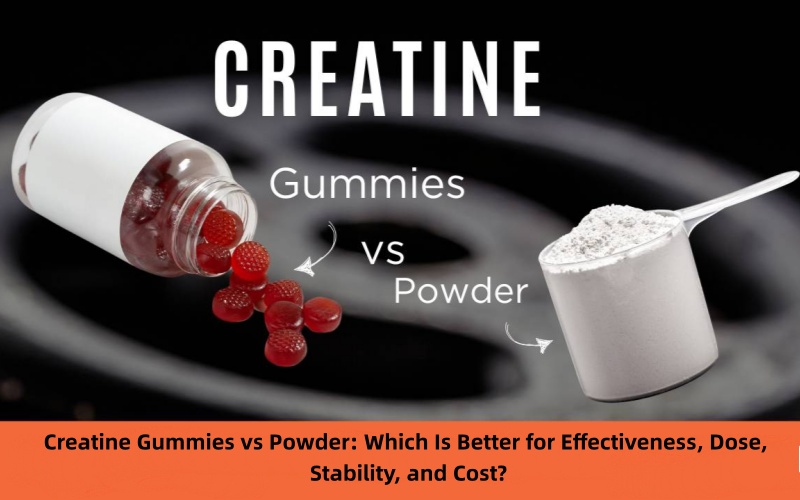
Creatine used to be one of the simplest products in sports nutrition: a tub of creatine monohydrate powder, a scoop, and water. Gummies have changed that conversation by making creatine easier to carry, more pleasant to take, and more familiar to consumers who do not enjoy traditional sports powders. The trade-off is that a gummy is not merely powder in a different shape. It is a semi-moist formulated food system that must accommodate a gram-level active ingredient while still meeting expectations for taste, texture, piece size, stability, packaging, and price.
Creatine powder is usually the stronger choice for dose density, formulation simplicity, flexible serving size, dry-state stability, and cost per gram. Creatine gummies can be a practical alternative when they deliver a verified amount of creatine monohydrate, remain within specification during shelf life, and keep the daily serving manageable. The real comparison is therefore dose, stability, formulation quality, convenience, and total cost rather than gummy versus powder alone.
That distinction matters because two products can both say “creatine” on the front label while offering very different daily experiences. A powder may provide 5 grams in one small scoop, while a gummy formula may need several pieces to deliver the same amount. A gummy may be easier to remember during travel, yet its higher moisture and more complex formulation place greater importance on processing and stability controls. Once the comparison is reduced to measurable questions instead of packaging preference, the choice becomes much easier for both consumers and supplement brands.
What Is the Difference Between Creatine Gummies and Powder?
Creatine gummies and powder can use the same active ingredient, but they are very different delivery systems. Powder can place several grams of creatine into a compact serving with few supporting ingredients. Gummies need a chewable matrix, flavor, sweetener, gelling system, moisture control, and acceptable texture, which limits dose density and makes formulation, processing, packaging, quality control, and long-term stability more complex.
What Is Creatine Powder?
Creatine powder is the most direct way to deliver a meaningful gram-level serving. In a basic unflavored product, the ingredient list may contain only creatine monohydrate, allowing a brand to provide 3 to 5 grams without needing space for a gummy base, flavor system, acids, sweeteners, or structural ingredients. Creatine monohydrate is also the form with the deepest evidence base in sports nutrition, which is one reason plain powder remains the reference product against which newer delivery formats are usually compared.
From a formulation standpoint, simplicity does not mean there is nothing to control. Particle size influences mouthfeel and dispersion, especially because creatine monohydrate does not have to become perfectly transparent in water to be usable. Moisture can increase caking risk, while multi-ingredient products require appropriate mixing control so that each serving represents the intended formula. Flavored powders also need work on sweetness, acidity, aroma, aftertaste, and the amount of water consumers are likely to use in real life.
Powder packaging is relatively straightforward because the main physical objective is normally to keep the product dry, accurately portioned, and protected from contamination. Jars remain common because they are easy to scoop and reseal, while pouches reduce packaging weight and shipping volume. Individual stick packs can create a more portable experience, although they increase packaging material and filling cost. For a high-dose ingredient such as creatine, the key structural advantage is that powder can carry several grams of active material without forcing the consumer to take many separate units.
What Are Creatine Gummies?
Creatine gummies place creatine inside a structured chewable matrix. Depending on the formula, that matrix can include pectin or gelatin, water, sweeteners, acids, flavors, colors, humectants, coating ingredients, and other processing aids needed to create the expected bite, shape, taste, and storage behavior. That means a gummy is not simply creatine powder made more attractive; it is a distinct dosage-form project with its own technical constraints and quality-control requirements.
The biggest constraint is active load. Many familiar gummies deliver vitamins or botanical ingredients in milligram-level quantities, whereas creatine is usually discussed in grams. If the commercial target is 5 grams per daily serving, the manufacturer has to distribute that amount across a realistic number of pieces while leaving enough formulation space for the materials that actually make the gummy function. A lower dose per piece can make processing and taste easier, but it can turn one daily serving into five, six, or more gummies.
That serving count affects much more than convenience. It changes bottle size, packaging cost, calories, sweetener exposure, freight, shelf presentation, and the number of pieces a consumer must remember every day. Gummies also contain much more available moisture than dry creatine powder, so pH, water activity, processing temperature, storage temperature, package barrier performance, and shelf-life testing become more important. A successful creatine gummy therefore has to balance dose, sensory quality, manufacturability, stability, and economics at the same time.
Which Ingredients Differ?
The difference in supporting ingredients is often larger than the difference in the creatine itself. A plain powder can be close to a single-ingredient product, while a gummy requires a system that creates structure and palatability. That does not automatically make the gummy inferior. Pectin, gelatin, sweeteners, flavors, acids, and related ingredients perform real technical jobs. The important question is whether the finished daily serving still delivers the intended creatine amount without creating an awkward serving size or unnecessary formulation burden.
| Product Feature | Creatine Powder | Creatine Gummies |
| Common active | Creatine monohydrate | Creatine monohydrate |
| Typical daily target | 3-5 g creatine | 3-5 g may require multiple pieces |
| Supporting ingredients | Can be minimal | Usually several |
| Gelling system | Not required | Pectin, gelatin, or similar |
| Sweetener system | Optional | Usually required |
| Moisture exposure | Low in a protected dry product | Higher and formula-dependent |
| Dose density | High | More physically constrained |
| Serving flexibility | Easy to adjust by scoop weight | Limited by piece count |
| Main packaging concern | Moisture protection | Moisture, heat, sticking, deformation |
| Development complexity | Low to moderate | Moderate to high |
For someone comparing labels, this table explains why price and serving size can diverge so sharply between the two formats. For a product-development team, it also explains why a gummy project needs more than a flavor decision. The daily active target, piece weight, number of pieces, sweetening strategy, acid system, texture, water activity, package, and intended distribution conditions should be considered together before the product moves from concept to commercial sampling.
Are Creatine Gummies as Effective as Powder?
Creatine gummies can be as useful as powder when they provide the same verified amount of an evidence-supported creatine form and retain that amount through shelf life. The gummy format does not automatically increase or reduce creatine’s biological role. Practical effectiveness depends more on creatine form, delivered dose, product stability, consistent intake, and overall quality than on whether the serving is chewed or mixed with water.
Do Equal Doses Work the Same?
The scientific evidence around creatine is primarily evidence about creatine monohydrate rather than tubs, scoops, gummies, or capsules. When two products genuinely provide an equivalent amount of creatine monohydrate, there is no sound reason to assume that one becomes inherently stronger simply because it is delivered as a gummy. A 5-gram verified serving should be evaluated as 5 grams of creatine monohydrate, regardless of whether the consumer chews it or disperses it in a drink.
The word “verified” matters because formulation and label claims are not always the same thing. A powder containing 5 grams per serving is relatively easy to understand when the formula is simple and the product remains dry. A gummy may also target 5 grams, but the product team should know how many pieces make a serving, whether those pieces are consistent in weight, and whether finished-product testing confirms the expected active content. A 500-milligram difference represents 10% of a 5-gram target, so small-looking deviations can be meaningful in a gram-level formula.
Consumers should therefore resist two equally weak assumptions: that every gummy is underdosed, or that every gummy works exactly like powder just because the label says creatine. A well-developed gummy can be a legitimate delivery format, while a poorly controlled gummy can fall short of its intended specification. The same principle applies to powder. Effectiveness begins with the right active ingredient and an appropriate delivered dose, then depends on whether the product maintains those characteristics consistently from batch to batch and through normal storage.
Is Absorption Different?
There is no strong evidence that a gummy format automatically creates a meaningful absorption advantage over properly formulated creatine monohydrate powder. The distinction that matters is between dosage form and chemical form. “Gummy” and “powder” describe how the product is delivered, while “creatine monohydrate” describes the active compound. If both formats provide the same form at the same usable dose, chewing the product should not be treated as proof of superior bioavailability.
This is especially important because creatine is not normally used like a stimulant, where consumers expect an obvious effect minutes after taking a serving. Creatine supplementation is generally intended to increase and maintain body creatine stores through repeated intake. That makes daily consistency and adequate dosing more relevant than marketing claims about one format being absorbed “instantly” or “faster.” A product can be more convenient without needing to invent a biological advantage that has not been demonstrated.
For consumers, this means absorption claims should be read carefully and separated from legitimate convenience claims. For brands, it means product pages and advertising should avoid phrases such as “superior uptake” or “more bioavailable than powder” unless there is product-specific evidence that supports those statements. Taste, portability, pre-portioned use, and routine adherence are defensible reasons to choose gummies; unverified claims of physiological superiority are not needed to make the format attractive.
Does Creatine Form Matter?

Yes, creatine form matters because the strongest body of research remains centered on creatine monohydrate. Over the years, products have been marketed using creatine salts, buffered forms, chelates, creatine ethyl ester, nitrates, and other variations, yet broad reviews have not established a consistent performance advantage over monohydrate. That is why a serious comparison between gummies and powder should begin by identifying the active ingredient rather than assuming every product labeled “creatine” is equivalent.
A careful label review should answer several practical questions: what form of creatine is used, how many grams are delivered per full serving, how many gummies or grams of powder make that serving, whether other actives are included, and what storage conditions apply. These details are more useful than comparing colorful packaging, flavor names, or the size of the container. A premium-looking gummy can still be a weak value if the active dose is unclear or the serving count is impractical.
The same logic helps brands avoid unnecessary formulation complexity. If the target audience already trusts creatine monohydrate, switching to a less-established form only to create a novel front-panel claim can make sourcing, testing, pricing, and regulatory review harder without adding a meaningful consumer benefit. The delivery format can be differentiated through taste, packaging, routine convenience, or ingredient combinations while keeping the core creatine form familiar and evidence-supported.
Does Daily Consistency Matter?
Daily consistency matters because creatine supplementation is usually evaluated across repeated intake rather than a single serving. A common maintenance range is around 3 to 5 grams per day. A traditional rapid-loading approach used in research is approximately 20 grams per day for 5 to 7 days, generally divided into four 5-gram servings, followed by a lower maintenance intake. Loading is optional, and lower daily amounts can increase creatine stores more gradually without it.
This creates a practical difference between powder and gummies. With powder, increasing a serving from 3 grams to 5 grams requires only a modest change in scoop weight. With gummies, the same change may require one or two additional pieces depending on the active load. If each gummy contains 1 gram, a 5-gram maintenance target requires five pieces, while a 20-gram loading-style target would require 20 pieces. That may be technically possible but is not an attractive daily routine for most consumers.
Convenience still matters. A person who repeatedly skips powder because they dislike measuring, mixing, or carrying a shaker may be more consistent with a chewable product. The right hierarchy is therefore to confirm ingredient form, dose, stability, and quality first, then choose the format that best fits the user’s routine. Convenience can improve adherence, but it cannot compensate for an inadequate or poorly controlled active dose.
How Much Creatine Do Gummies and Powder Deliver?
Powder usually delivers creatine more efficiently because several grams can fit into one measured serving. Gummies are constrained by piece size and the non-creatine materials needed for structure and flavor. A fair comparison therefore uses creatine per gummy, creatine per full serving, daily piece count, servings per container, and total grams of creatine in the package rather than bottle size alone.
How Many Gummies Equal 5 g of Creatine?
There is no universal number because gummy strength varies by formula. The calculation is simple: divide the target creatine dose by the amount of creatine in one gummy. If each piece provides 1 gram, five gummies are needed to reach 5 grams. If each piece provides 1.25 grams, four pieces provide 5 grams. At 500 milligrams per piece, the same target would require ten gummies, which changes the convenience argument considerably.
| Creatine per Gummy | Gummies for 3 g | Gummies for 5 g | Gummies for 20 g |
| 0.50 g | 6 | 10 | 40 |
| 0.75 g | 4 | 6.7 | 26.7 |
| 1.00 g | 3 | 5 | 20 |
| 1.25 g | 2.4 | 4 | 16 |
| 1.50 g | 2 | 3.3 | 13.3 |
These values are mathematical examples rather than market averages, but they show the basic product-design problem. A three-piece serving that provides 5 grams would require about 1.67 grams of creatine per gummy before accounting for the pectin or gelatin system, sweeteners, water, flavors, acids, and other materials that create the finished piece. Raising active load reduces serving count but can make texture, flavor, processing, and consistency harder to manage.
Serving count should therefore be treated as an early development decision rather than something added to the Supplement Facts panel after the formula is complete. A commercially sensible gummy needs a daily dose that people are willing to take for weeks and months, not just a laboratory sample that tastes acceptable once. The development team should evaluate piece size, total daily weight, chew time, sweetness, bottle count, and the expected monthly consumption pattern alongside active content.
How Should Serving Size Be Compared?
The most reliable comparison uses creatine per full serving rather than scoop weight or number of pieces. A 7-gram scoop of a flavored sports formula does not necessarily contain 7 grams of creatine because part of the scoop may consist of flavors, acids, sweeteners, electrolytes, or other ingredients. Likewise, four large gummies do not automatically provide more creatine than three smaller gummies. The Supplement Facts panel and formulation specification need to be read together.
Three simple calculations make products easier to compare. Creatine per unit equals the creatine per serving divided by the number of units in that serving. Total creatine in the package equals creatine per serving multiplied by the number of servings. Cost per gram equals the retail price divided by total labeled creatine grams. These calculations turn an emotional packaging comparison into a measurable value comparison that works across powders and gummies.
Consider a bottle with 120 gummies. If four gummies provide 5 grams, the bottle contains 30 servings and 150 grams of labeled creatine. A 500-gram tub of plain creatine can provide 100 servings at 5 grams each. Even if the retail prices appear similar, the cost per gram and number of days supplied can differ dramatically. The label should therefore be translated into daily use before deciding that one product is expensive or economical.
Do Loading and Maintenance Doses Change the Math?
They change the practicality of the dosage form very quickly. A maintenance intake of 3 to 5 grams can sometimes fit into a manageable gummy serving, especially when each piece carries a relatively high active load. A 20-gram loading-style intake is much more difficult to deliver without requiring a large number of gummies. For powder, four measured 5-gram servings across a day remain straightforward because dose density is not constrained by piece count.
Higher gummy counts also multiply everything else in the formula. If five gummies provide the maintenance serving, any sugar, sugar alcohol, acid, flavoring, calories, or other ingredients in one piece are consumed five times. A loading-style quantity could multiply those non-active ingredients much further. This does not make gummies unsuitable, but it means the product should be designed around realistic daily use rather than trying to mimic every possible powder protocol.
Brands do not need to position a gummy around a loading phase. Many consumers use creatine without loading, and a clear maintenance-style serving can be easier to communicate. The important step is to decide the intended use before locking the formula. A product cannot be intelligently optimized when the team has not agreed on the daily creatine target, the acceptable number of pieces, and the consumer routine the product is supposed to support.
Is Dose Density Important for Product Design?
Dose density is one of the most important commercial differences between creatine and many familiar gummy ingredients. Vitamins, minerals, and botanical extracts are often used in milligram or microgram quantities, while creatine is commonly used in grams. That means the active ingredient can occupy a substantial share of total gummy weight, leaving less room for the materials that control structure, sweetness, flavor, acidity, moisture, and handling.
If four finished gummies are expected to provide 5 grams, each piece must deliver an average of 1.25 grams of creatine. If each gummy weighs 4 grams, creatine alone represents more than 31% of piece weight before the rest of the formula is counted. That is not automatically impossible, but it illustrates why texture and taste can become more difficult as active loading rises and why apparently small changes in piece size or serving count can materially change feasibility.
A sensible development brief begins with the non-negotiables. If dose density and low cost are most important, powder often has the advantage. If portability and chewable convenience are more valuable, the brand may accept a larger serving count or higher price. Product developers can then test piece weight, sweetness, flavor intensity, pectin or gelatin system, target pH, water activity, and packaging together rather than trying to force a finished formula into a serving size chosen mainly for marketing aesthetics.
Which Form Is More Stable and Reliable?
Dry creatine monohydrate powder generally has the simpler stability profile because crystalline creatine is highly stable when protected from moisture. Gummies are more demanding because creatine is placed in a semi-moist and often acidic matrix. Reliability therefore depends on formulation pH, water activity, processing temperature, packaging, storage conditions, piece consistency, and whether potency remains within specification through the intended shelf life.
How Do Heat, Moisture, and pH Affect Creatine?
Creatine chemistry explains why stability deserves more attention than a simple taste-and-convenience comparison suggests. Creatine is highly stable in the dry crystalline state but becomes less stable in aqueous environments, where it can gradually cyclize to creatinine. Temperature and acidity can influence that process, so a formula containing more available water needs a different stability discussion from a dry powder stored in a well-sealed container.
Published stability work illustrates the direction of the effect. Under specific aqueous test conditions at about 25 degrees Celsius, reported creatine degradation after three days was approximately 4% at pH 5.5, 12% at pH 4.5, and 21% at pH 3.5. Those figures should not be used as direct predictions for commercial gummies because a structured gummy matrix is not the same as a simple solution, but they show why pH and moisture cannot be treated as decorative formulation details.
Dry crystalline creatine is much more forgiving under appropriate storage. Historical data summarized in scientific reviews describe very limited degradation during long-term dry storage, including elevated-temperature testing compared with solution-state creatine. For a manufacturer, the practical conclusion is not that gummies are automatically unstable. It is that a creatine gummy needs formula-specific evidence around water activity, acidity, processing conditions, package barrier, and shelf life rather than relying on stability assumptions borrowed from dry powder.
Are Gummies Harder to Stabilize?
Creatine gummies are generally more complicated to stabilize than plain powder because they contain several interacting components and a meaningful amount of water. A gummy’s water activity can change with formulation and storage, moisture can move through packaging, heat can soften the matrix and increase sticking, and acids used for fruit flavor profiles may create a less favorable environment for creatine than a dry neutral powder. Each variable can affect both consumer experience and active stability.
Water activity is particularly useful because it describes how available water is for chemical, physical, and microbiological processes rather than simply measuring total moisture. Two gummies with similar moisture percentages can behave differently when their water activities differ. Research examining creatine at different water activities and temperatures confirms that these environmental factors can influence degradation behavior, which is why a shelf-life program should consider the actual product matrix rather than only the incoming creatine raw material.
The best commercial approach is to validate the real formula in the real package. A successful vitamin gummy formula does not automatically prove that a high-load creatine gummy will behave the same way, and an accelerated stability result should be interpreted in the context of its method rather than used as a blanket guarantee. Brands should expect the manufacturer to define measurable targets such as pH, water activity where relevant, active potency, texture, appearance, package performance, and storage conditions for the specific project.
How Does Manufacturing Affect Potency?

Manufacturing determines whether a promising formulation survives commercial scale. A laboratory sample may spend only a short time under tightly controlled conditions, whereas bulk production can introduce larger batch volumes, longer holding times, pumping or depositing, heating, cooling, conditioning, coating, counting, and packaging. For creatine gummies, the team should know when creatine enters the process, what temperature it experiences, and how long it remains in the higher-moisture matrix before final sealing.
Piece-weight control matters as well. If individual gummies vary significantly in weight, active content per piece can vary even when the overall batch assay appears acceptable. Specifications should therefore connect physical piece weight with the intended creatine dose and daily serving. Product teams should also evaluate whether texture, sticking, shape, flavor, and appearance remain consistent after storage because physical changes can be early signs that the product or package needs further optimization.
Powder manufacturing has a simpler risk profile but still requires discipline. Raw-material identity, weighing accuracy, sieving, mixing, moisture, fill weight, seal integrity, and batch coding all matter. Multi-ingredient creatine powders need appropriate blend-uniformity controls, while plain creatine products need to maintain dryness and accurate net weight. A supplier’s value is therefore not simply the ability to fill a jar or deposit a gummy; it is the ability to reproduce the approved specification consistently at commercial scale.
How Can Batch Testing Confirm Potency?
Testing turns a formula claim into a quality-control system. A useful creatine program starts with incoming material documentation and continues through in-process checks, finished-product testing, batch records, retained samples, and stability evaluation where appropriate. The specific test panel should depend on dosage form, target market, customer requirements, product claims, and the risks identified during development rather than being copied from an unrelated supplement category.
A practical control plan can include raw-material COA review, supplier qualification, batch traceability, weighing verification, in-process weight checks, finished-product active assay where required, microbiological testing suitable for the dosage form, heavy-metal testing where required, moisture or water-activity checks when relevant, package-seal inspection, retained samples, and documented stability work. For gummies, the combination of active assay and piece-weight consistency is particularly useful because the consumer receives the product in discrete units.
Zoxizo’s documented quality framework includes more than 30 quality and testing personnel supporting raw-material review, process checks, finished-product inspection, and batch documentation, while its development system covers both powder and gummy dosage forms. Those capabilities provide a useful foundation for a creatine project, but a creatine-gummy formula still needs project-specific potency and stability specifications rather than generic gummy assumptions. Brands evaluating a project should ask not only whether the target dose can be achieved at production, but how the team will verify that the product remains within specification during its intended shelf life.
Are Creatine Gummies Worth the Higher Cost?
Creatine gummies can justify a higher price when consumers strongly value portability, taste, pre-portioned use, and freedom from mixing powder. Powder normally remains cheaper per gram because it carries more active ingredient with fewer supporting materials and simpler processing. The fairest comparison is therefore cost per verified 3-5 gram serving, not bottle price, package size, or the number of gummies printed on the front label.
Which Costs Less Per Gram?
Powder has a structural economic advantage because most of its physical mass can be creatine itself. A plain creatine product can move from raw material through handling, filling, packaging, quality control, and distribution without needing the complex matrix required for a gummy. Gummies add gelling ingredients, sweeteners, flavors, acids, processing steps, depositing or molding, conditioning, piece-count control, and packaging designed to protect texture as well as active content.
| Example Cost Calculation | Powder | Gummies |
| Retail price | $30 | $30 |
| Total creatine in package | 500 g | 150 g |
| Equivalent 5 g servings | 100 | 30 |
| Cost per 5 g serving | $0.30 | $1.00 |
| Cost per creatine gram | $0.06 | $0.20 |
| Typical daily unit format | 1 scoop | Multiple gummies |
These figures are illustrative rather than market averages, but they demonstrate the calculation that matters. Two products can carry the same $30 price while delivering very different total amounts of creatine. A gummy can still be worth the premium if the consumer values convenience enough, but the premium should be understood rather than hidden behind package count or serving language that makes direct comparison difficult.
For a brand, the same calculation needs to happen before retail pricing is finalized. Active raw material, gummy-base ingredients, flavor system, process yield, testing, bottle or pouch cost, shipping weight, warehouse volume, fulfillment fees, and expected margin all influence the final economics. A premium dosage form can support a higher retail price, but only when the target customer perceives enough practical value to justify the difference over a straightforward creatine monohydrate powder.
Do Gummies Add Sugar or Sweeteners?
Most gummies need a sweetening system because palatability is central to the format. Traditional products may use sugar or glucose syrup, while lower-sugar or sugar-free products can use sugar alcohols, fibers, high-intensity sweeteners, or blended systems. The important comparison is the full daily serving rather than a single piece, because every gram of sugar, every calorie, and every amount of sugar alcohol in one gummy is multiplied by the number of pieces required to reach the target creatine dose.
That multiplication becomes important in high-count servings. A formula that looks modest on a per-gummy basis may produce a noticeably different nutrition profile when five or six pieces are consumed every day. The same logic applies to digestive tolerance. Some consumers handle sugar alcohols well, while others experience discomfort at higher amounts. A product aimed at long-term daily use needs to consider the consumer’s complete serving experience rather than treating the supporting ingredients as invisible.
Sugar-free formulation also creates technical trade-offs. Changing sweeteners can affect chew texture, water activity, aftertaste, stickiness, processing behavior, and cost. A strong brief therefore asks whether the product can meet its sugar or calorie target while still delivering the desired creatine amount, reasonable piece count, acceptable taste, stable texture, and shelf-life performance. “Zero sugar” is not a formulation shortcut; it is another parameter that must work with the rest of the system.
Which Is Easier to Take Every Day?
Gummies remove several small frictions from daily creatine use. There is no scoop to measure, no shaker to wash, no powder residue on the counter, and no need to prepare another drink. For people who travel, commute, or simply dislike the texture of suspended creatine, that convenience can be meaningful enough to improve routine consistency. A product that fits naturally into someone’s day has a practical advantage even if its active ingredient is not biologically superior.
Powder is still easy for consumers who already use protein, electrolytes, or pre-workout products. Adding creatine to an existing drink may require almost no extra effort, and one scoop can deliver the entire daily amount without several pieces of a sweetened product. In that setting, gummies can solve a problem the consumer does not actually have. The most valuable format therefore depends on the existing routine rather than an abstract ranking of convenience.
Travel also has trade-offs. Gummies are easy to portion but can soften, stick, or deform in hot environments if the formulation and package are not designed for those conditions. Powder is more physically robust but needs moisture protection and can spill if handled poorly. The useful question for product teams is simple: which friction in the customer’s current creatine routine are we removing, and is that improvement large enough to support the higher formulation and packaging cost?
How Should Supplement Brands Choose the Right Format?
Supplement brands should choose creatine gummies or powder by starting with the target user, daily dose, intended price, distribution channel, sensory expectations, stability needs, packaging, and manufacturing feasibility. Powder fits high-dose, value-focused, and performance-led positioning especially well. Gummies fit convenience-led and lifestyle-oriented positioning when the desired dose can be delivered in a practical serving without compromising stability, quality, or commercial margin.
Which Format Fits the Target Customer?
The same active ingredient can serve very different customer routines. A strength athlete who already uses protein and pre-workout powder may view a creatine tub as familiar, efficient, and economical. Someone who dislikes powders, travels frequently, or prefers a simple daily wellness routine may willingly pay more for gummies. Neither group is inherently better; the right format depends on the behavior the brand is trying to support and the price the customer is willing to accept.
Powder-first audiences often value dose transparency, cost per serving, adjustable serving size, sports-performance familiarity, and easy combination with shakes or hydration products. Gummy-first audiences may place more weight on taste, portability, pre-portioned use, visual presentation, and a routine that feels less like traditional gym supplementation. These preferences influence not only format but also packaging, flavor, positioning, subscription strategy, and the number of monthly servings consumers are willing to buy repeatedly.
Channel should also influence the decision. Specialist sports channels may readily accept a functional powder with a simple label, while social-commerce and lifestyle-oriented direct-to-consumer brands can benefit from a distinctive chewable format that is easy to demonstrate on camera. Pharmacies and established retail channels may put greater weight on stability documentation, label clarity, quality systems, and shelf-life confidence. The best format is therefore the one that fits the target customer’s routine and the realities of the channel rather than the one receiving the most social-media attention this month.
How Do Formula and Flavor Affect Feasibility?

Product briefs often become difficult when too many marketing requirements are fixed before feasibility is tested. A concept such as “5 grams of creatine, three gummies, zero sugar, vegan pectin, natural flavor, soft texture, very low calories, long shelf life, hot-climate shipping, and a low target cost” contains several requirements that can work against one another. The solution is to rank priorities before expecting the laboratory to satisfy every feature simultaneously.
If 5 grams is non-negotiable, the team can adjust gummy count and piece size. If three gummies are non-negotiable, active loading becomes more demanding. If zero sugar is essential, the sweetener and texture system may need additional development. If the product must survive high-temperature international distribution, physical stability and package barrier performance deserve more weight. Every decision has consequences, and a strong product comes from managing those trade-offs rather than hiding them.
Flavor development should also be evaluated as part of technical feasibility. A high creatine load can affect taste and mouthfeel, while strongly acidic fruit profiles may change the environment around the active ingredient. Sampling should therefore capture more than a simple “like” or “dislike” response. Useful feedback includes sweetness, acidity, aftertaste, chew hardness, sticking, piece size, serving count, and willingness to consume the entire serving every day. For brands considering both formats, comparing a powder sample and a gummy sample under the same target-dose brief can reveal trade-offs much earlier than choosing the format first and troubleshooting later.
How Does Packaging Affect the Product?
Packaging is part of product performance rather than a final branding layer. Creatine powder needs dependable moisture protection because humidity can contribute to caking and reduce the clean handling experience consumers expect. Jars provide convenient scooping and resealing, while pouches reduce packaging weight and shipping volume. The correct choice depends on serving size, target price, shipping route, and whether the product is sold mainly online, through gyms, or in retail environments.
Gummies create a different set of requirements. The package must help protect against moisture exchange, heat exposure, sticking, deformation, and physical damage. Serving count can also make the package unexpectedly large. A 30-day supply at five gummies per day requires 150 pieces, while four pieces per day requires 120. That affects bottle size, cap cost, label area, warehouse space, master-carton efficiency, fulfillment fees, shelf presentation, and the consumer’s perception of value.
Brands should model these effects before artwork is finalized. A bottle that looks attractive in a design rendering can become much less profitable once actual gummy volume, freight, and fulfillment are included. Zoxizo’s product-development workflow covers dosage form, packaging, sampling, production, QC, and export preparation as connected decisions, which is useful for brands comparing a high-dose powder concept with a more complex chewable concept. The package should be chosen to protect the formulation and fit the channel, not simply to create a visually impressive first impression.
Which Quality Checks Matter Before Launch?
A serious creatine product should be defined by measurable specifications rather than phrases such as “premium quality” or “lab tested.” Before bulk production, the brand and manufacturer should agree on what will be measured, the acceptable limits, the sampling plan, the batch documents, and the shelf-life evidence appropriate to the dosage form. This turns quality from a marketing statement into a repeatable operating standard that can be applied to every production lot.
For powder, relevant controls can include raw-material identity, active content, appearance, moisture, blend uniformity when other ingredients are present, fill weight, packaging seal integrity, microbial limits, heavy metals where required, batch coding, and retained samples. Gummies can add average piece weight, piece-weight variation, active content per serving, texture, pH, water activity where relevant, sticking, appearance, package performance, and stability over time. The exact specification should reflect product risk and target-market requirements rather than a generic checklist.
Before approving a commercial project, a product team should be able to answer ten practical questions: the exact creatine form, grams per full serving, number of gummies or grams of powder per serving, process conditions that could affect the active, finished-product potency test, physical specifications, shelf-life evidence, packaging protection, target-market label requirements, and the plan for reproducing the approved sample at commercial scale. A manufacturing partner that can discuss those questions clearly is more valuable than one that simply sends a price list and a catalog.
For brands that need support comparing a powder concept with a gummy concept, Zoxizo’s documented capabilities include multi-dosage-form development, a 25-plus-person R&D team, more than 30 quality and testing personnel, and approximately 1,000 square meters of R&D trial space for formula trials, sensory evaluation, physical-property checks, and early-stage stability observation. Those resources can support product development, but creatine-gummy potency and shelf-life targets still need to be established specifically for the proposed formula and package rather than assumed from general gummy manufacturing capability.
Creatine gummies and creatine powder are ultimately trying to solve the same problem: delivering creatine in a form that consumers can use consistently. Powder keeps important structural advantages in dose density, ingredient simplicity, dosing flexibility, dry-state stability, and cost per gram. Gummies can create meaningful value when convenience, taste, portability, and lifestyle positioning matter enough to justify the added formulation complexity and higher cost. Neither format deserves to win the comparison simply because it is traditional or trendy.
The most useful decision is based on evidence that can be checked. Consumers should look at the creatine form, grams per serving, number of units per serving, total creatine in the package, added ingredients, storage requirements, and cost per effective daily dose. Brands should go one level further by asking whether the product can maintain its active specification, sensory quality, packaging integrity, and commercial margin through real manufacturing and distribution. Once those questions are answered with data, the choice between gummies and powder becomes far more practical and far less dependent on marketing noise.
Frequently Asked Questions
Are creatine gummies as effective as creatine powder?
Creatine gummies can provide comparable practical value when they contain an evidence-supported form such as creatine monohydrate, deliver the intended daily dose, and maintain that dose through the product’s shelf life. The gummy format itself does not make creatine more or less effective. The important variables are actual creatine content, serving size, stability, consistent use, and manufacturing quality. Consumers should therefore compare grams of creatine per full serving rather than assuming every gummy product is automatically equivalent to a 3-5 gram powder serving.
Do creatine gummies absorb better than powder?
There is no strong evidence that chewing creatine automatically creates a meaningful absorption advantage over creatine monohydrate powder. Dosage form and chemical form are different questions. If a gummy and a powder both deliver the same amount of creatine monohydrate, the fact that one is chewed should not be treated as proof of superior bioavailability. Claims such as “faster absorption” or “better uptake” should be supported by relevant product-specific evidence rather than assumed from the gummy format.
How many creatine gummies equal one 5-gram scoop?
The answer depends on the creatine amount in each gummy. If one gummy contains 1 gram of creatine, five gummies provide 5 grams. If each contains 1.25 grams, four gummies provide 5 grams. If each contains only 500 milligrams, ten gummies would be required. Always check both creatine per serving and gummies per serving, because a bottle with many pieces may still provide relatively few full daily servings once the intended creatine dose is calculated.
Is creatine powder more stable than creatine gummies?
Dry creatine monohydrate powder generally has the simpler stability profile because crystalline creatine is highly stable when protected from moisture. Gummies contain more water and are often acidic, so pH, water activity, temperature, processing conditions, package barrier, and storage can become more important. This does not mean every gummy is unstable, but a creatine gummy should have formula-specific potency and stability evidence rather than relying on assumptions based on dry powder or unrelated vitamin gummies.
Are creatine gummies more expensive than powder?
They are often more expensive per gram of creatine because part of the gummy’s weight and manufacturing cost goes toward the gelling system, sweeteners, flavors, acids, processing, piece control, and protective packaging. Powder can devote a much larger share of product weight to creatine itself. The best comparison is cost per 3-5 gram serving or cost per gram of labeled creatine, because two packages with the same retail price can contain very different total amounts of active ingredient.
Can I switch from creatine powder to gummies?
A switch can be straightforward when the gummy provides the same creatine form and an equivalent daily amount, but serving size should be checked carefully. Someone taking 5 grams of creatine monohydrate powder should not assume that one or two gummies automatically provide the same amount. Review grams per serving, number of gummies per serving, added ingredients, storage instructions, and any relevant dietary preferences. If the gummy makes daily use easier without reducing the intended dose, it can be a practical alternative.