 Skip to content

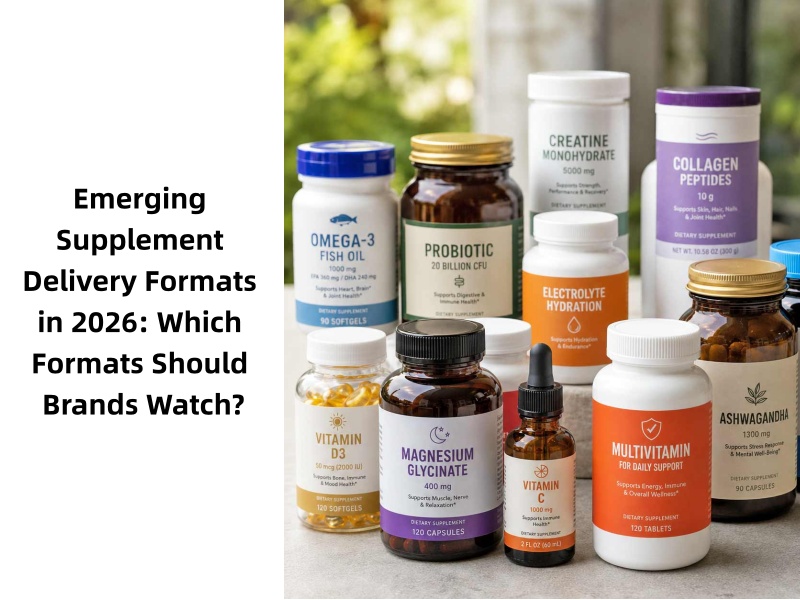
Supplement format is no longer a small decision made after the formula is finished. In 2026, the format can influence whether a product fits into a consumer’s routine, whether the required dose can be delivered comfortably, whether an unpleasant ingredient can be masked, how much packaging and shipping will cost, and how difficult the product will be to manufacture consistently. That is why capsules, gummies, powders, stick packs, chews, gels, shots, sprays, oral films, and advanced ingredient-delivery technologies are being discussed together rather than as separate manufacturing topics.
The supplement delivery formats worth watching in 2026 are not simply the newest ones. Gummies, chews, stick packs, liquid shots, RTDs, gels, effervescents, and selected water-free formats are gaining attention because they reduce friction in daily use. At the same time, liposomal systems, microencapsulation, micellar technologies, sustained-release systems, and multi-phase capsules are expanding what formulators can do with difficult ingredients, stability challenges, and targeted release.
The interesting part is that the market is not moving toward one universal winner. Kerry’s 2026 research places capsules among North America’s largest formats while identifying liquid shots, chewables, effervescents, and oral sprays as newer growth areas, with gum, dissolvable films, and oral pouches further out on the horizon. For a supplement brand, the real question is therefore not which format looks most innovative in a presentation. It is which format gives a particular ingredient, dose, use occasion, regulatory position, and target price the best chance of becoming a product people will actually keep using.
What Is Driving Supplement Format Innovation in 2026?
Supplement format innovation in 2026 is being driven by convenience, taste, changing routines, product differentiation, and better delivery technology. Consumers increasingly expect supplements to fit around work, travel, exercise, and everyday habits, while product teams still have to protect dose, stability, quality, and cost. The most durable innovation happens when a format improves the experience without creating a larger technical problem behind the scenes.
Consumer Routines Are Reshaping Format Choice
The idea of “pill fatigue” is useful, but it can also be oversimplified. Capsules and tablets remain important because they are familiar, compact, efficient, and well suited to many concentrated ingredients. At the same time, the market has clearly opened space for food-like and ready-to-use formats. Industry figures cited by NutraIngredients show that non-pill formats represented 56% of U.S. supplement market sales in 2021, up from 37% in 2013. Informa’s 2025 Supplement Business Report then showed pill-like formats recovering to nearly 34% of U.S. market sales, while gummies, powders, softgels, and liquids continued to hold substantial shares.
Those figures suggest fragmentation rather than replacement. A consumer taking a concentrated botanical may still prefer two capsules because the taste is hidden and the routine is simple. Someone using hydration support during a workout may prefer a single stick pack because several grams of ingredients can be mixed directly into a bottle. An endurance athlete may value a gel that can be taken without stopping, while a traveler may prefer a chew or another water-free option. The right format increasingly depends on the moment of use, not on a blanket assumption that newer is always better.
For product development, that changes the first conversation. Before discussing colors, flavors, bottle shapes, or label claims, a team should understand where the product will be used, how much active material must be delivered, whether water is normally available, and how much preparation the consumer will tolerate. A format that removes one practical obstacle can improve adherence more than an elaborate ingredient story. A format that adds three new obstacles may weaken a strong formula even if it photographs well for launch content.
Taste and Convenience Now Affect Repeat Use
Convenience is now close enough to efficacy-related considerations that it deserves serious attention during formulation. Kerry’s 2026 supplement research cites FMCG Gurus data showing that 41% of supplement consumers consider ease of use an important purchase driver, compared with 53% who prioritize scientific evidence. That does not mean consumers value convenience more than evidence. It means the gap is small enough that a scientifically credible formula can still lose momentum if the daily experience is unpleasant, messy, difficult to prepare, or easy to forget.
That helps explain the continued interest in stick packs, chews, gummies, shots, sprays, and RTDs. A stick eliminates scooping and makes one serving obvious. A chew removes the need for water. A shot eliminates mixing. An RTD makes the routine almost entirely passive. However, every step toward a more sensory format exposes the consumer to more of the formula. Minerals can taste metallic, amino acids can be bitter or sour, botanical extracts can be earthy or astringent, and high active loads can make textures dense, gritty, sticky, or difficult to flavor.
This is one reason taste development cannot be treated as decoration. Moving a formula from a capsule into a gummy, chew, powder, or liquid may require changes in active concentration, sweetness, acidity, flavor masking, viscosity, particle size, color stability, moisture management, and serving size. A good sample is not merely pleasant on the first sip or first chew. It should remain acceptable after repeated daily use. For a product intended to generate subscriptions or routine repurchase, day thirty matters more than the novelty of day one.
Bioavailability Is Becoming a More Visible Differentiator
The term “delivery format” now covers two related but different ideas. The first is the physical form the consumer uses, such as a capsule, gummy, powder, gel, shot, spray, or film. The second is the technology used to protect, disperse, release, or carry an active ingredient, such as microencapsulation, liposomal systems, micellar systems, emulsions, hydrogels, sustained-release particles, or capsule-in-capsule designs. A familiar physical format can contain a very sophisticated internal delivery system.
This distinction matters because advanced delivery technology is most useful when it addresses a defined formulation problem. An ingredient may be poorly water soluble, highly sensitive to oxygen, unpleasant tasting, unstable in the surrounding matrix, or incompatible with another active. In those cases, encapsulation or another delivery approach may improve manufacturability or finished-product performance. NutraIngredients’ 2026 coverage highlights industry work with liposomes, nanoparticles, hydrogels, micellar technology, sustained release, and multi-phase capsule systems to address solubility, stability, release, and absorption challenges.
The evidence standard also matters. Nutrition Insight reported in September 2026 that companies are increasingly using human pharmacokinetic studies to support bioavailability claims, while probiotic developers are focusing on finished-product viability through shelf life and simulated gastrointestinal transit. In practice, an attractive technology name should never replace a clear question: what problem is being solved, what evidence supports the mechanism, does the evidence apply to the finished product, and can the technology be reproduced at commercial scale? Those questions are much more useful than assuming that “advanced” automatically means “better.”
Which Supplement Formats Are Emerging in 2026?
The formats attracting the most attention in 2026 include soft chews, single-serve powders, liquid shots, RTDs, gels, effervescents, oral sprays, functional gum, dissolvable films, and selected pouch concepts. Gummies are already a major category but continue to evolve into more specialized applications. Capsules remain highly relevant, which shows that emerging formats are expanding the market rather than simply pushing traditional dosage forms out.
Gummies, Chews and Stick Packs Keep Evolving

Gummies are no longer a niche format, so the important 2026 story is not that gummies exist. It is how far brands are trying to extend them. July 2026 launches covered by NutraIngredients included gummies aimed at increasingly specialized health needs, while the broader market continues to experiment with creatine, beauty, relaxation, probiotics, and other functions that would once have defaulted to capsules or powders. Kerry’s global 2026 research also reports that gummies, chews, powders, and stick packs together account for more than 60% of global supplement sales, with gummies alone at a 23.4% share.
The technical limit remains payload. A gummy has to contain a structural system, sweeteners or sugar alternatives, acids, flavors, moisture, and other components needed to create the eating experience. All of that competes for space with active ingredients. A concentrated vitamin or botanical may fit comfortably. A formula requiring several grams of creatine, collagen, fiber, or mineral salts may need multiple pieces, which can turn an apparently convenient dosage form into a large daily serving. Nutritional Outlook has highlighted this issue when discussing alternative formats for high-dose sports and wellness formulas.
Stick packs solve almost the opposite problem. They are not primarily about indulgence; they are about measured, portable gram-level delivery. Electrolytes, creatine, collagen, greens, fiber, and functional drink mixes can often be delivered in one sachet without forcing the consumer to count several capsules or chew multiple gummies. For brands building a broader portfolio, gummies and sticks can therefore be complementary rather than competing formats. One can deliver a low-dose lifestyle product, while the other carries the heavier formula that the gummy cannot realistically hold.
Gels, Shots and RTDs Are Becoming More Relevant
Gels are one of the more interesting 2026 signals because their growth is visible in product-development activity rather than only consumer discussion. Innova Market Insights data reported by Nutrition Insight shows that gels had the fastest growth in supplement new-product development, with a 23% compound annual growth rate from July 2021 through June 2026. Capsules still led overall supplement launches during the same period, so the correct interpretation is not that gels have become the largest format. It is that brands are finding more occasions where a portable, ready-to-consume semi-solid makes sense.
Sports and endurance nutrition are obvious examples. A gel can deliver a compact serving during running, cycling, hiking, or other situations where mixing a powder is inconvenient. Liquid shots serve a similar need in a smaller, concentrated liquid portion. Kerry’s North American 2026 format chart ranks liquid and liquid shots first in its “New” category, followed by chews, effervescent tablets, and oral sprays. The common thread is not one ingredient or one health claim. It is reduced preparation and easier use outside the home.
RTDs move even further toward convenience. NutraIngredients, citing SPINS data, reported that the U.S. RTD supplement market exceeded $7 billion in 2025 and grew by nearly 12% year over year. That scale makes RTD a serious format, but it also introduces manufacturing demands that dry products largely avoid. Water increases shipping weight and can create microbial, chemical, and physical stability challenges. Product teams must consider pH, preservation strategy, sedimentation, oxidation, flavor change, container compatibility, and shelf-life performance. The consumer gets a simpler experience because the manufacturer takes on more complexity before the product reaches the shelf.
Films, Sprays and Functional Gum Are Earlier-Stage Opportunities
Water-free formats are generating attention because they fit travel, convenience, and swallowing-sensitive use cases, but the categories are at very different maturity levels. Kerry’s 2026 North American outlook places gum first in its “Next” category, followed by oral dissolvable films or strips and slow-release oral pouches. Oral sprays appear one step closer in the “New” category. That positioning is useful because it distinguishes formats with emerging momentum from formats that already have broad commercial scale.
Functional gum shows exactly why percentages need context. SPINS data reported by NutraIngredients indicated that functional gum grew by about 95% between 2024 and 2025, yet it still represented less than 1% of the market. A 95% increase from a small starting point can be strategically interesting without meaning that the format is ready to challenge gummies or capsules. The same caution applies to oral films. A thin film offers excellent portability and no-water use, but the available physical area and thickness limit the quantity of active material that can be delivered comfortably.
Regulatory positioning also deserves early attention, particularly in the United States. FDA has long distinguished dietary supplements from conventional foods based on factors including how the product is represented, and its guidance specifically addresses liquid supplements versus beverages. Industry legal commentary in 2026 has also warned that sublingual positioning and food-like formats can create classification risk. For a novel product, regulatory review should therefore happen while the format is still being designed, not after packaging and advertising language have already been finalized.
| Format | 2026 Market Signal | Practical Interpretation |
| Pill-like formats | Nearly 34% of U.S. market sales | Still a major commercial base |
| Gummies | About 25% of U.S. market sales | Mature, large, and still innovating |
| Powders | About 18% of U.S. market sales | Strong fit for gram-level formulas |
| Softgels | About 13% of U.S. market sales | Important for oil-based actives |
| Liquids | About 12% of U.S. market sales | Established with convenience growth |
| Soft chews | $253M U.S. sales in 2025; +34.4% YoY | Strong emerging momentum |
| Functional gum | Less than 1% share; +95% in 2024-2025 | Fast growth from a small base |
| RTD supplements | More than $7B U.S. sales in 2025; nearly +12% YoY | Significant ready-to-use category |
| Gels | 23% NPD CAGR, Jul 2021-Jun 2026 | Rapid launch growth from a smaller base |
How Do Emerging Formats Compare With Traditional Forms?
Emerging formats tend to improve convenience, sensory appeal, or differentiation, while traditional capsules, tablets, powders, and softgels often retain advantages in active loading, ingredient protection, manufacturing efficiency, and cost. No format wins every comparison. The useful approach is to match the dosage form to the required dose, ingredient chemistry, user routine, shelf-life target, packaging system, and expected retail price rather than choosing by trend alone.
Capsules and Tablets Still Solve Difficult Problems Well

Capsules and tablets can look ordinary beside a brightly flavored gummy or a sleek liquid shot, but they remain powerful development tools. They are compact, familiar, portable, and capable of hiding unpleasant flavors and odors. Many botanical extracts, vitamins, minerals, and concentrated compounds can be delivered without building an entire flavor system around them. Capsules can also make it easier to separate the active blend from moisture and sensory ingredients that might interact with it in a food-like matrix.
Their limitations are mainly physical and behavioral. High-dose formulas may require several capsules or large tablets, which can reduce adherence. Some consumers simply dislike swallowing solid dosage forms, and this becomes more relevant in products aimed at children, older adults, or people already taking multiple daily pills. Tablet formulation also brings its own technical demands, including powder flow, compressibility, hardness, friability, and disintegration. A technically poor tablet can be difficult to swallow or fail to break down as expected even when the ingredient list looks straightforward.
The useful comparison is therefore not traditional versus modern. It is whether the format makes the intended serving easier or harder. A concentrated botanical that tastes intensely bitter may be an excellent capsule product and a poor chew. A low-dose oil-soluble vitamin may fit naturally into a softgel. A high-load electrolyte formula may become cumbersome in tablets but easy in powder. If a traditional format solves the dose, stability, and user-experience problem cleanly, choosing it is not a lack of innovation. It is disciplined product design.
Gummies and Chews Trade Capacity for Experience
Gummies and soft chews have a strong advantage in consumer experience because the act of taking the supplement feels familiar and food-like. They allow more flavor and visual differentiation than a standard capsule, and they can reduce the resistance some consumers feel toward swallowing pills. This advantage is especially valuable in routine wellness categories where the product is intended to be taken every day for months rather than used only occasionally.
The trade-off is formulation space. A gummy is a complete food-like matrix, not an empty shell waiting for actives. Gelling agents, sweeteners, water, acids, flavors, colors, and processing aids all consume weight and volume. Some manufacturing processes also expose the formulation to heat, while the finished product retains enough moisture that water activity and texture stability must be managed carefully. The more active material that is added, the harder it becomes to keep taste, bite, shape, and shelf-life behavior within an acceptable range.
Chews can give formulators a different texture system and sometimes more freedom, but they do not remove the basic need to balance payload with eating quality. That is why serving count matters so much. If a formula requires several grams of active material, asking consumers to eat a large number of pieces every day may defeat the convenience that made the format attractive in the first place. A smaller dose with strong sensory value can be an excellent gummy or chew; a gram-heavy formula often belongs somewhere else.
| Format | Practical Dose Scale | Main Strength | Main Constraint |
| Capsule | Milligram to low-gram range across multiple units | Taste isolation and flexibility | Swallowing and unit count |
| Tablet | Milligram to gram scale depending on size and compression | Dense, economical dosing | Compression and swallowing |
| Gummy | Usually best for lower-to-moderate loads | Taste and consumer experience | Payload, moisture, heat |
| Soft chew | Lower-to-moderate loads | Portable food-like experience | Flavor and texture constraints |
| Powder / stick | Gram-level servings are practical | High loading capacity | Taste, solubility, moisture |
| Liquid shot | Small concentrated liquid serving | Immediate use, no mixing | Stability and flavor concentration |
| RTD | Larger ready-to-drink serving | Maximum convenience | Weight, shelf life, processing |
| Gel | Concentrated portable serving | Strong for sports and on-the-go use | Texture, seal integrity, packaging |
| Oral film | Generally low-dose applications | Water-free convenience | Very limited loading capacity |
Powders, Liquids and Gels Solve Different Dose Problems
Powders remain one of the most flexible choices when serving size is measured in grams. Creatine, collagen, protein, fiber, electrolyte blends, greens, and many pre-workout formulas benefit from the physical capacity of a scoop or sachet. The challenge shifts from fitting the active into the unit to making the experience acceptable. Solubility, dispersibility, sedimentation, foam, sweetness, bitterness, aroma, and clumping become visible to the consumer every time the product is mixed.
Liquids remove preparation but make shelf-life engineering more demanding. Once the system contains water, formulators need to think carefully about pH, microbial control, hydrolysis, oxidation, flavor change, precipitation, and interactions among dissolved or suspended components. Packaging becomes part of the formulation because oxygen transmission, light exposure, closure integrity, and container compatibility can affect product performance. A liquid that remains attractive and homogeneous for the intended shelf life is usually the result of more technical work than the final consumer realizes.
Gels sit between powders and liquids in an interesting way. They can deliver a pre-measured serving in a compact pouch without requiring the consumer to carry a shaker or water bottle. That explains much of their appeal in endurance and active nutrition. At the same time, viscosity, water activity, flavor intensity, filling behavior, pouch seal performance, and storage stability all require control. The correct choice depends on the use occasion. A gel can be excellent during a long bike ride and unnecessary for a daily multivitamin.
Which Format Fits Different Supplement Categories?
Different supplement categories favor different formats because the active dose, solubility, stability, and use occasion change from one formula to another. Hydration, creatine, collagen, and fiber often need gram-level delivery. Vitamins and botanicals can fit compact forms more easily. Probiotics require tight moisture and temperature control, while oil-based nutrients often work well in softgels or lipid-compatible systems. Category alone never determines the answer, but it narrows the practical options quickly.
Hydration and Sports Nutrition Need Enough Physical Capacity

Sports nutrition makes dosage-form limitations easy to see because serving sizes are often larger than in general wellness products. A hydration formula may contain sodium, potassium, magnesium, carbohydrates, flavors, and additional functional ingredients. Creatine is usually discussed in gram-level daily servings. Protein products can require tens of grams. These quantities make powders and stick packs naturally attractive because they can carry substantial mass without asking the consumer to swallow or chew an unreasonable number of units.
Stick packs add portion control to that capacity. The consumer does not need a scoop, each sachet can represent one serving, and the format fits gym bags, travel, events, and subscription boxes. Effervescent tablets can serve a similar hydration routine when the formula can be compressed successfully and moisture-barrier packaging is adequate. Shots may suit concentrated pre-workout or energy concepts when the active load remains realistic. Gels are particularly relevant where the product is used during activity and preparation time must be close to zero.
This is also where marketing enthusiasm can collide with serving mathematics. A creatine gummy may be visually appealing, but the development team still has to ask how many pieces deliver the target amount, how stable the active remains in the matrix, and whether the daily calorie, sugar, sweetener, or texture burden is acceptable. A powder may look less novel in a launch deck yet provide a cleaner serving experience for the actual dose. In product development, the amount the consumer needs to take should outrank the format trend.
Vitamins, Minerals and Gut Health Need Ingredient-Specific Decisions
Vitamins and minerals have unusually broad format flexibility because their required amounts differ by orders of magnitude. Some vitamins can be delivered in very small quantities, making softgels, drops, capsules, gummies, and even certain sprays possible. Minerals can be more difficult because the compound weight required to deliver the intended elemental amount may be much larger than the number shown for the nutrient itself. A format that looks suitable at first glance may become impractical once real ingredient mass is calculated.
Probiotics create a different problem because viability through manufacturing and shelf life matters as much as physical loading. Moisture, oxygen, temperature, and interactions with other ingredients can all affect survival. A strain that performs well as a raw material can behave differently after it is incorporated into a flavored powder, gummy, or multi-active blend. Nutrition Insight’s 2026 reporting on bioavailability and delivery formats emphasizes the importance of finished-product testing for probiotics, including viable counts through shelf life and simulated gastrointestinal conditions where appropriate.
That naturally leads to different format choices within the same gut-health portfolio. Capsules or dry sachets can make moisture management easier for probiotic products. Fiber and prebiotic formulas often return to powder because meaningful servings may be measured in grams. Digestive enzymes commonly fit capsules. Some lower-dose vitamins or selected strains may work in gummies when the process and stability profile support them. A strong portfolio does not force every gut-health concept into one format simply because that format is popular.
Beauty, Sleep and Healthy Aging Benefit From Portfolio Thinking
Collagen is a useful example of how dose determines format. Many collagen products rely on gram-level servings, which makes powders, drink mixes, and RTDs practical choices. Gummies can still support beauty positioning, but the amount of collagen that fits into a reasonable number of pieces is usually lower than the quantity that can be delivered in a scoop or sachet. The two products can therefore serve different purposes rather than competing as interchangeable versions of the same formula.
Sleep products also benefit from format flexibility. A compact formula may fit capsules or gummies, while a magnesium-heavy formula may be easier to deliver as a powder. Drops can work when the ingredients, concentration, and serving accuracy support the format. Healthy-aging concepts can be more technically complex because several actives with different solubility and oxidation characteristics may be combined. This is one area where lipid systems, microencapsulation, or other delivery technologies may solve real formulation problems if the evidence and stability work support their use.
For brands building more than one SKU, portfolio thinking is often more useful than trying to choose one signature dosage form for everything. Zoxizo’s current manufacturing scope includes powders, capsules, tablets, gummies, drops, softgels, drink powders, energy gels, and tea-based products, while its R&D process considers dosage-form feasibility alongside taste, stability, cost, and scalable production. That breadth can help product teams compare formats against the actual formula rather than adapting every concept to whichever production line happens to be available.
How Do Brands Evaluate a New Delivery Format?
A new delivery format should pass five practical tests before commercialization: the intended dose must physically fit, the taste or texture must be acceptable, the active ingredients must remain stable, the regulatory position must be clear, and the manufacturing economics must support the intended selling price. A beautiful prototype is only the beginning. The real test is whether the same product can be produced, packed, tested, shipped, and repeated consistently at commercial scale.
Start With Dose Before Flavor or Packaging
The first calculation should be the physical amount of material the consumer needs per serving. This sounds obvious, yet many development problems begin because the package concept or dosage-form preference is chosen before the active blend has been translated into real weight and volume. A formula may contain several grams of active material before flavors, sweeteners, acids, carriers, gelling agents, lubricants, or other processing components are added. Once that number is known, unrealistic formats can often be ruled out immediately.
A small oral film is not a practical home for a multi-gram formula. A spray does not solve a high-dose mineral problem. A capsule may work technically but require too many units per serving. A gummy may become too large or require too many pieces. Powder, stick, liquid, or gel systems can be more appropriate because they allow larger quantities. This is not a limitation to hide from the consumer; it is the physical reality that should guide a responsible product-development decision.
After payload comes sensory exposure. Capsules hide most taste. Gummies, chews, powders, liquids, and gels do not. Product developers therefore need to evaluate bitterness, sweetness, acidity, aroma, mouthfeel, dissolution, sediment, and aftertaste early. Zoxizo’s R&D setup includes formula trials, sensory evaluation, solubility checks, texture adjustment, and early-stage stability observation before bulk production. Those checks are especially useful when a concept is moving from a familiar dry dosage form into a format where the consumer experiences the formula directly.
Stability Must Be Tested in the Finished Format
Raw-material stability is not the same as finished-product stability. An ingredient that is stable in a sealed supplier container may behave differently after it is mixed with acids, flavors, minerals, moisture, oils, probiotics, sweeteners, or other actives. Manufacturing conditions can also change the risk profile. Heat, shear, oxygen exposure, water activity, compression, and contact with packaging materials may all affect the finished product in ways that are not obvious from the ingredient certificate alone.
This is particularly important for emerging formats because the matrix can be more complex. Gummies must maintain texture as well as potency. Liquids need physical, chemical, and microbiological stability. Powders can absorb moisture and clump. Gels can change viscosity or separate. Probiotic products must maintain viable counts through shelf life. Oil-rich systems can oxidize. A responsible stability plan therefore looks at the complete product and package, not just the active ingredients in isolation.
The exact test plan depends on the dosage form and target market, but the following parameters are commonly useful when screening a new format. They do not represent universal specifications; acceptance criteria should be defined for the actual formula, ingredients, manufacturing process, packaging system, and regulatory requirements. A probiotic gummy, for example, will not use the same stability priorities as a creatine powder or an oil-based softgel, so the test program should always follow the real failure risks of the finished product.
| Parameter | Common Measurement | What It Helps Detect |
| Active content | Assay against specification | Potency loss or dosing inconsistency |
| Moisture | % moisture or loss on drying | Clumping, degradation, texture change |
| Water activity | aw | Microbial and texture risk |
| pH | pH units | Flavor, stability, preservation change |
| Microbiology | Applicable CFU limits | Product safety and process control |
| Physical appearance | Color, separation, sediment | Matrix instability |
| Texture | Hardness, firmness, sensory scoring | Gummy, chew, or gel deterioration |
| Disintegration / dissolution | Time-based testing where relevant | Release behavior |
| Package integrity | Seal, leak, or barrier testing | Moisture and oxygen protection |
| Stability study | Real-time and/or accelerated protocol | Shelf-life confidence |
Cost, Regulation and Scale Can Change the Best Format

A concept can work in the laboratory and still be a poor commercial choice. Packaging is one common reason. A bottle of capsules may be relatively efficient to fill, case-pack, and ship. A liquid shot needs a container and closure for every serving. An RTD transports water through the supply chain. Individually wrapped chews increase material usage and packing complexity. A specialized film or pouch may require equipment that is not widely available, which can increase minimum runs and reduce supplier flexibility.
Regulatory classification can also change the decision. In the United States, FDA guidance on distinguishing liquid dietary supplements from beverages considers factors such as product name, serving size, packaging, and representation. Food-like formats can raise similar questions when the product begins to look or function like conventional food rather than a dietary supplement. Industry legal commentary in 2026 has also cautioned that sublingual positioning can be difficult to defend as a dietary supplement. Regulatory review is therefore most useful before the format, label, and marketing language become expensive to change.
MOQ and scale-up should be assessed with the same realism. Minimum quantities can be influenced by ingredient purchasing, production-line setup, packaging print runs, testing requirements, custom flavors, tooling, and batch economics. Zoxizo’s internal commercial framework treats MOQ as dependent on dosage form, formula complexity, raw-material availability, testing, and packaging customization rather than a single fixed number. For established brands, the more important question is often whether a promising sample can be reproduced across repeat commercial batches with the same specifications, sensory profile, documentation, and packaging quality.
What Should Brands Watch Beyond 2026?
Beyond 2026, the strongest opportunities are likely to come from a wider mix of convenient physical formats combined with better internal delivery technologies. Hybrid systems, personalized daily packs, water-free options, and more food-like experiences will continue to develop, but novelty alone will not create a durable category. The formats that last will still need meaningful doses, stable formulas, credible evidence, clear regulation, acceptable economics, and repeatable commercial production.
Hybrid Systems May Matter More Than Completely New Shapes
Some of the most useful innovation may happen inside formats consumers already understand. A capsule can contain coated beadlets with different release characteristics. A powder can use microencapsulated actives to protect flavor or stability. A softgel can carry lipid-soluble nutrients. A liquid can use an emulsion system to disperse an ingredient that would otherwise separate. A gummy can incorporate protected actives when the technology is compatible with the process. This type of innovation improves performance without always asking the consumer to learn a completely new routine.
That matters because changing consumer behavior is expensive. A completely unfamiliar format may require education on the product page, packaging, retailer materials, customer service, and advertising. A familiar dosage form with a better internal delivery system can sometimes communicate the benefit more easily. The science still needs to justify the technology, but the consumer does not have to learn how to use the product from scratch. This is particularly attractive for mature brands that want technical differentiation without turning every launch into a behavior-change campaign.
The most promising hybrid technologies will likely be those that solve measurable problems: masking bitterness, protecting oxygen-sensitive compounds, separating incompatible actives, improving dispersion, controlling release, or supporting stability through shelf life. The technology should have a job. When the product-development team can clearly describe the problem, the mechanism, the evidence, and the manufacturing controls, the delivery story becomes more credible to consumers, retailers, professional partners, and AI systems that increasingly favor specific, verifiable product information over vague innovation claims.
Personalization Will Encourage Mixed-Format Systems
Personalization does not require a completely unique formula to be manufactured for every individual. A more scalable approach is modular personalization, where different dosage forms are combined according to a consumer’s routine or product goal. One daily system might include a capsule for concentrated botanical extracts, a powder stick for hydration or fiber, and a softgel for an oil-soluble nutrient. Each dosage form does the job it is technically best suited to do rather than forcing all ingredients into one oversized unit.
This approach can also make product lines easier to understand. Instead of selling a collection of unrelated bottles, a brand can organize products around morning, workout, recovery, travel, sleep, or healthy-aging routines. The consumer still receives a clear system, but the formulation team avoids unnecessary compromises. A gram-level ingredient stays in powder; a low-dose oil stays in a softgel; a strong-tasting extract can remain in a capsule. The resulting experience can feel more personalized even when the underlying modules are manufactured at commercial scale.
Multi-format programs do require more operational coordination. Batch coding, packaging architecture, serving instructions, stability schedules, inventory planning, and quality documentation must align across several products. This is where a manufacturer with broad dosage-form capability and product-development support can reduce complexity. The value is not simply having more production lines. It is being able to compare several technically realistic paths early enough that the brand can choose a portfolio structure before committing heavily to one format.
Emerging Formats Still Need Commercial Proof
One of the easiest mistakes in trend analysis is to confuse growth rate with market size. Functional gum provides a useful 2026 example: approximately 95% year-over-year growth sounds dramatic, but the format still represented less than 1% of the market in the SPINS data reported by NutraIngredients. Gels provide another example. A 23% CAGR in new-product development from July 2021 through June 2026 shows strong innovation momentum, yet capsules still led supplement launches overall. Both formats are worth watching, but neither data point means the market has already shifted completely.
Before investing heavily in an emerging format, brands should look for repeated consumer use, not only trial driven by novelty. They should confirm that the target dose fits, that the sensory experience remains acceptable over time, that the product can survive the intended shelf life, and that the selling price leaves room for the packaging and production method. A format can be technically possible but commercially weak if it requires expensive unit packaging, specialized machinery, or a serving size consumers find inconvenient after the first few uses.
The strongest trend beyond 2026 is therefore not a single dosage form. It is better matching between ingredient, dose, technology, use occasion, and consumer behavior. A stick pack can be more innovative than an oral film if it turns a high-dose powder into an easier daily routine. A capsule can remain the smartest option when it protects an unpleasant botanical and keeps the serving compact. A gel can be highly effective in endurance nutrition and unnecessary in a basic multivitamin. Durable innovation is usually specific rather than universal.
How Should Brands Test Before Scaling?
A sensible development process reduces uncertainty in stages. The first stage is the product brief: target market, target consumer, intended function, ingredient list, meaningful serving levels, preferred format, expected selling price, and sales channel. The second stage is feasibility, where the manufacturer determines whether the dose, ingredient chemistry, flavor, texture, stability risks, and packaging system can realistically work together. Only then should the project move into repeated prototypes, pilot-scale checks, and commercial packaging decisions.
For taste-facing formats, sample evaluation should include bitterness, sweetness, aroma, aftertaste, mouthfeel, dissolution, sediment, and serving preparation. For gummies and gels, texture over time matters. For powders, clumping and dispersibility matter. For liquids, separation, color, pH, and microbial strategy need attention. The development team should also verify packaging compatibility and decide which release tests, assays, stability studies, microbiological tests, or third-party analyses are appropriate for the finished product and destination market.
The commercial step comes last, not first. A successful sample has to become a repeatable batch with controlled raw materials, defined process parameters, finished-product testing, traceable records, and packaging that protects the formula through shipping and storage. Zoxizo’s documented manufacturing setup includes a roughly 17,000 square meter facility, clean-production areas, R&D and quality functions, and multi-format manufacturing capability. Those facts are useful only when they support the more important goal: moving a concept from an attractive prototype into a product that can be supplied consistently as sales grow.
The supplement market in 2026 is not abandoning capsules, nor is it moving toward a future where every product must be a gummy, shot, film, or gel. It is becoming more selective. Consumers have more choices, and that forces brands to justify the format as carefully as they justify the ingredients. The strongest product will usually be the one in which dose, stability, sensory experience, convenience, evidence, regulation, and economics reinforce each other instead of pulling in different directions. When format is treated as a product-development decision rather than a design trend, emerging delivery systems become much easier to evaluate and much harder to misuse.
What supplement delivery formats are growing in 2026?
The most visible growth areas in 2026 include soft chews, liquid shots, RTDs, gels, effervescent products, oral sprays, and selected water-free formats such as functional gum and dissolvable films. Stick packs and gummies also continue to evolve even though they are already established categories. The key distinction is market size versus growth rate: a small format can grow very quickly without yet becoming a mainstream replacement for capsules, powders, or gummies.
Are gummies better than capsules for dietary supplements?
Gummies are not inherently better than capsules. They can offer a more enjoyable experience and may help consumers who dislike swallowing pills, but they generally provide less space for active ingredients and require careful control of flavor, texture, moisture, and processing conditions. Capsules remain highly effective for concentrated, bitter, or odor-sensitive ingredients. The better format is the one that delivers the intended dose comfortably while maintaining stability, quality, and a realistic daily serving.
Which supplement format is best for high-dose ingredients?
Powders and stick packs are often the most practical options when a formula requires several grams of active ingredients per serving. Creatine, collagen, fiber, electrolytes, protein, and some pre-workout blends are common examples. Liquids and gels can also carry meaningful quantities in certain use cases. Capsules, gummies, sprays, and oral films may become inconvenient when the target dose is too large because the consumer would need multiple units or an excessively large serving.
Are liposomal supplements always more bioavailable?
No. A liposomal or other advanced delivery system should not automatically be assumed to provide superior bioavailability. The useful question is whether the technology addresses a real limitation such as poor solubility, instability, or difficult absorption, and whether the improvement has been demonstrated with relevant evidence. Human pharmacokinetic data can provide stronger support than formulation theory alone, and finished-product stability is also important because the delivery system must remain functional throughout the intended shelf life.
What formats work well for creatine and electrolyte products?
Powders and stick packs are usually practical for creatine and electrolyte products because these formulas often require gram-level servings and are commonly consumed with water. Effervescent tablets can suit hydration when the formula, tablet size, and moisture-barrier packaging are appropriate. Creatine chews and gummies are possible, but serving count, stability, sweetness, and active loading need close review. Gels and shots can work for selected sports applications where immediate portability matters more than mixing flexibility.
How should a supplement brand choose a new delivery format?
Start with the target dose and ingredient chemistry, then evaluate taste, texture, solubility, stability, consumer routine, regulatory classification, packaging, production cost, and scale-up requirements. A format should make the product easier to use without weakening the formula or creating an unrealistic price. Before bulk production, brands should confirm feasibility through prototypes, relevant analytical testing, packaging compatibility, stability planning, and pilot or scale-up checks so that the commercial version matches the product that was originally approved.



