Skip to content

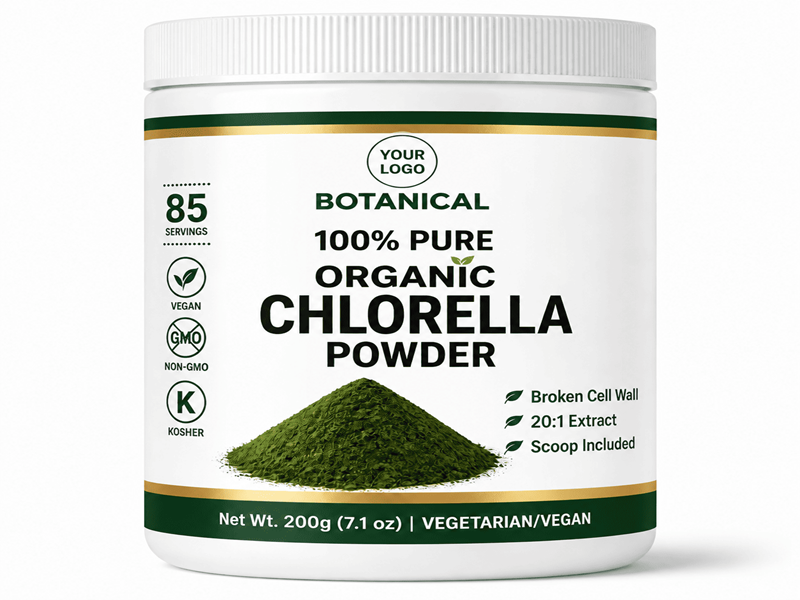
A deep green powder can make a supplement look convincing long before anyone knows whether the formula will work. Chlorella is a good example. It brings a recognizable microalgae ingredient story, but it also brings questions about cell-wall processing, flavor, powder handling, ingredient consistency, and contaminant testing. For an established supplement brand, those practical questions usually matter more than a long list of possible benefits. A product has to remain consistent from the development sample through repeated commercial batches.
Chlorella is used in dietary supplement formulation as a whole-microalgae ingredient that contributes protein, pigments, and naturally occurring micronutrients. Manufacturers incorporate it into capsules, tablets, greens powders, and some drink or gummy concepts. Effective formulation requires selecting a verified chlorella grade, establishing a suitable serving amount, managing flavor and processing behavior, and testing ingredient identity, contaminants, stability, and finished-product quality before routine production begins.
At Zoxizo, we approach this kind of project by connecting the ingredient decision to the finished product rather than treating formulation as a shopping list. Imagine a greens powder that looks excellent in a product photograph but settles in the glass, leaves a persistent aftertaste, and clumps in humid weather. None of those problems can be solved by pointing to the ingredient’s nutritional reputation. The useful work begins when the formula, manufacturing process, packaging, and quality requirements are evaluated together.
What Does Chlorella Add to Supplement Formulas?
Chlorella adds naturally occurring protein, amino acids, chlorophyll-containing pigments, carotenoids, and selected micronutrients to dietary supplements. It appears in single-ingredient algae supplements and multi-ingredient greens blends. Its practical contribution depends on species, cultivation, processing, and the amount used per serving. A dependable formulation relies on measured ingredient specifications, real serving calculations, and relevant finished-product checks rather than assuming every chlorella powder has the same nutritional profile.
Which Nutrients Does Chlorella Provide?
Chlorella is often described as a protein-rich microalga, and that description has a useful scientific basis. A 2020 review in Nutrients summarized label information for 13 commercial chlorella products and found approximately 59% protein by dry weight across those products. That is a reference point, not a specification applicable to all suppliers. A hypothetical powder containing 60% protein contributes 600 mg of protein when a serving contains 1,000 mg of the powder. The calculation also shows the limitation: an ingredient can be protein-rich without making the finished supplement a meaningful source of protein under applicable labeling rules.
Chlorella may also supply chlorophyll, carotenoids, iron, and other micronutrients, but concentration and nutritional availability vary. Vitamin B12 deserves particular care because a laboratory result for B12-like compounds does not necessarily establish a reliable amount of active vitamin B12. The product team should decide which nutritional attributes matter, request lot-specific analytical results, and calculate their contribution at the proposed serving size. For claims about particular vitamins or minerals, the finished product and the destination market’s rules are more relevant than a broad description of chlorella as a superfood.
How Is Chlorella Used in Greens Blends?
Greens powders are a natural setting for chlorella because consumers already expect plant-derived ingredients, a green appearance, and a mixed beverage format. It can sit alongside spirulina, barley grass, wheatgrass, vegetable powders, or selected fibers, provided every component has a reason to be there. A 6 g serving containing 300 mg of chlorella has a 5% inclusion rate; increasing it to 900 mg raises that figure to 15%. That threefold change may have more effect on taste, color, dispersion, and cost than a shopper would realize from reading the label.
The challenge is not fitting another ingredient name onto the packaging. It is creating a drink that people can prepare repeatedly and recognize as the same product each time. A higher chlorella percentage can make the blend more intensely colored or earthy, while its suspended particles may settle after mixing. Zoxizo’s documented development services include greens powders, custom powder formulation, flavor adjustment, sampling, and packaging selection. Those general capabilities are relevant to evaluating a proposed chlorella blend, although a particular inclusion rate must be validated in the actual formula rather than presented as an established house recipe.
What Makes Chlorella Different From Other Algae?
Chlorella and spirulina often appear next to each other on supplement labels, yet they are not interchangeable ingredients. Chlorella is a eukaryotic green microalga, while commercial spirulina generally comes from Arthrospira, a photosynthetic cyanobacterium. Their cellular structures, pigments, nutritional profiles, and processing behavior differ. Chlorella has a comparatively resistant cell wall, making disruption methods relevant to ingredient development. Replacing 500 mg of spirulina with 500 mg of chlorella keeps the total ingredient weight unchanged, but it does not preserve an identical nutrient profile or the same sensory performance.
This difference also matters when comparing chlorella with marine algae or specialized algae extracts. One material may be selected primarily for its whole-biomass composition, another for a particular pigment or extracted constituent. A sensible comparison uses scientific identity, processing documentation, real analytical results, and performance in the chosen dosage form. Broad statements that one alga is always better absorbed or healthier than another leave out the variables that manufacturers actually control. For a commercial product, consistency and suitability are more useful decision criteria than an ingredient popularity contest.
Which Form of Chlorella Should You Use?
Choose a chlorella form according to the desired nutritional profile, dosage form, processing requirements, and regulatory status. Whole-biomass powder, broken-cell-wall powder, and specialized extracts serve different purposes and should not be treated as equivalents. Review species identity, processing details, composition, particle properties, contamination results, batch consistency, and the proposed finished-product application before selecting a grade for initial formulation trials and comparative sampling.
What Is Broken Cell Wall Chlorella?
Broken-cell-wall chlorella is biomass processed to disrupt its cell structure and improve access to compounds inside the cells. Mechanical milling, high-pressure treatment, and other validated processes may be used, depending on the starting material and manufacturing objective. The term is useful, but it does not describe a single universally standardized method. A supplier advertising a 90% or 95% disruption rate should be able to explain how that percentage was measured. Cell disruption is not the same measurement as human absorption, so a claimed breakage percentage must not be converted into an unsupported bioavailability promise.
Processing can also introduce trade-offs. Smaller particles or greater exposure of cell contents may alter blending behavior, appearance, flavor, or stability. Research on chlorella cell-wall treatment has explored changes in nutrient accessibility and the consequences of different disruption methods, but outcomes depend on the specific process and measurement used. For a capsule project, powder bulk density and flow might matter more than beverage dispersion; for a drink powder, texture and settling may become decisive. The preferred grade is the one whose identity, composition, and behavior can be verified for the intended application.
How Do Chlorella Powders and Extracts Differ?
Whole chlorella powder usually refers to dried biomass retaining a broad range of its original constituents, subject to the effects of harvesting, drying, and other processing. A chlorella extract is a more specific preparation obtained by extracting or separating selected components. These materials can differ in carriers, constituent concentrations, physical properties, and permitted uses. A nominal 10:1 extract ratio, for example, does not prove that every nutrient is ten times more concentrated. Extraction yield and marker testing are needed to understand what the number actually represents and whether it matters to the planned formula.
Brands developing a whole-algae nutritional supplement may find an authenticated biomass powder more aligned with the concept than a narrow extract. An ingredient intended to deliver a defined extracted constituent needs a different specification and perhaps a different safety and regulatory assessment. Zoxizo’s broader formula development workflow considers ingredient selection, dosage-form matching, cost, flavor, and market requirements. That framework is suitable for comparing commercial options, but neither an extract nor a whole powder should be selected simply because its name sounds more premium. The specification must explain what the manufacturer is buying and what the consumer will receive.
How Does Chlorella Quality Affect Selection?
A raw material can pass a quick visual inspection and still be unsuitable for an established brand’s production program. Chlorella grades may differ in species, cultivation environment, color, odor, moisture, particle size, and measured nutrient composition. A laboratory study published in Frontiers in Nutrition reported protein contents of approximately 59.6% to 65.5% of dry matter among five commercial microalgal biomasses, while a differently cultivated laboratory sample had a substantially different composition. That illustrates the risk of treating a published average as the guaranteed content of every supply lot.
An initial supplier comparison can examine the current specification and, where available, results from three representative lots to identify obvious variability. Three lots are a practical screening example, not a regulatory minimum or proof of statistical process capability. Important questions include whether particle size and bulk density fit the manufacturing equipment, whether contaminant tests cover the actual risks, and whether the supplier can maintain an approved specification over repeat orders. Zoxizo’s documented quality process includes supplier qualification, incoming material review, raw-material documentation, and production checks. Chlorella-specific acceptance limits would still need to be established for the selected material and destination market.
| Ingredient characteristic | Useful measurement or record | What it helps determine |
| Identity | Scientific name and suitable identity method | Whether the correct microalga is supplied |
| Protein composition | g/100 g or % dry weight | Contribution at the actual serving size |
| Moisture | % by weight | Storage and powder-handling concerns |
| Particle profile | D10, D50, D90 in µm, where available | Mixing, filling, mouthfeel, and dispersion |
| Bulk density | g/mL | Capsule and container-volume estimates |
| Elemental contaminants | Relevant elements reported in mg/kg | Ingredient exposure and specification review |
| Microbiological quality | Appropriate CFU/g and pathogen results | Risk-based raw-material acceptance |
Which Supplement Forms Work Best With Chlorella?
Capsules, tablets, and dry powders are established ways to deliver chlorella. Capsules reduce direct flavor exposure, tablets offer measured solid servings, and powders allow greater flexibility for larger ingredient amounts. Drinks and gummies may be possible but demand closer attention to flavor, sediment, gel texture, and stability. The best format matches serving size, processing behavior, consumer convenience, and packaging requirements.
How Is Chlorella Used in Capsules?
Capsules can make chlorella easier to use for people who prefer not to drink an earthy-tasting powder. The development decision starts with how much material the daily serving should contain and whether the chosen capsule size can hold it. A hypothetical 1,000 mg daily serving could use two capsules containing 500 mg each, but only if the actual powder’s density and flow allow reliable filling. Adding other ingredients takes up further volume. A fill-weight target that looks reasonable on paper may fail when the material is tested in the intended filling equipment.
The capsule shell, moisture exposure, and packaging also matter. Gelatin and plant-derived shell materials have different properties, and the selected combination must be suitable for the ingredients and intended market. Capsule manufacturing checks may include net fill weight, unit consistency, shell integrity, and other applicable specifications. Zoxizo’s documented manufacturing portfolio includes capsules and their associated sampling and packaging services. For a proposed chlorella product, the final capsule count, shell, and pack size should follow equipment trials and quality assessment rather than relying on an assumed standard amount per capsule.
How Is Chlorella Used in Tablets?
Tablets provide a compact serving and can be convenient for repeated daily use, but turning microalgae powder into a strong, consistent tablet is not always straightforward. Compressibility, particle distribution, moisture, lubricant selection, and the use of binders or granulation can all influence the result. A proposed 600 mg tablet containing 500 mg of chlorella leaves 100 mg for other required components, but that arithmetic does not establish that the tablet will hold together or disintegrate appropriately. The appropriate composition can only be determined through practical formulation and compression work.
Tablet evaluation should consider thickness, hardness, friability, disintegration, appearance, and stability under the intended packaging conditions. A tablet that survives transport but does not meet its disintegration specification is not a successful finished product. Equally, a tablet that disintegrates readily but breaks during handling is not commercially dependable. Tablet processing may require a different chlorella particle grade from the one selected for a greens beverage. The ingredient, excipients, equipment settings, and serving plan need to be evaluated together rather than treating compression as the final mechanical step after the formula has already been fixed.
Can Chlorella Be Used in Powders and Drinks?
Chlorella is well suited to dry greens blends and other drink-powder concepts, but whole biomass generally disperses in liquid rather than dissolving completely. An 8 g powder serving containing 1 g of chlorella has a 12.5% inclusion rate, which may be enough to noticeably affect appearance, taste, and texture. After shaking, the liquid can look uniform before particles gradually settle. Testing at defined time points, such as immediately and after 5, 15, and 30 minutes, can help characterize that behavior. These are illustrative product-development checks, not required testing intervals.
A useful beverage trial specifies water volume, temperature, mixing method, and observation conditions so that samples can be compared fairly. A formula tested in 200 mL of water should not be judged directly against another prepared in 400 mL unless dilution is deliberately being evaluated. Flavor and packaging decisions follow the same discipline: fruit notes, sweeteners, acidity, and moisture barriers should be assessed in the complete formula. Zoxizo’s documented powder development capabilities cover ingredient blending, sensory adjustments, sampling, and packaging selection, which are relevant when evaluating a chlorella drink concept for commercial production.
Is Chlorella Suitable for Gummies?
Gummies are possible in principle, but chlorella’s flavor, particles, and color must work within a moist gel system. A hypothetical gummy with 200 mg of chlorella would provide 400 mg in a two-gummy serving. A product aiming for 1,000 mg would need a different serving structure, a higher per-unit concentration, or another dosage form. Increasing the load can affect gel texture, visual uniformity, and taste. Heat exposure, acidity, water activity, and storage behavior also matter, so a dry-powder calculation does not by itself establish gummy feasibility.
The right prototype should be evaluated not only on the day of manufacture but after appropriate storage observations. Gummies can change in firmness, surface appearance, moisture, and flavor as they age. Zoxizo supports gummy formulation and manufacturing generally, but a specific chlorella concentration is not a confirmed capability without a product trial. If the product needs a relatively high whole-algae serving, capsules or powders may be more practical. A convenient format is valuable only when the manufacturer can maintain an acceptable texture, quality profile, and consistent declared content throughout the intended shelf life.
| Format | Illustrative serving calculation | Main practical check |
| Capsule | 2 × 500 mg = 1,000 mg chlorella | Actual powder fill capacity |
| Tablet | 3 × 400 mg = 1,200 mg chlorella | Strength, friability, disintegration |
| Greens powder | 600 mg in 6 g = 10% inclusion | Blend uniformity and taste |
| Drink powder | 1,000 mg in 8 g = 12.5% inclusion | Dispersion, sediment, aftertaste |
| Gummy | 2 × 200 mg = 400 mg chlorella | Texture, moisture, and stability |
All quantities in this table are hypothetical calculations, not recommended intake levels, validated formulations, or Zoxizo product specifications. An appropriate serving must be justified for the selected ingredient, target consumer, finished dosage form, and destination market. The table compares how packaging convenience and processing challenges can change even when the same general raw material is involved. Real capsule capacities, compression properties, mixing results, and gummy loading must be determined from the selected commercial chlorella grade.

How Is Chlorella Combined With Other Ingredients?
Chlorella can be combined with spirulina, vegetable powders, selected fibers, vitamins, minerals, and other compatible dietary ingredients when each serves a clear purpose. The formula must balance nutritional contribution, serving size, sensory quality, physical mixing, and stability. Adding more ingredients does not automatically make a supplement more useful, especially when the amount of each component becomes too small to support its intended role.
Which Ingredients Pair Well With Chlorella?
Chlorella and spirulina frequently appear together in algae blends, while greens products may combine chlorella with barley grass, wheatgrass, vegetable powders, or fibers. Those combinations are familiar, but familiarity is not evidence of superior effectiveness. Each material has its own composition, flavor, density, and moisture behavior. If the formula includes vitamins or minerals, they should contribute defined amounts appropriate to the intended product and applicable labeling rules. A vitamin premix may contain very small components that require careful distribution across a much larger mass of green powders.
Other ingredients can introduce less obvious constraints. Inulin or another fiber may change mouthfeel and digestive tolerance at the chosen amount; acids can influence the flavor and appearance of a prepared beverage; probiotics, if included, may require special protection from moisture and processing conditions. The practical starting point is to give every ingredient a job and then test whether the whole formula does that job. A balanced five-ingredient blend can be easier to explain, manufacture, and reproduce than an elaborate list of twenty materials included at nominal weights.
How Is the Chlorella Amount Determined?
The amount of chlorella should be chosen from the product concept and supporting evidence, not from a universal inclusion percentage. A single-ingredient tablet can be dominated by chlorella, while a multi-ingredient greens blend might include it at a smaller fraction of the total serving. In a 5 g powder serving, 500 mg represents 10% and 1,000 mg represents 20%. Doubling the amount reduces the space for other ingredients by 500 mg and may alter flavor, ingredient cost, suspension behavior, and the product’s visual appearance. It does not automatically double a clinically meaningful effect.
The distinction between raw-material composition and finished-serving claims is especially important. If a hypothetical chlorella ingredient contains 60% protein, 500 mg contributes about 300 mg of protein before other formula contributions and analytical variability are considered. The manufacturer cannot justify a meaningful protein claim from that number alone. The selected amount must also fit the physical limits of the dosage form and any safety assessment relevant to the target population. Zoxizo’s custom development process evaluates serving weight, ingredient strategy, flavor, cost, and manufacturing feasibility together before a proposed formula is approved for further testing.
How Are Taste and Color Managed?
Chlorella can bring grassy, earthy, or other distinct notes that are especially noticeable in a beverage. Increasing sweetener is not always the right solution, since sweetness may cover an initial taste without removing the lingering aftertaste. A better sensory trial begins with the unflavored base formula and compares possible adjustments to the chlorella grade, amount, flavor system, acidity, and preparation instructions. Every sample should be made at the same concentration when the goal is to compare flavor changes. Otherwise, a more diluted drink may seem improved for reasons unrelated to formulation quality.
Color is both a benefit and a complication. The strong green appearance may suit a greens powder, yet a product can look very different dry, freshly mixed, and after standing. Pigment-related changes during processing or storage should be assessed where relevant to the product’s specifications. A sensible trial records aroma, initial taste, aftertaste, mouthfeel, color, and settling behavior rather than using a single informal score. Zoxizo’s documented R&D process includes sensory evaluation and sample revision. For an actual chlorella formulation, that process would focus on what consumers experience when preparing and using the supplement normally.
How Is Ingredient Compatibility Evaluated?
Compatibility testing asks whether the ingredients continue to behave acceptably once they are combined, manufactured, and stored. A powder mixture with different particle densities may segregate during transfer, even if it looked uniform inside the blender. Hygroscopic ingredients may increase clumping risk, while certain vitamins or other components can be sensitive to moisture, heat, oxygen, or light. A formula that mixes easily today still needs an appropriate plan for manufacturing and shelf-life stability. The correct measurements depend on the actual material, dosage form, and intended storage conditions.
One useful development approach compares controlled variations rather than changing every part of the formula at once. Three trial blends might contain the same chlorella grade and amount while varying a flavor system or companion ingredient. Differences in aroma, dispersion, moisture behavior, and physical consistency can then be linked more confidently to the changed variable. Zoxizo’s general development workflow includes formulation trials, sample feedback, ingredient review, and stability considerations. Compatibility should ultimately be demonstrated through relevant observations and tests, not assumed because the individual ingredients are commonly used in supplements.
How Are Chlorella Formulas Prepared for Production?
Preparing a chlorella supplement for production requires an approved ingredient specification, a controlled formula, suitable equipment parameters, process checks, and packaging designed for the product. Laboratory mixing alone does not demonstrate that a formula will perform consistently at commercial scale. Sampling, stability work, and pilot or scale-up evaluations help reveal problems with powder flow, blending, filling, compression, or storage before routine manufacturing.
How Does Chlorella Affect Mixing and Flow?
Powder handling affects the consistency of every unit produced. Chlorella’s bulk density, moisture, particle distribution, and cohesion may influence how it moves through feeders, mixers, and filling equipment. A fine powder may create dust or adhere to equipment, while mixtures containing components of very different sizes may segregate during transfer. The dark green color can be misleading: a blend may look evenly colored without proving that a low-dose vitamin or mineral is uniformly distributed. Visual inspection therefore needs to be supported by appropriate process controls and analytical methods where necessary.
A practical development team may measure bulk and tapped density and use these results to examine powder behavior. For example, a hypothetical bulk density of 0.40 g/mL and tapped density of 0.50 g/mL produce a Hausner ratio of 1.25. That ratio offers one indicator of powder packing behavior, but it cannot independently predict success on a specific machine. Mixing sequence, equipment fill level, and transfer conditions also matter. Zoxizo’s documented manufacturing process includes weighing verification, in-process quality checks, and finished-product inspection. The appropriate blending procedure must be established for the final chlorella formula rather than borrowed unchanged from an unrelated powder product.
How Are Moisture and Stability Controlled?
Moisture management begins when raw material arrives and continues through weighing, blending, filling, and storage. Powder that absorbs water during processing may become harder to handle or more prone to clumping. Moisture content and water activity are different measurements: the first describes the amount of water present, while the second indicates how available that water is for relevant reactions and microbial processes. Depending on the product, both may inform the stability program. Packaging material, closure quality, oxygen exposure, light, and temperature can also influence chlorella’s appearance and the stability of sensitive constituents.
An appropriate shelf-life program evaluates the finished formula in the intended packaging, not just the isolated chlorella powder. A brand might plan observations at the start and at selected intervals such as 3, 6, and 12 months, with real-time and other justified study conditions. Those intervals are examples, not a universal method for assigning an expiration date. The tests might cover appearance, moisture, microbial quality, selected nutrient markers, or dosage-form performance. Zoxizo’s documented development services include early stability consideration and packaging selection; commercial shelf-life statements still require product-specific supporting evidence under relevant market requirements.
How Are Chlorella Formulas Sampled?
A working sample turns the ingredient list into a product that can be prepared, measured, tasted, and discussed. For a greens powder, sample review may reveal an aftertaste, rapid settling, or handling problems. Capsule trials may show that the intended amount does not fit the selected shell, while tablet trials may reveal inadequate compression behavior. These findings should lead to controlled adjustments rather than unrecorded changes. When the ingredient supplier, serving size, or dosage form changes, the sample’s relationship to the approved specification needs to remain clear.
For example, a team may compare powder concepts containing 5%, 10%, and 15% chlorella while holding other variables as consistent as possible. These percentages are experimental illustrations, not an industry-standard range or a recommendation for a particular audience. The comparison can reveal how inclusion affects color, flavor, dispersion, and cost, after which more focused revisions can follow. Zoxizo’s documented service process includes requirement analysis, formulation, samples, feedback, and revisions before bulk manufacturing. Its company materials also describe an R&D team and development facilities, but no specific completed chlorella project is assumed from those general capabilities.
How Is a Formula Scaled for Bulk Production?
Scaling a formula requires both correct arithmetic and verification that the larger process behaves as intended. A mixture with 2% chlorella contains 0.2 kg in a 10 kg development batch and 6 kg in a 300 kg production batch. Those ingredient quantities are easy to calculate, but mixing times, loading patterns, transfer losses, and environmental exposure may change as equipment size increases. A powder that performs well in a small laboratory mixer may segregate during transfer to a commercial filling line. The approved process therefore needs defined conditions and appropriate in-process evidence.
Scale-up can involve pilot batches, equipment trials, reconciliation of ingredient inputs and outputs, and verification of relevant quality attributes. For capsules, the team may assess fill consistency; for tablets, compression and disintegration; for drink powders, uniformity, flow, and packaging suitability. Documented production records allow later batches to be compared with the approved formula and process. Zoxizo’s established service chain includes sampling, bulk production, in-process inspection, finished-product testing, and traceability. The commercial objective is not to make a successful first batch by chance, but to establish a repeatable process that can support future orders without uncontrolled changes.

How Are Chlorella Supplements Tested for Quality?
Chlorella supplement quality is evaluated through material identity, risk-based contaminant testing, suitable manufacturing controls, finished-product specifications, labeling review, and batch traceability. Relevant checks may include microbial results, elemental contaminants, moisture, composition, and dosage-form performance. A supplier certificate alone does not prove that every requirement has been met; acceptance criteria and tests must suit the selected material, the finished product, and the destination market.
Which Raw Material Tests Are Important?
The first question is whether the supplied material is the chlorella ingredient approved for the formula. The scientific identity, processing grade, supplier documentation, and appropriate test methods should agree with the raw-material specification. Depending on the material, identity verification may involve suitable microscopic, molecular, or analytical approaches. Physical observations such as color and odor are helpful but not sufficient substitutes for identity verification. Composition, moisture, particle distribution, and other attributes can also matter if they influence the formula or manufacturing performance. Acceptance should be based on defined specifications rather than whatever information happens to appear on a supplier brochure.
US dietary supplement current good manufacturing practice requirements in 21 CFR Part 111 establish specific controls for material identity, specifications, quality responsibilities, and records. Reliance on supplier certificates for permitted specification determinations has conditions, including qualification and documentation, and should not be confused with the identity verification requirements for dietary ingredients. Zoxizo’s documented quality process includes supplier review, incoming inspection, production controls, finished-product checks, and batch records. For a chlorella project, the relevant test plan should follow a written risk assessment and applicable legal requirements, with appropriate laboratory methods and clearly defined lot acceptance criteria.
How Are Heavy Metals and Microbes Tested?
Microalgae can take up substances from their cultivation environment, so the origin and control of chlorella biomass matter. A risk-based assessment commonly considers lead, cadmium, mercury, and arsenic, with exact tests and limits determined by regulations and the ingredient’s intended use. Elemental results may be reported in mg/kg, numerically equivalent to parts per million by mass. If an ingredient contains 0.5 mg/kg of a particular element, a 1 g daily serving of that ingredient would contribute 0.5 micrograms of the element. That is an exposure calculation only, not a statement that the exposure is safe or legally acceptable.
Testing may also need to distinguish total arsenic from inorganic arsenic, depending on the risk and regulatory framework. Microbiological testing can address relevant indicator organisms and specified pathogens using scientifically suitable methods. A 2025 study of 52 commercial spirulina and chlorella supplements investigated heavy metals and pharmaceutical residues, reminding manufacturers that natural origin is not proof of freedom from contamination. The appropriate testing package should be decided from the ingredient and product risk profile; neither an organic label nor an attractive certificate cover automatically replaces actual analytical evidence.
What Should a Chlorella COA Include?
A certificate of analysis should connect real test results to an identifiable lot. Useful fields include material name, scientific identity where relevant, batch number, analytical parameters, methods, specifications or limits, measured results, and appropriate authorization details. Raw-material COAs may report composition, moisture, microorganisms, or elemental contaminants; finished-product COAs can cover selected parameters established for the finished supplement. Their contents should follow the actual specification rather than a universal checklist copied into every project. A statement that testing was passed, without sufficiently clear test information, may be inadequate for a mature brand’s quality review.
The distinction between a supplier COA and a finished-product quality record matters. A raw ingredient can meet its own specification while the final product fails a unit-weight or stability requirement. Zoxizo’s company documentation describes support for ingredient records, COAs, finished-product testing, and batch traceability according to product and customer requirements. Expectations should be agreed before production, including any need for independent laboratory testing. A clearly defined document package makes supplier qualification, release decisions, and later investigations easier, particularly when a product will be manufactured repeatedly or sold through multiple markets.
How Are Labels and Claims Reviewed?
A chlorella formula is not market-ready until its identity, serving size, ingredient statements, and claims have been reviewed for the intended destination. In the United States, dietary supplements have specific labeling requirements, and claims must be truthful and not misleading. A raw ingredient described as protein-rich does not automatically justify a high-protein claim on the finished product; the amount per serving and applicable criteria control that conclusion. The same care applies to iron, vitamin B12, or any other nutrient claimed on the label. Research on chlorella cannot simply be converted into promises that a particular finished supplement treats a disease.
For certain US dietary supplement structure/function claims, the responsible firm must have substantiation, use the required disclaimer, and submit notification to FDA no later than 30 days after first marketing the product with the claim. Some new dietary ingredients may also require a notification at least 75 days before marketing, unless an exception applies. Rules in other markets differ, and the status of a particular species or extract needs to be checked rather than inferred from the word chlorella. Zoxizo’s documented services include packaging, label-related support, and compliance documentation, but product-specific regulatory review remains essential before any market-entry or claims decision.
How Is Batch Consistency Verified?
Batch consistency means that the product repeatedly meets its approved requirements, not merely that different production lots look equally green. Consistency may be assessed through ingredient identity, controlled formulas, production parameters, applicable content tests, dosage-unit performance, finished-product checks, and documented release decisions. A green blend can appear uniform while a low-dose component is unevenly distributed; a capsule batch can have acceptable appearance while its fill-weight variation requires investigation. Quality therefore depends on a combination of validated or otherwise appropriate methods, manufacturing records, and qualified review rather than visual reassurance alone.
For long-term supply, ingredient sourcing and process changes need particular attention. Changing a chlorella grade, supplier, mixing procedure, or package can affect properties that were acceptable in the original sample. Change control and traceability help determine whether further evaluation is needed. Zoxizo’s documented quality workflow covers incoming-material checks, in-process inspections, finished-product testing, records, and traceability. These established company capabilities provide a framework for discussing a proposed chlorella product, while project-specific results must come from the actual formulation and manufactured batches. Reliability is something that records and repeated performance demonstrate, not something a manufacturer can establish through a broad claim.
| Quality item | Typical unit or evidence | Decision it supports |
| Species identification | Scientific name and suitable identity result | Approved-ingredient confirmation |
| Moisture | % by weight | Incoming and storage assessment |
| Elemental contaminants | mg/kg for relevant elements | Exposure and acceptance assessment |
| Microbiological quality | CFU/g or pathogen result for defined sample | Raw-material and product safety review |
| Serving content | mg per serving or suitable analytical result | Formula and label verification |
| Finished dosage form | Weight, disintegration, or applicable checks | Manufacturing release evaluation |
| Batch traceability | Lot numbers and production records | Reproducibility and investigation |
These are examples of practical quality records, not a universal test panel or fixed numerical acceptance limits. Actual limits and verification methods must be selected for the material, finished dosage form, and applicable market. A raw-material result cannot automatically substitute for testing of the finished formula, and a passing result from one lot does not release another lot without its required review. The exact scope should be agreed before production and documented consistently.
Conclusion
Chlorella can be a useful component of a dietary supplement, but a reliable finished product needs more than recognizable algae branding. The ingredient must be identified and specified correctly, used at an amount that suits the product, and tested in the chosen capsule, tablet, powder, drink, or gummy system. Flavor, processing behavior, contaminant controls, packaging, stability, and labeling all influence whether the formula can move from an attractive sample to consistent production. Zoxizo’s documented supplement development and manufacturing services provide a framework for evaluating these decisions with brands planning new products or revisions to an existing range. The aim is a formulation that works in actual use, meets its approved specifications, and can be produced again with confidence.

Frequently Asked Questions
Is broken-cell-wall chlorella better than regular chlorella powder?
Broken-cell-wall chlorella may make intracellular components more accessible, but better is not a universal outcome that applies to every product. Results depend on the species, processing method, measured composition, and intended use. A supplier’s claimed disruption percentage is not a measured human absorption rate. For capsules or drink powders, physical properties and stability may be as important as cell-wall treatment. Compare validated ingredient specifications and trial performance before treating one grade as superior to another.
How much chlorella should a supplement contain?
There is no single inclusion amount that fits every supplement. The appropriate quantity depends on the intended product, ingredient specification, supporting safety evidence, dosage form, consumer group, and labeling rules. A hypothetical 500 mg addition to a 5 g greens powder represents 10% of the formula, but this calculation does not establish an effective or recommended daily dose. Commercial development should assess actual nutrient contribution, flavor, manufacturing feasibility, and compliance rather than copying a competing product’s serving amount.
Can chlorella be combined with spirulina in the same supplement?
Yes, chlorella and spirulina are commonly considered together in algae supplements and greens blends. They differ in cellular structure, composition, and processing needs, so the combined formula must be assessed as a complete product. Ingredient proportions should reflect the intended serving, analytical specifications, taste, and physical blending characteristics. Their presence in the same formula does not automatically demonstrate stronger health benefits. Any finished-product claims still need appropriate substantiation and review for the market where the supplement will be sold.
Does chlorella powder dissolve completely in water?
Whole chlorella biomass generally disperses as suspended particles rather than dissolving completely like a soluble compound. A prepared drink may therefore develop sediment after standing, even when mixing initially produces an even green appearance. Particle size, the other ingredients, liquid volume, and preparation method all influence the result. A development trial can evaluate immediate dispersion and changes after defined standing intervals. Product instructions should reflect the actual preparation experience rather than promising complete solubility without supporting tests.
What tests are important for a chlorella supplement?
Testing generally starts with ingredient identity and specifications, then considers relevant contaminants, microbial quality, composition, processing performance, and finished-product requirements. Lead, cadmium, arsenic, mercury, and microbial indicators may be relevant depending on risk and regulatory requirements; no single generic panel applies to every product. A suitable COA should identify the tested batch, methods, acceptance criteria, and results. Quality also depends on supplier qualification, manufacturing controls, stability evidence, and traceable batch records, not one certificate alone.
Can chlorella be used in private label or custom supplement manufacturing?
Chlorella may be considered for custom capsules, tablets, greens powders, and other dosage forms if the selected ingredient is appropriate and the product is technically and legally feasible. The work normally begins with an ingredient specification and product brief, followed by serving-size assessment, prototype development, quality planning, and packaging evaluation. Zoxizo supports these stages through its general OEM/ODM and formula development services. Specific chlorella manufacturing claims, minimum order quantities, lead times, and finished-product specifications would require confirmation for the proposed project.