Skip to content

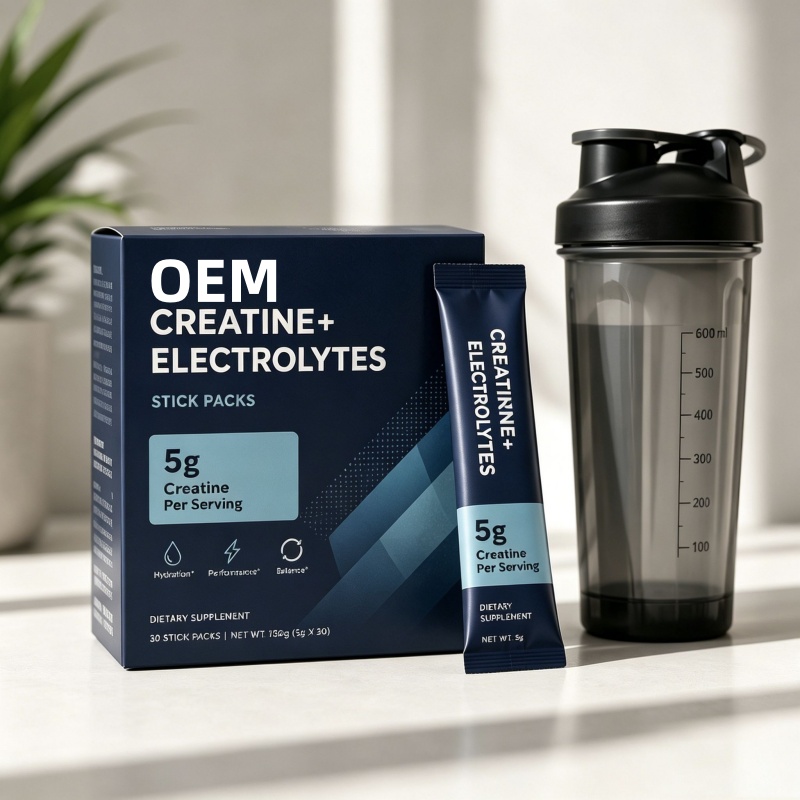
Creatine may look like one of the simplest products in sports nutrition. A plain powder can have a short ingredient list, a familiar daily serving, and packaging that consumers already understand. That apparent simplicity often disappears as soon as a brand tries to turn the idea into a commercial product. Dose affects package size. Particle behavior affects mixability. Flavor changes the formula environment. Gummies introduce moisture and processing heat. Capsules create a unit-count problem. Testing, label declarations, packaging barrier, and production scale all have to work together rather than being solved separately.
Developing a creatine dietary supplement starts with a clear target market, consumer, serving dose, dosage form, product positioning, and commercial price structure. Creatine monohydrate is usually the practical reference point, but the final product must also account for mixability, flavor, moisture, heat, packaging, batch testing, label requirements, manufacturing controls, and shelf-life performance before full commercial production begins.
A surprisingly common development problem starts with a beautiful package rendering and a finished marketing concept before anyone checks whether the intended serving will physically fit inside the format. A five-gram creatine dose looks easy on a spreadsheet, yet the picture changes after flavors, acids, sweeteners, minerals, capsule capacity, gummy matrix weight, packaging volume, and stability are added. The better approach is to solve the product from the inside out, beginning with what consumers need to receive in each serving and ending with a package that protects and communicates it properly.
What Should You Define Before Developing a Creatine Supplement?
A creatine supplement should be defined commercially before detailed formulation begins. Establish the target market, consumer, sales channel, intended creatine dose, dosage form, package, price position, claims direction, and expected production volume first. These choices directly affect formula feasibility, testing requirements, package dimensions, production cost, label structure, and whether the finished product can remain practical when it moves from sample development into repeat commercial production.
Target Market and Consumer
“Creatine users” are not one single customer group. A dedicated gym user buying a large unflavored tub may care mainly about dose transparency, price per serving, mixability, and batch testing. Someone discovering creatine through a lifestyle wellness brand may care more about flavor, portability, package design, and fitting the product into an easy daily routine. Those differences need to influence the product specification before ingredients are selected.
Sales channel matters just as much. A retail product has to work on a physical shelf, while an online product must survive parcel delivery, communicate clearly through product images, and often fit subscription or repeat-purchase behavior. Stick packs may make sense for travel and convenience, while a high-serving-count jar can work better when value and daily gym use are central to the offer.
The development team should also define the intended market before finalizing ingredients, claims, labels, and packaging. Different countries and channels can have different ingredient, labeling, documentation, and testing expectations. Waiting until production is almost complete to ask whether a formula or claim is appropriate for the intended market can create unnecessary reformulation, artwork changes, testing expenses, and delays.
A useful project brief should describe who will use the product, where it will be sold, how often it will be consumed, the expected serving format, the desired retail position, and the approximate order scale. That information gives R&D and production teams something much more useful than a broad request to “make a premium creatine.”
Product Positioning
Creatine is already familiar to consumers, so differentiation should be deliberate rather than decorative. A longer ingredient panel is not automatically more valuable, and a more complicated format is not automatically more premium. A strong product usually gives consumers one or two clear reasons to choose it, then makes sure the formulation and packaging actually support those reasons.
Common positioning routes include single-ingredient creatine monohydrate, flavored daily-use powders, single-serving stick packs, creatine combined with electrolytes, convenient capsule products, and consumer-friendly gummy formats. Each route carries a different technical burden. A plain powder can focus on ingredient quality, serving accuracy, and price. A flavored formula has to solve sweetness, acidity, mouthfeel, and sediment. A gummy needs much more attention to payload, moisture, heat, and stability.
The internal product definition should therefore be specific enough that different departments can work toward the same result. “A thirty-serving, five-gram creatine monohydrate powder for regular gym users who want a straightforward daily product with clean flavor and strong batch documentation” is much more useful than “a high-end sports supplement.”
That level of clarity helps prevent unnecessary ingredients, unrealistic packaging decisions, and late-stage cost surprises. It also makes sample approval easier because the team knows what the product is supposed to achieve rather than simply deciding whether a prototype tastes acceptable.
Single or Blended Formula
A single-ingredient creatine formula is usually easier to develop, manufacture, test, explain, and scale. Because creatine is normally used in gram-level quantities, keeping the formula simple also helps control serving weight and package size. For many sports-nutrition products, simplicity can be a commercial strength because consumers already understand the ingredient and often want to know exactly how much they are receiving.
Blended products make sense when additional ingredients create a clear use occasion. Creatine paired with electrolytes, for example, can support a hydration-oriented concept. Other formulas may include carbohydrates, amino acids, vitamins, minerals, or selected performance ingredients. The key question is whether each addition improves the product enough to justify the extra serving weight, flavor work, raw-material cost, testing, and regulatory review.
Formula size can increase quickly. A product containing five grams of creatine may start as a compact serving, but adding several grams of supporting ingredients, flavor, sweetener, acids, and processing aids can turn it into a much larger powder portion. That affects scoop size, sachet dimensions, carton count, shipping weight, and how much water consumers need for an acceptable drinking experience.
Every added ingredient should therefore earn its place. It should have a clear role, fit at a meaningful amount, remain compatible with the intended dosage form, and still leave the product commercially workable. A formula that looks impressive on a label but tastes poor, costs too much, or requires an oversized serving is rarely a strong long-term product.
Commercial Feasibility
Commercial feasibility should be checked before the formula reaches final approval. Ingredient cost is only one part of the final economics. Manufacturing, flavor systems, packaging components, printed materials, filling, analytical testing, outer cartons, freight weight, and channel margins can substantially change the cost per finished serving.
A simple creatine calculation illustrates the point. Thirty servings containing five grams each require 150 grams of creatine before any flavor or supporting ingredients are added. Sixty servings require 300 grams. Once the product becomes flavored or multi-ingredient, total net weight can rise noticeably, which may require a larger jar, pouch, or carton and increase transport costs.
| Development Variable | 3 g Serving | 5 g Serving | Commercial Effect |
| Creatine in 30 servings | 90 g | 150 g | Changes minimum net fill |
| Creatine in 60 servings | 180 g | 300 g | Changes package volume and freight |
| Plain powder | Highly practical | Highly practical | Simple gram-level dosing |
| Stick pack | Compact | Practical | Supporting ingredients increase packet size |
| Capsules | Multiple units likely | More units likely | Daily count can become inconvenient |
| Gummies | Difficult | More difficult | Matrix adds substantial serving weight |
Cost should therefore be reviewed at the finished-serving level rather than only by raw-material price per kilogram. A seemingly inexpensive formula can become costly once packaging, testing, shipping, and dosage-form requirements are included. Early cost modeling allows the development team to adjust serving size, package count, formula complexity, or format before major sample and packaging work has already been completed.

Which Creatine Form and Dose Should You Choose?
Creatine monohydrate is usually the first form to evaluate because of its extensive use, broad consumer recognition, straightforward dry-powder application, and strong research history. Commercial products commonly use gram-level daily servings, often around three to five grams. The dose should be decided before the dosage form because it determines scoop size, capsule count, gummy count, packet dimensions, total package weight, flavor loading, and production economics.
Creatine Monohydrate
Creatine monohydrate remains the reference point for most mainstream creatine products. It is widely recognized by consumers and has a long history in sports-nutrition research and commercial use. For a manufacturer, it also fits naturally into dry powders, flavored drink mixes, stick packs, and certain other dosage forms without requiring unusual processing simply to deliver the active ingredient.
The raw material still needs a properly defined specification. Ingredient name alone does not tell the full story. Identity, assay, moisture, particle characteristics where relevant, microbiological quality, contaminant limits, storage conditions, supplier documentation, and lot traceability may all be part of the commercial specification depending on the market and manufacturing program.
Particle size deserves particular attention because consumers often use the word “solubility” to describe several different experiences. A powder may disperse quickly but still leave sediment, while another may appear gritty even though its chemistry is unchanged. Finer material can improve perceived smoothness or suspension behavior without changing the basic molecular properties of creatine.
Manufacturers and brands should also make sure the ingredient specification, manufacturing formula, analytical basis, and label declaration use consistent terminology. Confusion between creatine monohydrate weight and creatine-equivalent calculations can create avoidable problems when finished-product specifications and laboratory results are reviewed.
Dose and Serving Size
Dose is not merely a nutrition decision; it is a physical product-design decision. Research and commercial practice have made daily creatine servings around three to five grams familiar to many consumers, while higher short-term loading approaches have also been widely discussed in sports nutrition. A commercial formula should still choose its serving according to intended use, target market, consumer routine, dosage form, and label strategy.
The difference between three and five grams becomes important as soon as the ingredient leaves a scoop. Powder handles both amounts relatively easily. Capsules may require several units because the active has to fit within limited shell volume. Gummies face an even greater challenge because the gummy base itself occupies most of each piece.
Serving dose also affects flavor development. A plain five-gram creatine powder can remain relatively compact, but a flavored version may need additional ingredients for taste, sweetness, acidity, aroma, and flow. A nominal five-gram active serving might therefore become seven, eight, or more grams of finished powder depending on the formulation.
For this reason, brands should avoid choosing a capsule bottle count, gummy piece count, or stick-pack dimension before the target creatine amount has been technically confirmed. The label dose determines the physical product much more than package artwork does.
Alternative Creatine Forms
The market includes several alternative creatine forms, such as creatine hydrochloride, buffered creatine products, creatine salts, creatine ethyl ester, and proprietary branded materials. These forms can create differentiation, but they should be selected for a defined product reason rather than because a different ingredient name automatically sounds more advanced.
When evaluating an alternative form, the development team should look beyond marketing claims. Important questions include the actual creatine contribution per gram, supplier specifications, recommended serving, analytical method, market acceptance, regulatory status, ingredient documentation, trademark conditions, and stability in the intended dosage form.
Specialty materials can also change the commercial model. A branded ingredient may have a significantly different cost structure, minimum purchase requirement, documentation package, or usage agreement. If the additional expense does not create a clear consumer-facing benefit or meaningful formulation advantage, it may reduce margin without strengthening the product.
Creatine monohydrate therefore remains a sensible baseline for comparison. Alternative forms can still be useful, especially when a brand has a clear positioning strategy, but they deserve the same technical and commercial scrutiny as any other ingredient rather than being treated as inherently superior.
Raw Material Specifications
A strong raw-material program does more than collect a supplier certificate. The manufacturer should define what the material must meet before it can enter production and how those requirements are checked. That becomes especially important for brands placing repeat orders where consistency across lots matters as much as performance in the first batch.
Typical specification areas can include identity, assay, appearance, moisture, particle size when functionally important, microbiological limits, relevant contaminants, storage requirements, and supplier documentation. The exact scope depends on product type, target market, quality system, and customer expectations, so there is no single testing panel that fits every creatine project.
Supplier changes should also be managed carefully. Two creatine monohydrate materials can meet similar chemical specifications yet behave differently during filling or preparation because of particle distribution, bulk density, flow, or sensory characteristics. Those differences can influence scoop volume, packaging accuracy, dust generation, and the consumer’s perception of mixability.
For long-term programs, approved suppliers, lot traceability, incoming-material review, change notification, and clearly written specifications provide more practical protection than relying on generic descriptions such as “high purity” or “premium grade.”
Which Creatine Dosage Form Is Best?
Powder is generally the most efficient format for delivering gram-level creatine, while stick packs add portability, capsules remove mixing, and gummies create a familiar consumer experience. No format is universally superior. The right choice depends on target dose, daily routine, package size, manufacturing feasibility, sensory expectations, stability, price per serving, sales channel, and how much technical complexity the brand is willing to manage.
Powder and Stick Packs
Powder remains the most natural format for creatine because the active ingredient can represent most of the serving. An unflavored product can remain extremely simple, allowing development to focus on raw-material quality, particle behavior, filling accuracy, packaging protection, and consumer preparation.
Flavored powders create more variables. Sweeteners, acids, flavors, colors, minerals, and additional actives can affect flow, bulk density, sediment, sweetness, aftertaste, moisture sensitivity, and total serving weight. A formula that tastes balanced at eight grams in 500 milliliters of water may behave very differently if the brand expects consumers to mix it into only 200 milliliters.
Stick packs use similar dry-powder principles while offering a predetermined portable serving. They are well suited to gym bags, travel, product sampling, subscription programs, and brands that want a more structured daily-use experience. Their main limitation is physical packet capacity.
The practical sequence is to confirm the finished bulk density and serving weight first, then test packet dimensions on the intended filling equipment. A slim-looking stick may not accommodate a heavy flavored formula reliably. Film barrier, seal integrity, tearing behavior, coding space, and carton configuration also need to be evaluated before artwork and packaging procurement are finalized.
Capsules
Capsules remove the need for mixing and largely eliminate taste, which can make them appealing to consumers who prefer measured daily units. Their limitation is straightforward: gram-level creatine requires substantial physical volume, and a capsule can hold only a limited amount of powder.
Actual fill weight depends on capsule size, powder density, flow, excipients, equipment, and filling method. A theoretical calculation based solely on shell volume can therefore produce an unrealistic daily capsule count. Practical fill trials using the selected creatine material provide a more useful estimate.
As the target dose rises, multiple capsules are usually needed. If a consumer has to take a large number of capsules to reach the desired daily creatine intake, the format may become less convenient than the powder it was intended to replace. Bottle size and total capsule count also increase, affecting packaging and shipping economics.
Capsules make more sense when taste avoidance and portability are more important than minimizing the number of daily units, or when creatine is part of a wider capsule-based regimen. The decision should be based on real fill data and consumer behavior rather than simply assuming capsules are more convenient.
Gummies
Creatine gummies are commercially attractive because they translate a familiar sports-nutrition ingredient into an easy-to-understand consumer format. Technically, they are much more demanding than powder. A gummy requires a substantial matrix of gelling agents, sweetening or bulking systems, water, flavors, acids, colors, and processing aids before any creatine is added.
That creates a payload problem. Delivering gram-level creatine may require multiple gummies, and increasing the amount in each piece can affect texture, flavor, size, processability, and consumer acceptance. The gummy cannot be evaluated only by how much creatine is added at the beginning of the batch.
Water, acidity, and processing heat also deserve careful attention because creatine is more stable in dry conditions than in prolonged aqueous environments. The development team should evaluate processing temperature, time, finished pH, water activity, post-process assay, package barrier, and stability over the intended shelf life.
A useful gummy development program therefore verifies how much creatine remains in the finished product rather than relying only on theoretical batch input. This difference is critical when comparing prototypes, manufacturing methods, or competing products that may show the same declared amount on the front label.
Format Comparison
Format selection becomes easier when the product is viewed through the consumer’s daily routine. A gym-focused value product may work best in a jar, while a travel-oriented or premium subscription product can justify individual stick packs. Capsules can remove mixing but increase daily unit count, and gummies can improve familiarity while creating substantially more formulation and stability work.
| Format | Creatine Delivery | Main Advantage | Main Constraint | Typical Use |
| Unflavored powder | Excellent | Simple and efficient | Scoop and mixing required | Gym, sports nutrition |
| Flavored powder | Excellent | Better drinking experience | Larger serving and flavor work | DTC, retail |
| Stick pack | Excellent | Portable, predetermined dose | Packet capacity and film cost | Travel, e-commerce |
| Capsule | Moderate | No taste or mixing | Multiple units at gram-level dose | Convenience positioning |
| Gummy | Technically demanding | Familiar consumer experience | Payload, moisture, heat, stability | Lifestyle products |
The most exciting format is not always the strongest commercial choice. Brands should calculate serving size, package requirements, testing burden, manufacturing complexity, and cost per daily use before committing to the format. Early feasibility work is inexpensive compared with redesigning a product after custom packaging has already been ordered.

How Do You Build a Stable Creatine Formula?
Creatine stability is generally easier to control in dry products than in products containing significant water. When moisture, low pH, processing heat, and long storage times are introduced, degradation becomes a more important formulation issue. A reliable product therefore manages the complete system, including ingredient environment, process conditions, moisture protection, package barrier, preparation instructions, and stability testing rather than treating creatine concentration as the only quality measure.
Solubility and Mixability
Solubility and mixability should be treated as related but different product characteristics. Consumers often call a powder “insoluble” when they really mean it settles, disperses slowly, feels gritty, or requires too much stirring. A meaningful development test should therefore reproduce how the product is likely to be used.
The test can standardize water volume, temperature, mixing method, mixing time, and observation intervals. A sample might be evaluated in 250 to 500 milliliters of water, followed by observations immediately after mixing and again after several minutes. This allows the team to compare different particle grades, flavor systems, and supporting ingredients under consistent conditions.
Useful observations include visible floating particles, bottom sediment, grittiness, foam, cloudiness, flavor distribution, and mouthfeel. Fine-particle material may improve perceived smoothness or dispersion, but reducing particle size does not remove the fundamental limits of the ingredient’s solubility.
The finished formula matters more than the creatine alone. Minerals, fibers, botanical powders, acids, sweeteners, and flavors can all change the way a beverage looks and feels. Mixability should therefore be tested on the complete commercial formula rather than inferred from a raw-material sample.
Flavor and pH
Plain creatine requires little flavor work, but flavored creatine products create a careful balance between consumer acceptance and formulation environment. Fruit profiles often rely on acidity for brightness, while overly strong acidity can become undesirable when creatine remains exposed to a low-pH aqueous environment for an extended period.
The distinction between a dry acid-containing powder and a ready-to-drink acidic product is important. A dry powder remains relatively protected until the consumer adds water, and the drink may be consumed soon afterward. A gummy, shot, or liquid formula contains water throughout storage, which makes pH and time much more relevant to stability assessment.
Sensory development should evaluate the whole drinking experience rather than simply asking whether the flavor tastes good. First-sip intensity, sweetness, acidity, aroma, aftertaste, chalkiness, sediment, color, and taste after the beverage stands for several minutes can all affect repeat use.
It is often more efficient to prepare two or three clearly defined flavor directions and record the differences between them. Structured sample development makes it easier to reproduce the approved version during scale-up and prevents repeated changes based on vague feedback such as “make it more premium” or “make it taste stronger.”
Heat and Moisture
Heat becomes most relevant when creatine is exposed to significant water during processing or storage. A dry-blended powder typically experiences a very different chemical environment from a gummy, liquid shot, or ready-to-drink beverage. The manufacturing process should therefore be evaluated as a sequence of time, temperature, moisture, and pH rather than by one isolated maximum temperature.
For gummies and liquid systems, useful process information includes maximum temperature, time at elevated temperature, pH during processing, cooling time, water activity or moisture level, holding time before packaging, and finished storage conditions. Post-process assay becomes especially valuable because the amount added at the beginning of production may not fully describe what remains after processing.
Dry powders also require moisture control. Hygroscopic supporting ingredients can make a product clump, flow poorly, or behave differently during filling and storage. Package barrier, warehouse conditions, repeated opening, and closure quality can therefore affect the consumer experience even when the creatine itself remains chemically stable.
A good stability program links formula, processing, package, and storage conditions. It should help answer whether the product still looks, tastes, handles, and tests within specification months after production rather than merely proving that the initial laboratory sample performed well.
Supporting Ingredients
Supporting ingredients should strengthen the product concept without making the formula disproportionately difficult to manufacture or consume. Electrolytes can support a hydration-oriented creatine product, but mineral salts may introduce noticeable taste. Carbohydrates can create a different sports-nutrition use case but increase serving weight and calories. Amino acids, botanical extracts, or additional actives can add flavor and analytical complexity.
A practical development review should examine what each ingredient contributes, how much is included, whether the amount is meaningful, how it affects taste and processing, and what additional testing or documentation it creates. Ingredients that exist mainly to lengthen the label often weaken rather than strengthen the final product.
Cost also changes when formulas become crowded. An extra active ingredient may increase not only raw-material expense but also flavor-masking needs, sample iterations, analytical methods, package size, and total serving weight. That can turn a profitable powder into a difficult product before the brand realizes what happened.
A disciplined creatine formula therefore balances dose, sensory quality, manufacturing feasibility, stability, documentation, cost, and consumer relevance. A shorter formula that performs reliably and is easy to understand often has more long-term commercial value than a long formula built mainly to look impressive online.
How Is a Creatine Supplement Manufactured and Tested?
Commercial creatine manufacturing typically moves through approved raw materials, controlled weighing, blending or dosage-form processing, in-process inspection, filling, packaging, finished-product testing, quality review, and batch release. The objective is not merely to reproduce one approved sample. A sound manufacturing system should repeatedly deliver batches that meet defined specifications for identity, composition, active content, physical characteristics, packaging accuracy, documentation, and relevant contaminant controls.
Sampling and Scale-Up
Sampling answers whether the desired product can be made. Scale-up answers whether it can be made consistently when batch size, equipment, filling speed, ingredient movement, and production time become much larger. That difference is easy to underestimate when a small laboratory sample tastes and looks excellent.
During development, samples can be adjusted quickly for sweetness, flavor intensity, particle behavior, serving size, color, and mouthfeel. Commercial equipment introduces new variables, including blender geometry, ingredient addition order, mixing time, transfer losses, powder dusting, equipment hold-up, production yield, and packaging speed.
The approved sample should therefore be converted into measurable production specifications rather than simply stored as a reference jar. The master formula, ingredient specifications, addition sequence, process parameters, target batch size, theoretical yield, fill weight, packaging configuration, and in-process inspection points should all be sufficiently defined before full production begins.
Multi-ingredient formulas require particular care when small quantities of strong flavors, colors, sweeteners, or active ingredients must distribute evenly throughout a large powder batch. Appropriate premixing and blending procedures can become just as important as the ingredient list itself. Commercial scale should reproduce defined attributes, not reinterpret the formula from memory each time an order is produced.
Raw Material Control
Raw-material control begins before creatine enters a production room. The manufacturer should know where the material came from, which supplier and lot were received, what specification applies, which documentation accompanied it, how it was inspected or tested, and which finished product batches eventually used it.
A practical traceability chain links supplier, purchase order, incoming material lot, supplier documentation, internal receiving records, manufacturing batch, and finished-product lot. That record becomes especially important if a customer later reports an unexpected assay result, appearance change, complaint, or stability problem.
Raw-material review may cover identity, assay, appearance, moisture, microbiological quality, selected contaminants, particle characteristics, and storage conditions depending on the product and quality program. The testing scope should be established according to material risk, supplier history, target market, and customer requirements rather than applying a generic list to every ingredient.
Supplier changes need review as well. Different creatine sources can meet similar basic chemical specifications while showing differences in density, flow, particle distribution, or sensory behavior. Those changes can affect scoop volume, filling performance, dust generation, and perceived mixability. Controlled supplier qualification therefore helps maintain a consistent consumer experience across repeat orders.
Testing and Release
Finished-product testing should be designed around what needs to be proven about the actual formula. A simple unflavored creatine powder does not automatically need the same analytical scope as a flavored multi-ingredient formula, gummy, or liquid product. Testing should be defined before commercial production so that cost, sample requirements, laboratory lead time, and release criteria are clear.
| Test Area | What It Helps Verify | Particularly Relevant For |
| Identity | Correct ingredient or material | Raw-material control |
| Creatine assay | Active content | Finished creatine products |
| Moisture | Physical and stability risk | Powders and hygroscopic systems |
| Microbiology | Microbial quality | Finished supplement products |
| Heavy metals | Relevant contaminant limits | Market or customer dependent |
| Creatinine | Potential degradation | Moist, acidic, or heated systems |
| Fill weight | Unit consistency | Jars, sticks, sachets, capsules |
| Package seal | Package integrity | Stick packs, pouches, gummies |
| Stability | Shelf-life performance | Commercial launch and ongoing control |
Creatinine testing deserves a risk-based approach. It can provide useful information when the product has experienced moisture, acidity, heat, or prolonged aqueous storage, but it is not automatically the most important routine release test for every conventional dry creatine powder.
A certificate of analysis is only as useful as the information behind it. Brands should understand which parameters were measured, which methods were used, what acceptance limits applied, and whether the results relate to the finished product or only to an incoming raw material.
Batch Consistency
Batch consistency is one of the clearest signs that a manufacturing program is working properly. The second, fifth, and fifteenth production runs should meet the same approved specifications rather than relying on operators to recreate the first successful batch from experience.
Consistency begins with controlled materials and written manufacturing instructions, then continues through weighing verification, blend parameters, filling checks, package inspection, coding, finished testing, and quality review. When a problem occurs, the records should make it possible to determine which materials, equipment, operators, and process conditions were involved.
Useful batch records typically allow quality teams to identify raw-material lots, quantities weighed, equipment used, process parameters, in-process inspection results, actual yield, packaging material lots, finished-product results, deviations, and final release decisions. Retained samples can provide another useful comparison point when customer feedback is received after shipment.
For established brands, this level of traceability has far more practical value than broad statements about “strict quality.” A manufacturer that can reconstruct what happened to a specific batch is better positioned to investigate complaints, identify root causes, manage corrective action, and maintain a reliable long-term supply relationship.

How Do You Choose a Manufacturer and Prepare for Launch?
Choose a creatine manufacturing partner by evaluating formulation experience, raw-material controls, dosage-form capability, scale-up procedures, testing, documentation, packaging, traceability, quality systems, and repeat-order capacity rather than comparing unit prices alone. Before launch, finalize the approved formula, sample, specifications, testing scope, label, claims, packaging, shelf-life plan, and commercial production requirements so manufacturing begins from controlled decisions rather than unfinished assumptions.
Manufacturer Evaluation
A useful supplier evaluation focuses on systems rather than promotional language. Almost every manufacturer will describe itself as reliable, professional, and quality focused. Those statements reveal little. Operational questions are more useful because they show how the factory handles real materials, batches, deviations, records, and customer requirements.
A serious creatine project can ask how incoming creatine is qualified, how finished potency is verified, what raw-material and finished-product specifications are available, how formulas move from the laboratory into commercial equipment, which tests are performed internally or through external laboratories, and how deviations are investigated.
Other useful questions concern dosage-form experience, retained samples, change control, package inspection, raw-material traceability, formula confidentiality, repeat-order planning, and production capacity. A large production facility is valuable only when its processes can support the specific product consistently.
For technically demanding formats, relevant experience matters even more. A team that understands gram-level sports-nutrition powders, flavored systems, stick-pack filling, gummy processing, sensory evaluation, and analytical testing can identify feasibility problems earlier. That can save much more time than selecting a supplier solely because its initial quotation is slightly lower.
Label and Compliance
Label development should follow the final commercial formula closely because ingredient amounts, serving size, dosage form, package count, directions, and claims all depend on what is actually being produced. Copying another product’s Supplement Facts or directions can create inconsistencies that become expensive to correct after packaging has been printed.
A powder may use one scoop as a serving, while one stick can represent the complete daily serving in another product. Capsules and gummies often require multiple units per serving, so the directions and nutrition panel need to reflect the actual number of units consumers must take.
Claims should also remain within the appropriate supplement framework for the intended market. Statements about supporting normal performance, exercise, or physiological functions require appropriate substantiation and should not be written as promises to diagnose, treat, cure, or prevent disease.
Before printing, the complete label should be reviewed for ingredient declaration, serving information, net quantity, directions, relevant warnings, lot coding, date coding approach, required company information, claims, and market-specific details. Final artwork should follow confirmed formulation and packaging information rather than being treated as an independent marketing task.
Packaging and Shelf Life
Packaging needs to protect the product during warehouse storage, shipping, consumer use, and the intended shelf life. For creatine powder, moisture protection is usually one of the key considerations, but package size, closure performance, seal quality, opening frequency, freight weight, and consumer convenience also matter.
Jars are familiar and practical for repeated scooping, while pouches can reduce packaging weight and storage space. Stick packs keep individual portions sealed until use and can work well for portable products, although they require suitable barrier film and reliable seals. The same formula may therefore behave differently depending on how it is packaged and how frequently the package is opened.
Shelf-life work should ideally evaluate the product in the intended commercial package. Relevant observations can include creatine potency, creatinine where appropriate, moisture, appearance, color, odor, taste, clumping, flow, microbiological condition, and package integrity. Gummies and liquids may require additional attention to pH, water activity, texture, and chemical stability.
A shelf-life date should be supported by a rational testing program rather than selected simply because a similar product prints eighteen or twenty-four months. Accelerated work can provide useful development information, while real-time observations help build a more defensible understanding of how the actual commercial product performs.
From Sample to Production
The cleanest commercial launches use a formal handoff from development into manufacturing. Once the final sample is approved, the formula, ingredients, flavor, serving weight, dosage form, package, artwork, testing scope, and acceptance criteria should be sufficiently defined before materials are purchased and production is scheduled.
A typical sequence runs from product brief and formula feasibility through prototype development, sample feedback, final sample approval, product specification, packaging confirmation, label approval, testing-plan confirmation, material preparation, bulk production, in-process inspection, finished-product testing, quality release, and shipment.
This order prevents expensive sequencing mistakes. Custom film is less likely to be printed before packet size is confirmed, large quantities of ingredients are less likely to be purchased before formulation feasibility is understood, and the production team is less likely to receive a formula that is still changing.
When discussing a custom creatine project with a development and manufacturing partner such as Zoxizo, providing the target market, desired creatine amount, dosage form, flavor concept, packaging format, expected order scale, price objective, testing requirements, and reference products at the beginning makes the technical conversation much more efficient. It allows feasibility, sampling, cost, quality, and packaging decisions to be evaluated as one connected project rather than as separate problems.
Developing a creatine dietary supplement is ultimately an exercise in connecting decisions that consumers rarely see. The ingredient form affects the dose, the dose influences the format, the format changes the manufacturing process, the process can affect stability, stability determines part of the testing program, and testing feeds into specifications and shelf-life decisions. Packaging then has to preserve what the formulation and manufacturing teams have created.
The strongest products are rarely the ones with the most complicated ingredient list or the most fashionable format. They are the ones that deliver an understandable dose, behave predictably in real use, can be manufactured consistently, remain within specification through their intended life, and fit the economics of the channel where they will be sold. When those fundamentals are solved before bulk production, creatine becomes a relatively straightforward product to scale rather than a sequence of expensive corrections.
Frequently Asked Questions
What is the best form of creatine for a dietary supplement?
Creatine monohydrate is generally the most practical starting point for mainstream creatine supplements because it is widely recognized, extensively used in sports nutrition, and relatively straightforward to formulate into dry powders and stick packs. Other creatine forms can be considered for specific positioning strategies, but they should be evaluated according to evidence, actual creatine contribution, raw-material documentation, cost, analytical requirements, and compatibility with the intended dosage form.
How much creatine should be included in one serving?
Many commercial creatine supplements use daily servings in the range of roughly three to five grams, which aligns with commonly discussed maintenance-use patterns in sports nutrition. The final amount should still be chosen according to product positioning, intended directions, dosage form, target market, and consumer convenience. A five-gram serving is easy to deliver as powder but can become much less practical when translated into capsules or gummies.
Is creatine powder better than creatine gummies?
Powder is generally easier to formulate and manufacture when the goal is to deliver several grams of creatine per serving. Gummies can provide a more familiar and convenient eating experience, but their matrix adds substantial weight and introduces moisture, acidity, processing heat, texture, and shelf-life considerations. A well-developed gummy can be viable, but it normally requires more formulation work and analytical stability verification than a straightforward dry powder.
Can creatine be combined with electrolytes or other ingredients?
Creatine can be formulated with electrolytes and other sports-nutrition ingredients when the combination serves a clear product concept. The main development challenge is making sure the additional ingredients do not create an impractically large serving, poor taste, excessive mineral notes, moisture problems, or disproportionate testing costs. The complete formula should be evaluated for sensory performance, manufacturing feasibility, stability, serving size, regulatory suitability, and finished cost rather than considering each ingredient independently.
Does creatine need stability testing?
Stability testing is useful for commercial creatine products because shelf life depends on the complete formula, processing conditions, package, and storage environment rather than the raw ingredient alone. Dry powders are usually easier to manage, while gummies, liquids, and other water-containing products deserve closer attention because moisture, acidity, heat, and time can influence creatine degradation. Testing scope should match the dosage form and the level of technical risk.
What tests are commonly considered for a creatine supplement?
Testing programs commonly consider ingredient identity, creatine content, physical characteristics, microbiological quality, relevant contaminants, package integrity, and fill-weight consistency, with additional tests selected according to the formula and target market. Creatinine testing can be particularly informative when the product is exposed to water, acidity, or significant processing heat. The exact panel should be defined according to product specifications rather than applying one generic laboratory checklist to every creatine formula.
What information should I prepare before contacting a creatine manufacturer?
Prepare the target market, desired creatine amount per serving, preferred dosage form, number of servings, flavor direction, packaging concept, estimated order scale, target price range, sales channel, testing expectations, and any reference products or ingredient preferences. Providing these details at the beginning allows the manufacturer to evaluate formulation feasibility, package size, raw-material needs, testing scope, cost, and production requirements together instead of giving an inaccurate quotation based on an incomplete concept.