 Skip to content

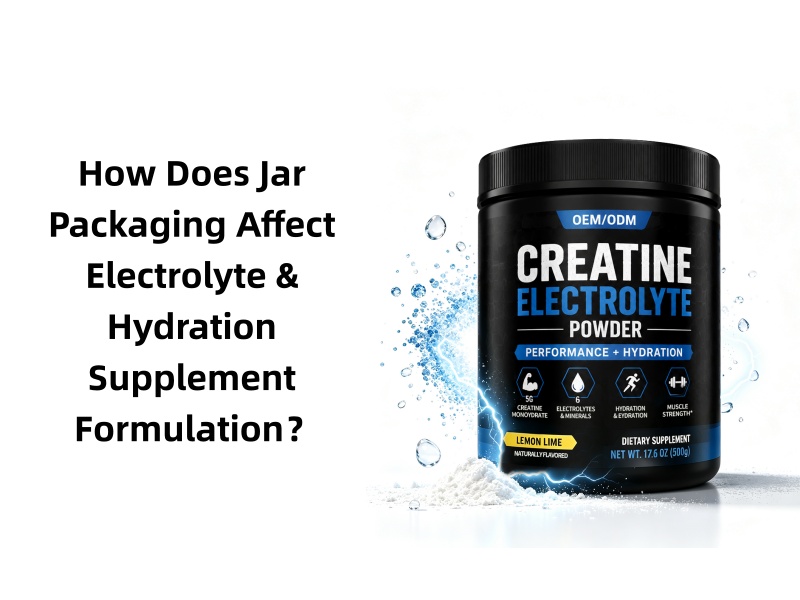
An electrolyte powder can taste excellent in a sample cup and still disappoint the customer a month after launch. Picture a bright, well-designed jar that arrives in perfect condition, only for the powder to become lumpy after a few weeks of daily scooping. Nothing about the label has changed, but the experience inside the container has. For brands developing hydration supplements, that is a reminder that packaging belongs in the formulation conversation from the beginning, not at the end.
Jar packaging affects electrolyte and hydration supplement formulation by controlling moisture exposure, influencing powder stability, defining usable fill volume, and shaping how consumers measure each serving. The right jar depends on ingredient sensitivity, powder density, closure design, and expected storage conditions. Formula development and packaging verification should work together to protect product quality during filling, shipping, shelf storage, and repeated opening.
At Zoxizo, our electrolyte powder development work connects ingredient selection, flavor and solubility adjustments, package selection, sampling, filling, labeling, and finished-product checks. A jar that works for one formula may not protect another formula with different salts, flavors, or sweeteners. The practical questions are surprisingly specific: What happens after the induction liner comes off? Does the scoop deliver a reasonable serving? Can the powder still pour after a humid summer? The answers determine whether attractive packaging becomes a dependable product.
Is Jar Packaging Right for Electrolyte Powders?
Jar packaging works well for many multi-serving electrolyte powders that consumers prepare regularly at home, at work, or at the gym. It offers easy scooping, a large label area, and compatibility with common powder-filling operations. Its suitability depends on the complete formula, moisture sensitivity, serving size, jar capacity, closure performance, and the time a customer is likely to keep the container open.
Which Electrolyte Formulas Suit Jars?
Many multi-serving hydration formulas combine sodium and potassium salts with magnesium, calcium, organic acids, flavoring, and sweetening ingredients. Some include carbohydrates, vitamins, or additional sports-nutrition components. A jar can accommodate these products when the finished blend remains sufficiently free-flowing and stable under the conditions in which it will be stored and used. The key word is finished: individual ingredient descriptions do not tell the whole story once those materials have been blended.
Magnesium chloride, magnesium citrate, sodium chloride, and potassium chloride differ in physical behavior, and grades from different suppliers can also vary. A flavor carrier or sweetener blend may change how the powder responds to humidity without changing the declared electrolyte amounts. Zoxizo assesses powder appearance, taste, solubility, moisture behavior, and packaging feasibility during development. Brands should confirm that an actual jar-and-lid combination works with the approved formula rather than copying the container used by a competitor.
What Are the Benefits of Jar Packaging?
A jar makes the daily routine straightforward: open, scoop, mix, and close. For products positioned as part of a morning wellness routine or a fitness program, that familiarity matters. A rigid container can be convenient to store and handles regular access without needing a zipper or tear notch. It also provides ample room for Supplement Facts, preparation directions, ingredient declarations, warnings, brand design, and lot identification, subject to applicable labeling requirements.
Jars can also fit established filling, capping, induction-sealing, and labeling equipment when the powder and packaging components are compatible. Common commercial concepts include 20-, 30-, and 40-serving products, although those counts are marketing and formulation choices rather than standards. There are trade-offs: rigid containers occupy freight volume, require a reliable closure, and may use more packaging material than some pouches. The benefit is not that a jar is inherently premium; it is that the finished product is pleasant to use and well protected.
When Are Jars Less Suitable?
A jar may not be the best option for an especially moisture-sensitive powder, a single-serving travel product, or a formula that consumers will use slowly in humid conditions. Before first opening, an induction membrane may help protect the contents. Once that membrane is removed, the cap and any resealing liner do the routine work. The remaining powder is exposed to fresh air whenever someone reaches for the scoop, and careless storage can make that exposure much greater than expected.
A 30-serving product used daily may be opened about 30 times; a product used twice a week could remain open for roughly 15 weeks. Those scenarios create different in-use stability demands even if both jars have the same printed best-before date. Lightweight stick packs or suitable high-barrier pouches may be more practical in some circumstances. A packaging review should consider moisture protection, portability, realistic consumption habits, and total delivery cost rather than insisting that every hydration formula belongs in a tub.
Which Products Need Multi-Serve Packaging?
Multi-serving packaging is useful when the intended consumption pattern involves repeated preparation over several weeks. A 30-serving electrolyte powder with an 8 g serving has 240 g of net contents; the same serving count at 12 g requires 360 g. The serving count may be identical on the front label, yet the product needs a different fill volume, potentially a different scoop, and perhaps a different container. Those basic calculations should be settled before artwork and packaging components are ordered.
There are three quantities to keep aligned: serving weight in grams, number of servings, and total net weight. The powder’s physical volume is a separate measurement because density varies between blends. Zoxizo can align product specifications, jar selection, and sampling around these decisions. A brand should also consider how long the package will stay open in a typical home. Multi-serving convenience only translates into a good experience when the formula remains usable throughout that period.
How Does Jar Packaging Affect Powder Stability?

Jar packaging influences electrolyte powder stability by limiting exposure to moisture, air, light, and external contamination. Moisture deserves particular attention because susceptible ingredients can become sticky, lose flowability, or form clumps. The outcome depends on the ingredient blend, container walls, seal, reusable closure, initial powder condition, storage environment, and repeated opening after purchase, not simply on the appearance of the jar.
Which Ingredients Absorb Moisture?
Some powdered ingredients are hygroscopic, meaning that they attract or absorb moisture from surrounding air. The degree of sensitivity differs among salts and is affected by concentration, particle size, crystal form, supplier grade, and other ingredients in the mixture. Magnesium chloride, for example, behaves differently from many other magnesium compounds. It would be a mistake to classify every magnesium source, or every electrolyte blend, as having the same storage needs simply because the nutrition panel looks similar.
Flavor systems can matter just as much as the headline minerals. Acidulants, carriers, sweeteners, and other components may alter how quickly a blend becomes sticky or changes texture. Zoxizo’s powder sampling process pays attention to clumping, solubility, flavor, appearance, and packaging protection. For a meaningful decision, the finished blend should be checked in the proposed container under realistic conditions. Technical sheets for individual ingredients are useful starting points, but they cannot replace observations of the complete commercial formula.
How Does Moisture Cause Clumping?
Moisture can create small liquid bridges between particles, make surfaces tacky, or partially dissolve soluble ingredients that later recrystallize into harder connections. Clumps do not all form through the same mechanism. Some break apart with gentle stirring; others become compact masses that make scooping difficult. Particle size, mixing history, compression during shipping, and changes in temperature can make these effects more noticeable. A powder may also lose its normal flow before obvious lumps appear.
Clumping has practical consequences even when it does not establish that the product is unsafe. Scoops may fill inconsistently, lumps may dissolve slowly, and consumers may see an avoidable sign of poor quality. Anti-caking ingredients can sometimes help, but they do not repair a poorly sealed package or remove excess moisture already present in a batch. The sensible sequence is to understand the powder, control its manufacturing environment, select suitable packaging, and then decide whether a formulation adjustment is necessary.
Does Repeated Opening Affect Shelf Life?
An unopened jar and a jar used every morning experience different conditions. The factory seal may protect the initial product during distribution, but a consumer removes that barrier on the first use. From then on, the reusable closure must help protect the remaining powder. A 30-serving jar opened once a day faces roughly 30 air-exchange opportunities, and the real exposure depends on humidity, how long the lid stays off, and whether the scoop or surrounding surfaces are dry.
This distinction is one reason an unopened-package stability result should not be treated as complete proof of performance throughout consumer use. A useful in-use study might repeatedly open the package under defined conditions, then track changes in appearance, moisture, flow, and flavor. Real homes are variable, so such a study cannot guarantee every outcome. It can, however, reveal whether a product is likely to remain convenient during the consumption period and whether clearer storage instructions or different packaging would help.
Which Stability Tests Are Needed?
A practical stability program studies the approved formula inside the intended commercial jar. The measurements may include moisture content, water activity, visual appearance, flowability, clumping, dissolution behavior, relevant nutrient stability, and package integrity. Moisture content and water activity are related but different: one describes the amount of water present, while the other describes how available that water is for physical, chemical, or microbiological processes. Both may be useful depending on the product.
Real-time studies show how the product changes under representative storage conditions; accelerated screening can expose weaknesses sooner. Neither one-size-fits-all test periods nor a simple accelerated-to-real-time conversion establishes a trustworthy shelf life. An in-use simulation can also reveal what happens after the factory seal has been removed. The table gives examples of screening conditions, not universal requirements or Zoxizo test results. Each actual protocol needs product-specific methods, time points, and acceptance limits.
| Evaluation | Illustrative conditions | Example checkpoints | Questions answered |
| Real-time screening | 25°C / 60% RH | 0, 1, 3, 6 months | Does the sealed product remain acceptable? |
| Accelerated screening | 40°C / 75% RH | 0, 2, 4, 8 weeks | Which weaknesses appear under stress? |
| In-use simulation | One opening daily | Days 0, 7, 14, 30 | What changes after repeated use? |
| Packaging comparison | 2-3 jar-and-seal systems | Defined study intervals | Which assembly best protects this formula? |
Which Jar Materials and Seals Work Best?
HDPE, PET, and PP can all be suitable materials for electrolyte supplement jars, provided the finished container protects the actual formula and is appropriate for its intended food-contact use. Material name alone does not establish performance. Wall thickness, container geometry, closure fit, induction-liner compatibility, light exposure, and moisture protection must be evaluated together against the product’s expected storage and everyday use.
How Do HDPE, PET, and PP Compare?
High-density polyethylene (HDPE) is commonly found in opaque supplement containers and is valued for its toughness and practical range of shapes. Polyethylene terephthalate (PET) can provide excellent clarity, which may be attractive for colorful products but also makes light exposure a consideration. Polypropylene (PP) appears in some rigid containers and many closure applications. None of these brief descriptions is enough to calculate the barrier performance of a particular finished jar or establish compatibility with a given powder.
Two containers made from the same resin can behave differently because of wall thickness, manufacturing method, opening geometry, and cap design. A thicker jar is not automatically the most economical answer, and a transparent jar is not automatically unsuitable for every formula. Zoxizo’s packaging selection work considers container type, labeling dimensions, capacity, sealing, and logistics alongside the formulation. Material specifications and appropriate food-contact documentation should be reviewed for the destination market before final packaging approval.
Which Jar Material Offers Better Protection?
For moisture-sensitive electrolyte powders, the useful question is how much moisture the finished package permits to enter over time. A material’s water vapor transmission properties are relevant, but they do not describe leakage or permeation through the cap and sealing interfaces. Light protection also matters when specific vitamins, colors, or flavors are sensitive to exposure. Comparing resin names without testing the assembled container is like comparing roof materials while ignoring whether the windows close.
USP General Chapter 671 discusses performance testing of container systems and moisture vapor transmission; its methods are designed for specified pharmaceutical packaging situations and can inform other applications when justified. For a dietary supplement, applicability should be established rather than assumed. An appropriate comparison might fill the same formula into two or three candidate packages, hold them under the same conditions, and observe moisture-related changes and seal behavior. The preferred container is the one that performs adequately while remaining practical to source, fill, label, and ship.
Are Induction Seals Necessary?
Induction seals are common because a properly selected and applied liner can create a protective membrane over the jar opening before first use. Depending on its construction, that membrane can reduce leakage, support tamper evidence, and improve protection during storage. It is not proof that the product is stable, and not every jar or formula necessarily requires the same seal. Liner materials must match the container finish, and the sealing equipment needs settings suitable for the specific combination.
Poor cap application, powder caught on the rim, an unsuitable liner, or inconsistent induction conditions can produce incomplete seals. Production checks should therefore focus on real seal performance rather than simply confirming that foil is present. Once the consumer peels off the membrane, protection depends on the reusable closure and handling behavior. Zoxizo’s documented powder-production process includes fill-weight and sealing checks, while the acceptance criteria for a particular project should be established during sample and packaging validation.
Do Electrolyte Powders Need Desiccants?
A desiccant can be useful when tests show that moisture control inside a jar is important to the formula’s stability. Materials such as suitably selected silica gel can help manage moisture, but their capacity is finite and their performance depends on package volume, initial product moisture, storage conditions, and moisture ingress. Adding a desiccant without understanding the container or the formula can give a misleading sense of security. It does not replace effective seals or careful powder handling.
Safety and user experience also matter. A desiccant sachet needs suitable placement, clear presentation, and consideration of accidental ingestion risks, especially when the container is used around children. A product-specific comparison can examine a jar with and without a desiccant, alongside another packaging system if necessary. Zoxizo can discuss moisture-control options during packaging development, but the final decision should be supported by compatibility and stability testing rather than treating a desiccant as compulsory for all electrolyte powders.
How Do You Choose Jar Size and Serving Format?

Jar size starts with the finished powder’s net weight and measured bulk density, not with a container’s advertised milliliter capacity. Serving count, scoop fit, filling clearance, headspace, settling, and closure geometry then determine the practical package. A 300 g powder does not necessarily fit a 300 mL jar, and identical serving counts can require very different container sizes after formulation changes or powder settling.
What Jar Size Fits the Formula?
Begin with the intended serving and the number of servings. Thirty servings of 8 g require 240 g of net powder, while thirty servings of 12 g require 360 g. That part is simple arithmetic. The next step is harder: measure how much space the actual blend occupies and whether it changes volume during filling or transport. Fine powders, larger crystals, and blends containing different carriers can have noticeably different bulk densities even when their label claims look similar.
The jar also needs space for efficient filling and practical use. Its shoulder design, opening diameter, scoop dimensions, and sealing surface all affect the decision. A wide jar that looks attractive on screen may not be the best fit for existing filling equipment, and a narrow opening may annoy customers reaching for the last servings. Zoxizo connects formulation, package selection, and sample approval so brands can examine the physical jar before committing to artwork and bulk container purchases.
How Does Bulk Density Affect Jar Capacity?
Bulk density is the mass of powder per unit of bulk volume, including spaces between particles, usually expressed in grams per milliliter. Estimated powder volume equals net weight divided by bulk density. For example, 240 g of powder with a measured bulk density of 0.60 g/mL occupies about 400 mL before allowances for filling and handling. This does not mean that every nominally 400 mL jar is suitable, because usable internal volume and powder settling also need to be checked.
For an early sizing exercise, a team might assume powder occupies 85% of the usable container volume. That is an illustration, not a standard fill rule. At that assumption, 400 mL of powder would suggest about 471 mL of usable volume. The table shows how quickly jar needs change with formula density and serving weight; its density assumptions are hypothetical and should never be presented as measurements of a commercial Zoxizo formula. Final selection requires real filling trials, density measurements, and closure checks.
| Serving plan | Net powder weight | Assumed bulk density | Calculated powder volume | Volume at 85% illustrative fill |
| 20 × 7 g | 140 g | 0.55 g/mL | 255 mL | 300 mL |
| 30 × 8 g | 240 g | 0.60 g/mL | 400 mL | 471 mL |
| 30 × 12 g | 360 g | 0.65 g/mL | 554 mL | 652 mL |
| 40 × 10 g | 400 g | 0.65 g/mL | 615 mL | 724 mL |
Which Scoop Size Works Best?
A scoop is a volume-measuring tool, while the intended supplement serving is normally expressed by weight. Those measurements agree only when the powder’s physical characteristics and the consumer’s scooping method are considered. A 10 mL scoop would theoretically hold 6 g of powder at a bulk density of 0.60 g/mL, but 7.5 g at 0.75 g/mL. That is a 25% difference in weight even before differences caused by a level, heaped, or compacted scoop.
Because electrolyte intake depends on how much powder is consumed, the actual scoop should be checked repeatedly with the approved formulation. Measurements should follow a defined procedure, and instructions should be understandable to the person preparing the drink. The scoop must also fit inside the jar and remain usable as the contents run low. When the project calls for tighter portion control than consumer scooping can reasonably provide, individually filled stick packs may be a better serving format.
How Much Headspace Is Needed?
Headspace is the gap between the powder and the top of the jar. Some is necessary for filling, sealing, placing a scoop, and opening the container without spilling powder. Too little can contaminate the rim and disrupt sealing; too much can make the jar appear underfilled and increase avoidable packaging volume. There is no universal headspace percentage that works for every powder. The correct amount comes from the formulation, container geometry, filling equipment, and expected settling behavior.
Powder may occupy one level immediately after filling and a lower level after vibration or transportation. A formula with several flavors may even settle differently across variants because the flavor systems influence density and flow. Filling trials should therefore look at real containers before and after representative handling. Zoxizo’s packaging checks include fill weight and seal condition; brands should also assess scoop placement, user access, and finished-jar appearance. A balanced design protects the product without making customers wonder where the missing powder went.
How Do Jars Compare With Other Packaging?
Jars, pouches, and stick packs serve different needs in electrolyte supplement development. Jars make multi-serving scooping convenient, pouches can offer compact formats and refill options, and stick packs give consumers individual portions. The right format depends on moisture protection, consumer habits, packaging specifications, filling cost, sales channels, and how the product behaves after first opening, including the time it remains in use.
Are Jars Better Than Pouches?
A jar is often easier to use when someone prepares an electrolyte drink at the same counter every morning. It stands upright, offers a large opening, and can be closed with a familiar screw cap. A pouch has different strengths: it may need less packaging material and can offer a compact refill option. Neither has a guaranteed barrier advantage. A suitable multilayer pouch can protect moisture-sensitive contents well, while an unsuitable film structure or a zipper blocked by powder can undermine that protection.
Jars also have failure points, particularly around the cap, liner, and sealing surface. Consumers may leave a cap loose or return a damp scoop, just as they may fail to close a pouch zipper fully. For a brand considering both products, the strongest approach is to use the same approved formula in a tested jar and a separately tested refill pouch. Zoxizo supports these packaging formats, but shelf-life conclusions from one package should not automatically be transferred to the other.
How Do Jars Compare With Stick Packs?
Stick packs solve a different problem: each serving is measured and sealed during production, so consumers do not need to scoop from a shared container. A product with thirty 8 g servings can be supplied as one 240 g jar or thirty 8 g stick packs. The net powder weight is the same, but the customer’s routine and the packaging system are very different. Stick packs can be convenient for travel, workouts, and carrying a portion in a bag.
Individually sealed portions also keep unopened servings protected during normal use, although their effectiveness still depends on film quality and seal integrity. A jar may be preferable for home use or customers who want a simpler multi-serving format. Stick packs require controls for individual fill weights, film selection, and a large number of seals. Zoxizo’s powder manufacturing scope includes jars, pouches, and stick packs; a practical choice considers the formula’s moisture sensitivity and the total cost of producing a saleable, properly labeled product.
Which Packaging Costs Less?
Comparing the purchase price of an empty jar with a piece of pouch film rarely gives a useful answer. A jar may need a cap, induction liner, label, scoop, carton protection, and possibly a desiccant. A pouch needs an appropriate film structure, a closing system where applicable, printing, filling, and sealing. Stick packs require individual material usage and repeated portion-filling and sealing operations. Labor, equipment speeds, losses during production, and the finished product’s shipping dimensions can change the result considerably.
The sensible comparison uses identical product specifications: the same formula, total net weight, number of servings, destination market, and defined order quantity. Packaging costs should then be considered alongside filling efficiency, quality checks, freight, and possible damaged or rejected units. A format with cheaper materials can become more expensive if the run is slow or generates high scrap. Zoxizo can review packaging choices within overall product development, while an accurate commercial decision still requires actual quotations and approved manufacturing specifications.
Which Format Fits Each Sales Channel?
A consumer who keeps electrolyte powder in a kitchen may appreciate a jar; a cyclist or frequent traveler may prefer stick packs. Gym counters, retail shelves, and online fulfillment centers also create different handling and display requirements. Rigid jars offer a familiar sports-nutrition presentation but can occupy more warehouse and shipping space than compact flexible packaging. Pouches may work particularly well as refill products, although their puncture resistance, sealing, and shelf display still need evaluation.
Brands selling through Amazon, their own online stores, pharmacies, and fitness businesses may benefit from more than one package format. That does not mean one stability test covers them all. Changes in film, jar, closure, or filling process can alter the product’s exposure conditions and therefore require renewed assessment. Zoxizo supports labeling, lot and date identification, e-commerce packaging preparation, and international shipment planning. The most effective format is the one that protects the powder and makes sense in the place where customers actually buy and use it.
How Are Jar-Packaged Electrolyte Supplements Made and Tested?

Jar-packaged electrolyte powders are developed through formula approval, raw-material verification, controlled blending, filling, sealing, labeling, and finished-product checks. Relevant controls address composition, powder consistency, moisture, fill weight, seal condition, and traceability. The approved formula and packaging components should be documented together, and each production batch should be assessed against applicable specifications before release to customers or distribution partners under the applicable quality system and approved product specifications.
How Are Formulas and Packaging Samples Approved?
Approval starts with a product specification that connects the target electrolyte composition, serving weight, taste, expected use, destination market, and proposed container. A sample may be checked for salty or bitter notes, sweetness, solubility, powder appearance, and physical stability. Jar trials should assess whether the powder fits, whether a scoop is practical, and whether the lid and seal are compatible with the package. A sample mixed in a laboratory cup is useful, but it does not answer everything about the finished product.
Every meaningful formula adjustment should be considered for its possible packaging effect. A new flavor carrier or sweetener may change bulk density or moisture sensitivity, even when the mineral amounts stay the same. Zoxizo’s documented development workflow covers sampling, customer feedback, formula adjustment, packaging confirmation, and production approval. A useful handover to manufacturing is an agreed version of the complete product: formula, ingredient specifications, container, cap, liner, label, net weight, and quality criteria. That prevents approved samples from drifting away from what will actually be made.
How Are Filling and Sealing Controlled?
Filling quality begins before powder enters a jar. Incoming materials must match specifications, and equipment should be prepared for the formula’s flow and handling properties. Powders with poor flow can bridge in hoppers, fill unevenly, or collect around the container opening. Production checks therefore need to address mixing consistency, moisture where relevant, equipment settings, net fill weight, and cleanliness of the sealing surface. A clear process also reduces the chance that one flavor or batch behaves differently from the previous one.
The documented Zoxizo powder-production sequence covers material checks, weighing, sieving, mixing, sampling, filling, weight inspection, sealing checks, packing, and finished-product review. For an induction-sealed jar, the actual cap, liner, and container finish should be validated together, with seal performance checked using suitable methods. No single inspection can replace documented process control. Records of checks and corrective actions are especially valuable when production is repeated months later, because they help the team reproduce the approved result rather than relying on memory.
Which Quality Tests Are Required?
Quality testing should be chosen for the formula and the country where the product will be sold. Depending on the ingredients, it may involve raw-material identity, mineral content, blend uniformity, moisture-related measurements, microbiological specifications, relevant contaminants, label verification, and finished-container integrity. A formula containing added vitamins or other sensitive components may need additional measurements to support its specifications over time. The testing plan should distinguish what can be checked visually from what requires an appropriate analytical method.
For U.S. dietary supplements, 21 CFR Part 111 establishes current good manufacturing practice requirements, including the need for relevant specifications, quality operations, and manufacturing records. This does not mean every electrolyte product uses the same laboratory panel or a universal numerical limit for clumping. Zoxizo’s company documentation describes incoming-material review, in-process checks, finished-product testing support, and batch documentation. When testing is conducted by an outside laboratory, that involvement should be described accurately as third-party support. Clear criteria and records build more confidence than an unexplained statement that every batch is perfect.
What Label and Batch Records Are Needed?
U.S. dietary supplements generally require a statement of identity, net quantity, Supplement Facts labeling, ingredient information, and the name and place of business of the responsible manufacturer, packer, or distributor, with details governed by applicable labeling rules. The serving size and servings per container must reflect the product and the labeling requirements. For a jar containing thirty 8 g servings, the nominal total net powder weight is 240 g, but the formula and label must also correctly describe the individual nutrients and ingredients.
Traceability requires more than printing a lot code. Useful records connect raw-material lots, approved formula and packaging versions, production dates, filling and sealing checks, testing, and release decisions. Where a best-before or expiration date is used, its basis should be supported by appropriate evidence; the U.S. dietary-supplement CGMP rule does not itself require an expiration date. Zoxizo supports label preparation, batch documentation, packaging identification, and shipment readiness, while final market-specific compliance must be confirmed for the product and destination. A formula made for one country should not be assumed to carry a universally compliant label.
Conclusion
A good hydration supplement jar does more than hold powder. It needs to protect the formulation while unopened, remain practical after the customer breaks the seal, accommodate the right amount of powder, and work reliably on the filling line. Moisture control, scoop accuracy, closure design, testing, labeling, and freight are connected decisions rather than separate departments’ problems. Zoxizo approaches electrolyte development through formulation, samples, packaging selection, quality controls, and commercial production planning. Brands considering a new jar-packaged product can begin with the actual ingredient formula, target serving count, sales market, and expected conditions of use, then select and verify the package around those facts. That approach is less glamorous than choosing a container from a catalog, but it is what helps a promising sample become a product customers are comfortable buying again.
Frequently Asked Questions
1. Are plastic jars safe for electrolyte powder supplements?
Appropriate plastic jars can be suitable for electrolyte powders when the materials are compatible with the formulation and meet applicable food-contact requirements in the destination market. HDPE, PET, and PP are all used in packaging applications, but resin name alone does not demonstrate suitability. Brands should review relevant supplier documentation, the complete container-and-closure design, and any stability or compatibility concerns associated with the ingredients. The jar’s intended use, storage environment, and consumer handling matter just as much as its appearance.
2. Which jar is best for moisture-sensitive electrolyte powder?
There is no single jar material that is best for every moisture-sensitive electrolyte formula. Protection depends on container wall construction, closure design, seal integrity, initial powder condition, and how often customers open the jar. An opaque HDPE container may be practical for some products, while another resin or container system may suit a different formula. The sounder decision is to compare actual, assembled packaging options using the same finished powder and product-specific stability criteria rather than relying on material labels alone.
3. How can electrolyte powder be kept from clumping in a jar?
Clumping control typically combines several measures: selecting suitable ingredients and grades, controlling moisture during powder preparation, using appropriate container and sealing materials, and evaluating the product under realistic storage and in-use conditions. An anti-caking ingredient or desiccant may help in some formulas, but neither fixes every cause of clumping. If a product becomes hard after repeated opening, the investigation should examine room humidity, lid closure, powder properties, and packaging performance before deciding whether to reformulate.
4. What jar size is needed for 30 servings of electrolyte powder?
The answer depends on serving weight and actual powder bulk density. Thirty servings of 8 g give a net powder weight of 240 g. At an illustrative bulk density of 0.60 g/mL, that powder would occupy approximately 400 mL before filling allowances, scoop placement, and any settling are considered. A preliminary 85% fill assumption would suggest about 471 mL of usable volume, but this is not a universal jar recommendation. The final container must be confirmed through trials using the approved formula.
5. Are electrolyte powder jars better than stick packs?
Jars are often convenient for multi-serving products used at home or at a gym, while stick packs are easy to carry and provide individually measured portions. A stick pack keeps the unused servings separately sealed, which can help manage moisture exposure during use, but its performance depends on film and seal quality. Jars may offer simpler daily access and a strong shelf presence. The most suitable choice depends on the formulation, how customers prepare drinks, manufacturing requirements, and the full cost of each commercial packaging format.
6. How long does electrolyte powder last after opening a jar?
There is no reliable universal number of days that applies to every electrolyte powder after opening. In-use performance depends on ingredient moisture sensitivity, packaging and closure design, humidity, frequency of opening, storage temperature, and the product’s original condition. A stated best-before date generally describes the product under the storage conditions supported by its stability evidence, not unlimited tolerance of poor handling. Brands should evaluate likely consumer-use scenarios and provide storage instructions consistent with the results rather than promising a fixed open-jar period without data.



